With Herrencreme, one single detail decides the flavour. The rum must never be cooked, otherwise exactly the note that gives this dessert its name disappears.
We have been making Herrencreme for years, usually when we have guests and want a classic dessert that still does not taste like Sunday cake at grandma’s. The recipe comes from the East German tradition, where this cream was often also called Stracciatella with a kick. Our version uses 50 g rum to 450 g milk and 200 g double cream, with caramel pudding powder and dark chocolate chopped to rough shards in the Thermomix® beforehand. The result is a layered cream that tastes cool, light and gently alcoholic at the same time.
Herrencreme with the Thermomix®

Ingredients 0 / 7 ✓
- 60 g dark chocolate
- 1 sachet caramel pudding powder
- 450 g milk
- 50 g rum
- 60 g sugar
- 200 g double cream
- 1 sachet cream stabiliser (Sahnesteif)
Instructions 0 / 5
-
1
Chop the chocolate.
Add the chocolate to the mixing bowl and chop for 3 sec / speed 7, then transfer to a bowl.
-
2
Mix and cook the cream.
Add the pudding powder, milk, rum and sugar to the mixing bowl, mix for 4 sec / speed 4, then cook for 10 min / 95°C / speed 2. Transfer the pudding to a bowl, cover with cling film and leave to cool for approx. 3 hours. Rinse the mixing bowl.
-
3
Whip the cream.
Insert the butterfly whisk into the mixing bowl, add the cream and cream stabiliser and whip to stiff peaks on speed 3.5, watching through the lid opening.
-
4
Combine cream and pudding.
Remove the butterfly whisk, add the pudding and two thirds of the chocolate and mix using the spatula for 15 sec / speed 3.
-
5
Serve.
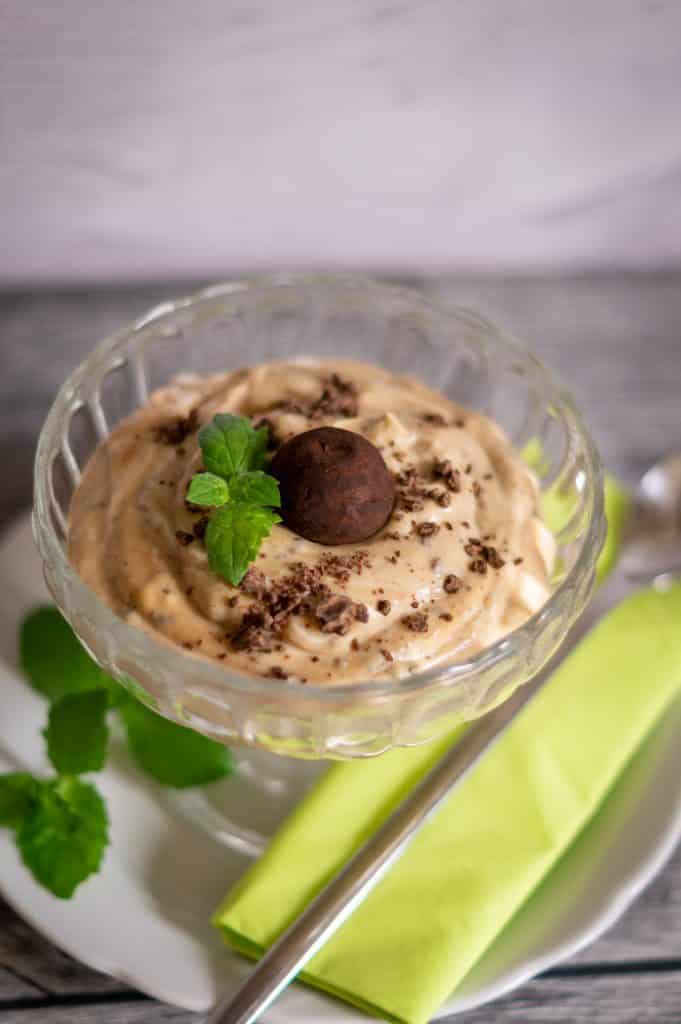
Divide among 4 dessert glasses and serve garnished with the remaining chocolate.
Tip: If you prefer not to use rum, replace it with milk and balance the flavour with a few drops of rum essence. You can also use other pudding flavours, such as cream or vanilla pudding powder.
Nutrition per serving
Why the rum goes into the cold pudding, not the hot one
The original recipe on the index card takes a shortcut that we used for a long time ourselves: pudding powder, milk, sugar and rum all go into the mixing bowl together, then 10 minutes at 95°C. It works, the pudding sets, the cream is sweet. But at 95°C, ethanol evaporates reliably. After 10 minutes of cooking, standard food science figures show that between 60 and 75 per cent of the alcohol is driven off, along with most of the characteristic rum aroma compounds. What remains is a sweet caramel cream with a trace of rum.
We do it differently: cook the pudding powder, milk and sugar first, leave to cool completely, then fold the rum in during the final mixing with the cream. This keeps the alcohol in, the flavour is noticeably stronger, and 50 g rum is plenty. If you follow the original method, you need at least 80 to 100 g rum to get the same taste, otherwise almost nothing comes through. Both methods work. The second is more economical and more honest.
Chocolate shards, not chocolate powder
The 60 g of dark chocolate go into the empty mixing bowl before anything else. 3 seconds at speed 7, nothing more. This gives rough, slightly splintery pieces rather than powder. If you blend longer or at a higher speed, you get cocoa dust and end up with a cream that turns uniformly brown instead of being threaded through with distinct chocolate pieces. We use 70 per cent dark chocolate because milk chocolate is too sweet in this already sweet cream and provides no contrast.
The chopped chocolate comes completely out of the mixing bowl into a separate bowl. Two thirds of it will be folded into the finished cream later, the rest stays for the garnish. If you leave the chocolate in the bowl and pour the pudding on top, you get melted lumps at the bottom of the bowl that land as a brown smear in the glass when you serve. Better to take the extra step and give the bowl a quick rinse.
Getting the pudding to set without lumps
The caramel pudding powder, 450 g milk and 60 g sugar go into the mixing bowl. Mix briefly on speed 4 for 4 seconds so the starch powder is evenly distributed in the milk. Only then cook for 10 minutes at 95°C at speed 2. A lower speed gives uneven setting because the starch binds against the hot bowl walls before it can spread. A higher speed creates foam and partially breaks down the starch molecules, making the cream watery.
Transfer the finished pudding to a bowl immediately and lay cling film directly on the surface rather than stretching it over the rim. This prevents a skin from forming that would later float as lumps through the cream. Three hours in the fridge is the minimum, four hours is better. The pudding must be cold right to the centre, otherwise the cream melts when you fold it through.
Whipping cream in the Thermomix® without ruining it
Insert the butterfly whisk, pour in 200 g cold double cream and one sachet of cream stabiliser, then whip on speed 3.5 watching through the lid opening. Watching means: lid in place, keep an eye on the mixing bowl through the small window. The cream is ready as soon as it climbs up the walls and the butterfly whisk leaves visible tracks. Depending on the temperature of the cream, this takes between 60 and 90 seconds. Whip for longer and you get butter, and in the Thermomix® that happens faster than with a hand mixer in a bowl, because the butterfly whisk is extremely efficient.
Cream stabiliser is not a luxury here. The finished cream sits in the glass for hours. Without stabiliser, whey separates and small puddles form at the bottom of the glass. With stabiliser the cream holds well for two days.
Combining pudding and cream without streaks
Remove the butterfly whisk first, otherwise it will break up the cream in the next step. Add the cold pudding and two thirds of the chocolate shards to the cream, then mix using the spatula for 15 seconds at speed 3. The spatula must be actively guided, otherwise the pudding sits as a stiff lump at the bottom. Without the spatula you can mix for 30 seconds and still have streaks.
This is exactly the point where the rum goes in, if you are using our method. Pour 50 g rum over the pudding before mixing, then fold through together. This distributes the alcohol evenly without collapsing the cream. If you used the original method with rum in the pudding, this step does not apply.
Rum, rum essence, or none at all
Real dark rum: We use a straightforward Jamaican rum at 40 per cent. Higher alcohol content makes the cream bitter, lower alcohol brings no aroma. Cachaca or white rum work technically but taste flat.
Rum essence for children: When children are eating, we replace the 50 g rum with 50 g milk and add 1 teaspoon of rum essence. Flavour-wise it comes close, though the warm sensation from alcohol is naturally absent.
Without any alcohol: Without rum and without essence, Herrencreme simply becomes a caramel pudding and cream dessert. It tastes good but is no longer the same dish. In that case, try the caramel pudding version with a little extra vanilla (1 scraped pod instead).
With advocaat, without rum, or as a layered dessert
Cream pudding instead of caramel: Using plain vanilla or cream pudding powder makes the dessert lighter in colour and more neutral in flavour. Add a caramel sauce as a topping, otherwise the caramel note is missing.
With advocaat instead of rum: 60 g of home-made advocaat replaces the rum one for one. The cream turns more yellow and sweeter, and the caramel note steps back.
Layered glass: Instead of mixing everything together, we sometimes build layers: 2 tablespoons of pudding at the bottom, then a layer of cream with rum, more pudding on top, finishing with the chocolate shards. This way you can see each layer and every spoonful has its own texture.
With cherries: Add 100 g drained sour cherries from a jar between the layers. The acidity cuts through the sweetness and pairs surprisingly well with the rum.
What to serve alongside
Herrencreme is sweet and creamy, so it benefits from something crunchy alongside. We often serve home-baked ladyfingers for dipping into the cream. For a quicker option, bought cantuccini work just as well. As a full dinner dessert, Herrencreme pairs better with a classic Sunday roast than a second heavy dessert like Tiramisu, because it is considerably lighter.
Keeps for 1 day in the fridge, ideal to prepare the day before
The finished cream keeps in the fridge for 2 days, covered with cling film. After day 2 some whey separates, but the flavour stays good. Freezing does not work as the cream crystallises when thawing and turns grainy.
Making ahead works well: the pudding can be cooked the day before and left to set overnight in the fridge. We always do the final mixing with the cream and rum on the day of serving, at most two hours before. Fresh pudding combined with freshly whipped cream gives the best texture.
How other recipes approach it differently
Looking across the top search results, almost all of them use the same base of vanilla pudding, whipped cream, rum and grated dark chocolate. Soured cream instead of double cream, advocaat instead of rum, or whisky as a variation barely appears, and neither does ladyfinger as a layer. Nobody uses gelatine, the cream carries the texture on its own. The main difference is in the chocolate: some recipes melt it and stir it in warm, which makes the cream darker and denser. We stick with grated chocolate because it adds a snap when you spoon through and keeps the cream light. That is exactly what Herrencreme in the Thermomix® is made for.
Goes well with: Waffles.
More classic desserts from the East German tradition: our Red Berry Compote, home-made Advocaat and further dessert recipes.