Making yeast at home sounds like magic, but at its core it is cultivation. We are not creating yeast from nothing. We are capturing the wild spores that already live in wheat beer and on the flour bran, and giving them 15 hours to multiply on 20 g of flour and 8 g of sugar. The Thermomix® is not a magic wand here, but a clean mixing station. The real work is done by the yeast itself, in the screw-top jar, at room temperature, in the dark.
We have been making this yeast starter for years, always when we realise late in the evening that we have run out of fresh yeast for Sunday’s pizza dough. In five minutes of active time the jar is set up, overnight it sits on the kitchen worktop, and by the next morning we have 128 g of liquid yeast, roughly equivalent to one fresh yeast cube. The rising power is gentler than dried yeast or a fresh cube. In return, the finished bread tastes noticeably more complex, because the longer proving time develops the flavour more deeply.
Homemade Liquid Yeast with the Thermomix®
Ingredients 0 / 3 ✓
- 20 g plain flour, type 405
- 8 g sugar
- 100 g wheat beer (unfiltered)
Instructions 0 / 4
-
1
Sterilise the jar.
Rinse the screw-top jar and lid with boiling water and place upside down on a clean tea towel.
-
2
Mix all ingredients.
Insert the butterfly whisk, add all ingredients to the mixing bowl and mix for 1 minute / speed 4.
-
3
Leave to ferment.
Pour the yeast mixture into the screw-top jar and leave to ferment at room temperature for 15 hours (ideally overnight).
-
4
Shake and use.
Shake well before using in a dough.
Warning! Homemade yeast does not have the same rising power as shop-bought yeast. It works very well for doughs that do not need a strong rise, such as pizza dough or our onion tart. An attempt with Ciabatta failed because the dough did not rise well enough.
Note: When using the liquid yeast, you must replace 100 g of the liquid in your recipe (milk or water) with the liquid yeast, otherwise your dough will become too sticky.
The yeast produced this way is roughly equivalent to one fresh yeast cube. Because the liquid yeast has slightly less rising power, the dough may need a little longer to rise properly. Allow extra proving time accordingly.
The beer smell and taste disappear completely during baking.
The yeast produced this way keeps in the fridge for several weeks. You must shake the jar regularly, though, to prevent mould forming.
Nutrition per serving
How flour, sugar and beer become active yeast
The process has three clear phases, and once we understand them it works reliably.
- Phase 1: Activate the starter. Naturally cloudy wheat beer contains live yeast cultures that the brewer has not filtered out. These yeasts are the seed. Flour and sugar provide starch and simple sugars as food. We mix for 1 minute at speed 4 with the butterfly whisk, and the spores are evenly distributed.
- Phase 2: Wild fermentation. In the sealed screw-top jar at room temperature (around 20 to 22 °C), the yeasts break down the sugar into CO2 and alcohol. After 12 hours the first small bubbles form, and after 15 hours the starter is active, smelling yeasty and malty rather than of fresh beer.
- Phase 3: Ready to use. Before baking, we shake the jar vigorously so the sediment recombines with the liquid. Only then does the starter go into the dough, replacing 100 g of the liquid from the original recipe, not as an addition.
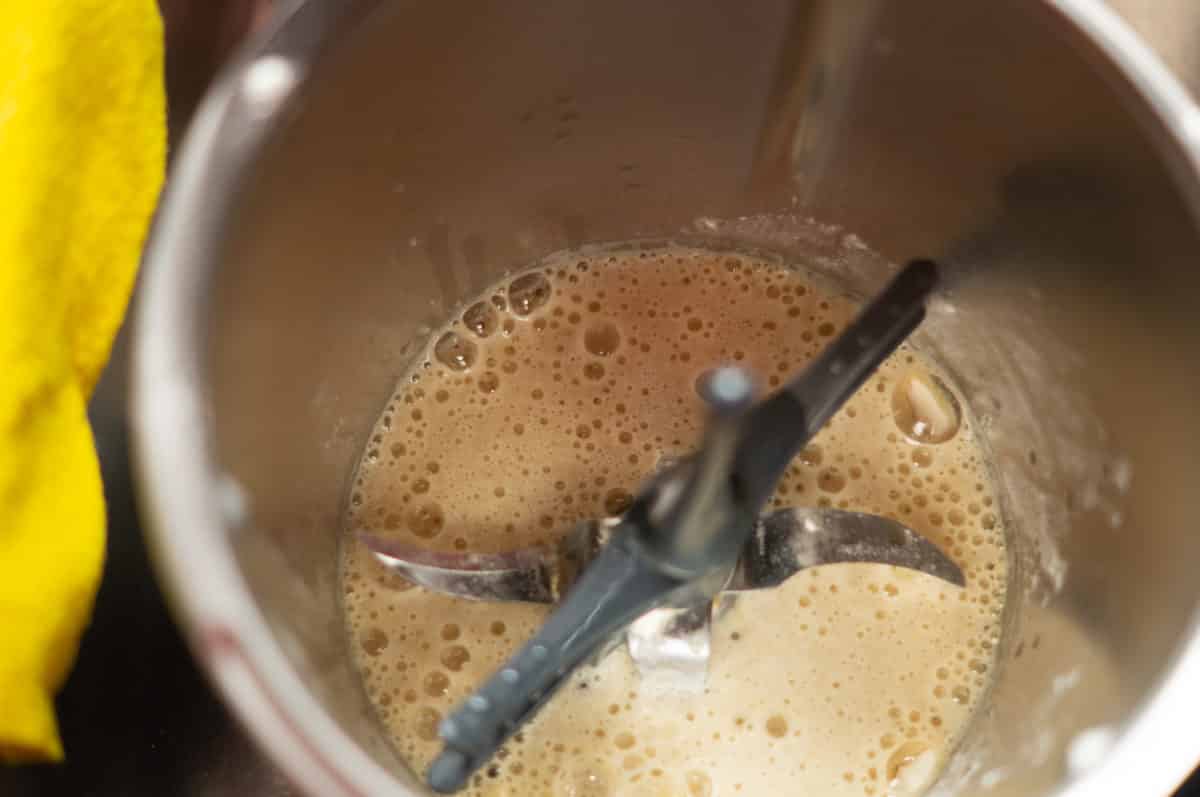
The Thermomix® does exactly one step in this chain: it mixes flour, sugar and beer so evenly that the yeast forms no lumps. 1 minute / speed 4 with the butterfly whisk is enough, because we want to combine, not chop. Higher speeds would stress the beer yeast unnecessarily.
Why wheat beer and not another beer
Naturally cloudy wheat beer is the most reliable yeast source available in a supermarket. The top-fermenting brewery yeast stays in the beer after fermentation and is not filtered out. Pilsner, lager or filtered wheat beer do not work, or barely work, because the yeast has been largely removed. If you hold a bottle up to the light and can read the text on the back label clearly through the glass, you have the wrong beer for this starter.
For your first attempt, a Bavarian Hefeweizen is worth choosing (Erdinger Weissbier naturtrub, Schneider Weisse or Weihenstephaner). These varieties have a high yeast content and react reliably. The beer smell in the finished starter is strong at first, but disappears completely during baking. Nothing in the finished bread or enriched dough will remind you of beer.
What can go wrong and how we spot it
Three problems come up most often in practice, and all of them have a clear cause.
The starter is not bubbling after 15 hours
Usually the beer was filtered or went straight from the fridge into the mixing bowl while still very cold. Our fix: Take the beer out of the fridge an hour before making the starter so it reaches room temperature. If the yeast gets a cold shock, it takes longer to activate. In a very cool kitchen (below 18 °C), placing the jar on a radiator valve with a tea towel on top helps.
The starter smells sour or vinegary
This happens when the jar was not clean or was left open too long, allowing acetic acid bacteria to take hold. Our fix: Always rinse the jar and lid with boiling water and leave them upside down to dry, as Step 1 of the recipe requires. No traces of washing-up liquid, no drying with a tea towel. If the starter smells sour, pour it away and start again. There is no saving it.
The dough does not rise properly with the yeast
Homemade yeast has less rising power than a fresh yeast cube or dried yeast. Our fix: Allow at least twice the usual proving time. Where a pizza dough would normally prove for 45 minutes, we give the wild yeast 90 minutes, or leave the dough to prove overnight in the fridge. A cold prove also develops the flavour better. For very light doughs such as Ciabatta, the rising power is not sufficient. We have tested this more than once.
What wild yeast is genuinely good for
Homemade yeast is not a straight swap for every use of fresh yeast. It has strengths and clear limits.
- Works well: pizza dough, onion tart, simple bread rolls, heavy bread doughs with a long prove. The slow, gentle fermentation pays off here.
- Works with adjustments: enriched doughs such as plaited loaf and sweet yeast doughs work, but need 1.5 to 2 times the usual proving time. If you are short on time, stick to a fresh yeast cube.
- Not suitable: Ciabatta, baguette and anything that needs a very strong rise. Brioche doughs with a high butter content also do not rise reliably.
How we use the starter in a recipe
The finished liquid yeast replaces liquid, not dry ingredients. That is the most important rule and the most common mistake for first-timers. Example: pizza dough with 250 g water and 21 g fresh yeast. We use 100 g of our yeast starter plus 150 g water. The fresh yeast is left out entirely. Anyone who keeps the full 250 g of water in the recipe and adds the yeast starter on top will end up with a sticky dough that cannot be kneaded.
The rule of thumb: 100 g of yeast starter equals half a cube of fresh yeast (about 21 g). For a full cube, use 200 g of yeast starter and reduce the liquid in the recipe by 200 g accordingly.
Refreshing the starter and changing the jar
At room temperature, the starter stays fresh for about 7 days. In the fridge it keeps for several weeks, as long as we give the jar a vigorous shake every 2 to 3 days to prevent mould forming on the surface. Before using it, always take the starter out of the fridge an hour beforehand and let it come to room temperature. Otherwise the cold will delay the dough rise further.
Freezing works for up to 3 months, but the starter loses some of its rising power in the process. Anyone who bakes regularly would do better to refresh the starter every 1 to 2 weeks with a little fresh flour, sugar and beer, rather than freezing it.
What our yeast works best with
Once the starter is ready, recipes with a long prove are worth making. A plaited loaf becomes especially flavourful with wild yeast, because the extra hour of proving deepens the aroma. For breakfast and brunch, yeast bunnies also work well. With apple and caramel traybake, the longer fermentation of the aromas between the base and the topping is a real benefit.
For something savoury, herb pull-apart bread and pull-apart loaf are the right choice. Both recipes make the most of the gentle rising power of the starter for an open, airy crumb.