15 grams of agar-agar to 500 grams of strawberries is not a compromise, it is the precise threshold. Below 2.5 per cent the jam stays syrupy; above 4 per cent it becomes rubbery, like jelly sweets. And because agar-agar only sets below 39 degrees Celsius, the classic wrinkle test with a hot spoon is useless here. Two minutes in the fridge will tell you whether the dosage is right.
We have been making jam without preserving sugar for years, especially when the strawberry season is in full swing and we have more fruit than we can eat fresh. The trade-off is that without the 50 to 65 per cent sugar that preserving sugar provides, the jam only keeps for 2 weeks in the fridge. This is not a store-cupboard preserve for winter, but a breakfast spread that is meant to be eaten soon.
Jam without Preserving Sugar, Thermomix®

Ingredients 0 / 3 ✓
- 500 g strawberries or other fruit
- 15 g agar-agar
- 1 sachet vanilla sugar optional: 1 tsp vanilla extract from the blog
Instructions 0 / 3
-
1
Mix the ingredients.
Add all ingredients to the mixing bowl, blend for 15 sec / speed 8, then cook for 15 min / 100°C / speed 2.
-
2
Fill into jars.
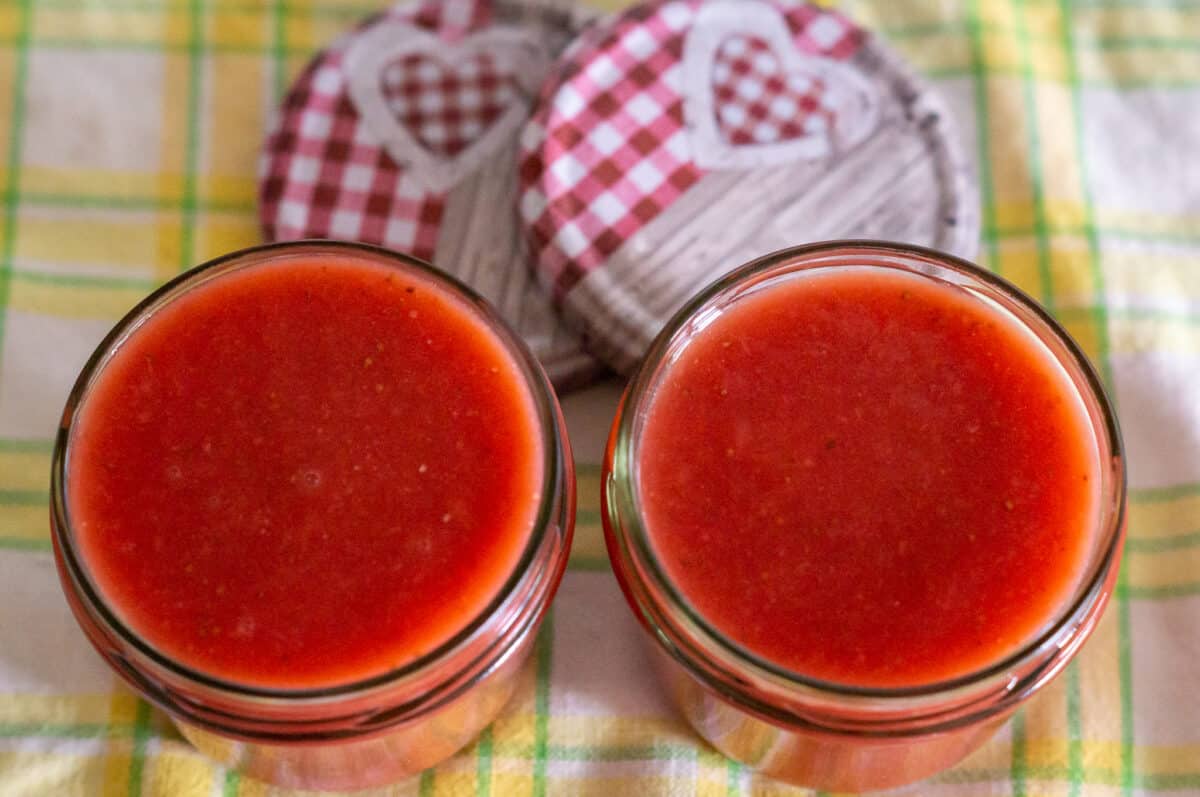
Fill the jam into sterilised jars, seal and leave to cool.
-
3
Storage note.
This jam contains no preserving sugar and should therefore be stored in the fridge and consumed within 2 weeks.
Tip: This jam can also be frozen to extend its life. Please use freezer-safe containers, as glass jars can crack in the freezer.
If you prefer not to use vanilla sugar, you can sweeten the recipe with 1 tbsp of honey instead.
Video
Nutrition per serving
Agar-agar instead of preserving sugar: 3 per cent is the threshold
Preserving sugar sets jam and preserves it in one step. Agar-agar only sets it, it does not preserve it. The 15 grams of agar-agar to 500 grams of strawberries is exactly 3 per cent. That sits in the middle between too runny and too firm.
Below 2.5 per cent the jam stays syrupy even after hours in the fridge. It runs off the bread instead of staying on it. Above 4 per cent it becomes rubbery like jelly sweets. You can cut it, but it sticks to the knife and has the wrong texture.
Agar-agar is a hydrocolloid derived from red algae. It sets between 32 and 39 degrees Celsius (Belitz, Grosch, Schieberle: Lehrbuch der Lebensmittelchemie, 2008, p. 342). This is the key difference from the pectin in preserving sugar, which sets at 80 to 90 degrees. Agar-agar sets cold, not hot. That is why the jam is still liquid after cooking and only firms up as it cools.
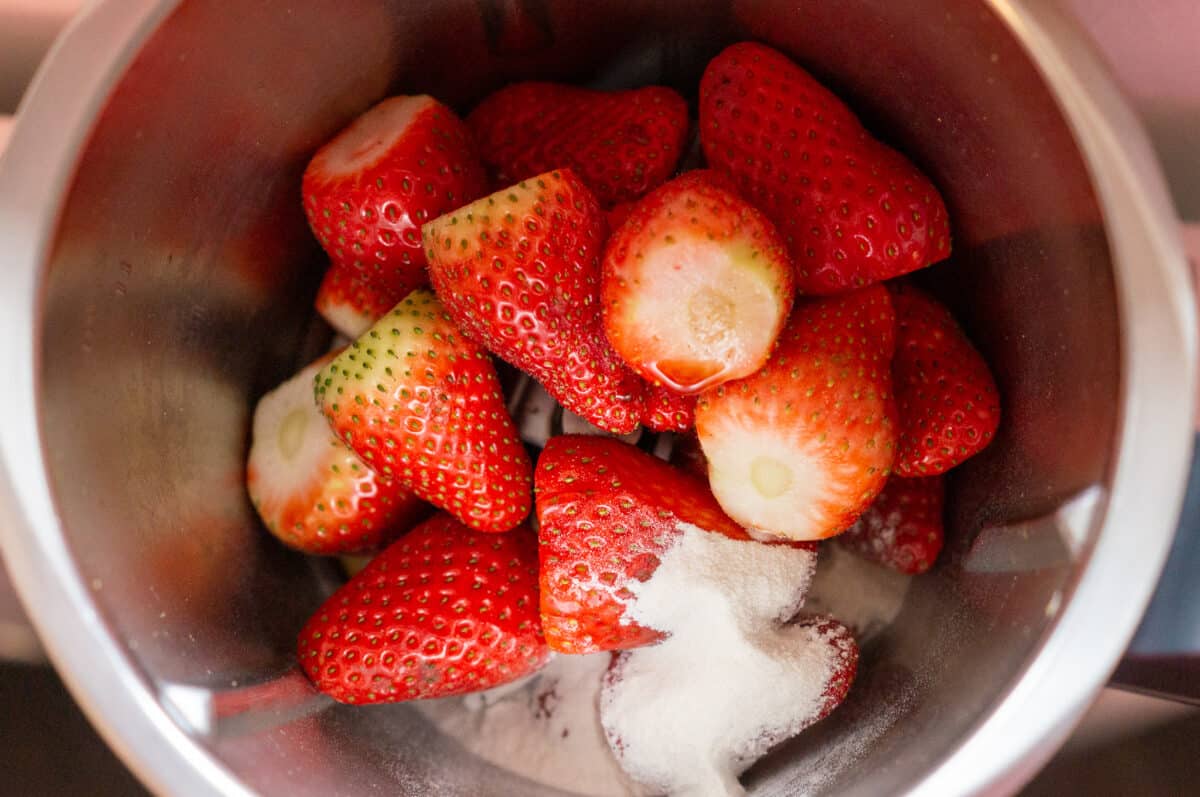
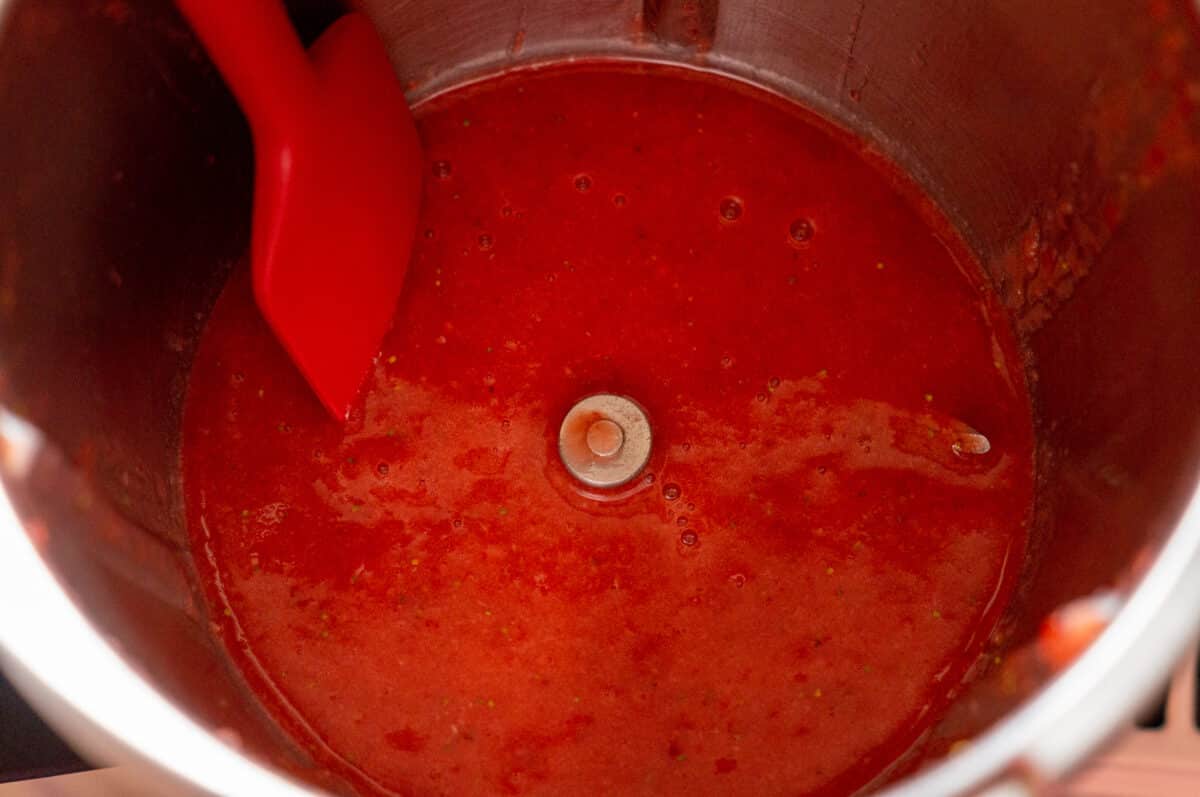
The 15 seconds at speed 8 before cooking are not optional, they are essential. Agar-agar must be evenly distributed through the fruit before the heat activates it. Lumps will not dissolve once cooking begins. We blend the strawberries smooth first rather than simply stirring them.
Why 2 weeks in the fridge instead of 6 months on the shelf
Depending on the type, preserving sugar delivers 50 to 65 per cent sugar in the finished product. That is not just sweetening, it is preservation. Sugar binds water osmotically. Bacteria and mould cannot access free water in a high-sugar environment and die off or stop growing (BfR information sheet on food hygiene in the production of jams and jellies, 2019).
Our jam contains only 8 grams of sugar from the vanilla sugar for 500 grams of strawberries. That is under 2 per cent, far too little for osmotic preservation. The free water in the strawberries remains free. Bacteria can grow. The fridge at 4 degrees Celsius slows that growth but does not stop it.
After 2 weeks a white mould typically forms on the surface. At that point the jam must be discarded. Anyone wanting to make large batches will need either preserving sugar or the freezer. Preserving without sugar does not work for long-term storage (DGE brochure on food shelf life, 2020, p. 18).
Sterilising jars: 10 minutes at Varoma instead of the oven
Sterilised jars will not extend shelf life from 2 weeks to 6 months, but they do prevent bacteria from the jar spoiling the jam within 5 days. We sterilise jars directly in the Thermomix® TM7, TM6, TM5 or TM31 instead of switching the oven on.
Add 500 grams of water to the mixing bowl. Stand the jars upside down without lids in the steamer basket. Place the lids separately in the Varoma dish. Steam for 10 minutes at Varoma temperature and speed 2. This reaches 100 degrees Celsius and kills vegetative bacteria and yeasts (WHO guideline Safe Food Handling, 2017, chapter 4.2). Spores survive, but with 2 weeks of fridge storage they are not a problem.
The jars must be removed hot and filled immediately. A hot jar filled with hot jam creates a slight vacuum as everything cools. The lid is pulled inward. This is not a preservation vacuum like proper bottling, but it confirms that the jar is sealed.
The set test in the fridge: 2 minutes, not 5 seconds
The classic set test with a cold spoon works for preserving sugar because pectin sets hot. You take a spoonful of jam from the pan, leave it for 5 seconds and see whether it wrinkles. With agar-agar this test is pointless. Agar-agar only sets below 39 degrees Celsius. After 5 seconds the mass is still 70 to 80 degrees hot.
We do the set test in the fridge. After the 15 minutes cooking time from the recipe card, place 1 teaspoon of jam on a cold plate and put it in the fridge for 2 minutes. The jam must be firm enough to cut, not just to wrinkle. If it is still too runny, add 3 grams of agar-agar and cook again for 5 minutes at 100 degrees Celsius on speed 2.
The jam rarely turns out too firm, because most people use too little agar-agar rather than too much. If it does set too firmly, the only fix is to thin it: add 100 grams of fresh strawberries, cook for another 5 minutes and test again.
Which fruits need more agar-agar
The 15 grams of agar-agar is calibrated for strawberries. Other fruits have a higher or lower water content. Watery fruits need more agar-agar; pectin-rich fruits need less.
The dosage depends on water content, not sweetness. Blackberries are sweeter than strawberries but need more agar-agar because they release more juice. Quinces are more tart than strawberries but need less agar-agar because they contain natural pectin and set more firmly on their own.
When mixing several fruits, go by the wateriest one. A mixture of 250 grams of strawberries and 250 grams of blackberries needs 18 grams of agar-agar, not 15 grams.
Chia seeds, flaxseeds, apple pectin: which setting agent to use when
Agar-agar is not the only alternative to preserving sugar. We have tested all common setting agents. Each one behaves differently.
Agar-agar (15 g per 500 g fruit): Firm enough to slice, neutral in flavour, sets cold. The texture is smooth like classic jam. Agar-agar is our default choice because it does not mask the flavour of the fruit.
Chia seeds (30 g per 500 g fruit): Thick and jam-like, but with visible black seeds. The texture is less firm than with agar-agar, more spreadable. Chia seeds add a slightly nutty flavour. Good for smoothie bowls or as a bread spread if the seeds do not bother you. Chia seeds also set cold, but more slowly than agar-agar. Allow at least 2 hours in the fridge after cooking.
Flaxseeds (40 g ground, per 500 g fruit): Thick and slightly gelatinous, with a high omega-3 content. The texture is not firm enough to slice, more like a compote. Flaxseeds give the jam a slightly brownish tinge and an earthy note in flavour. We only use flaxseeds when the omega-3 boost matters more than the appearance.
Apple pectin (10 g per 500 g fruit plus 1 tsp citric acid): Sets like classic preserving sugar, but apple pectin needs at least 50 per cent sugar to gel (Hydrocolloid manufacturer data sheet, Agar-Agar E406, Cargill, 2021). Without sugar, apple pectin will not set. It is therefore unsuitable for low-sugar jam. If you add 250 grams of sugar to 500 grams of fruit you can use apple pectin, but then you have a standard jam again, not a reduced-sugar one.
Freezing works, but agar-agar turns grainy
Jam without preserving sugar can be frozen. It will theoretically keep for 6 months. In practice the agar-agar gel separates on thawing. The water crystallises and the gel stays firm. After thawing you get a grainy texture instead of a smooth mass.
We only freeze when we have processed large quantities of strawberries and the 2-week fridge window is not enough. We fill small portions into freezer-safe containers. Glass jars crack in the freezer because liquid expands as it freezes.
After thawing, stir the jam with a spoon. This distributes the grainy texture a little. It will not be perfectly smooth again, but it is fine for yoghurt or quark. On bread the graininess is more noticeable.
Better than freezing: fill small jars of around 100 grams each and use them within 2 weeks. An opened jar keeps no longer than an unopened one.
Zero-sugar version with erythritol
The recipe card uses 1 sachet of vanilla sugar. That is 8 grams of sugar plus vanilla flavouring. The sugar is not enough to preserve the jam, but it lifts the natural flavour of the strawberries without over-sweetening them.
If you want to work completely without sugar, replace the vanilla sugar with 50 grams of erythritol plus 1 teaspoon of vanilla extract. The agar-agar dosage stays the same at 15 grams per 500 grams of strawberries. Erythritol is about 70 per cent as sweet as sugar, which is why a larger amount is needed.
Erythritol has a cooling aftertaste when the concentration exceeds 10 per cent. At 50 grams per 500 grams of fruit that is 9 per cent. The aftertaste is noticeable but not dominant. Stevia does not work here because at this agar-agar dosage it turns bitter.
The shelf life remains 2 weeks in the fridge. Erythritol preserves no better than no sugar at all.
Thermomix® models: TM7, TM6, TM5, TM31
All settings in the recipe card work identically on the TM7 (from 2024), TM6 (from 2019), TM5 (from 2014) and TM31 (from 2004). The 15 seconds at speed 8 for blending and the 15 minutes at 100 degrees Celsius at speed 2 for cooking are the same on all models. No Cookidoo mode is needed, manual input is all that is required.
The TM31 has no temperature display above 100 degrees Celsius, but the 100 degrees needed for this jam is the standard setting on all models. The Varoma mode for sterilising jars also works on all four models without any adjustment.
Homemade jam also goes well with these recipes:
- Pancakes, Thermomix®
- Sunday bread rolls
- Strawberry jam with Cointreau
- Rosehip jam
- Redcurrant jelly
- Apricot jam
- Sterilising preserving jars in the Thermomix®
Honey or agave syrup: why they are not a direct swap
Competing recipes using chia seeds often suggest 1 to 2 tablespoons of agave syrup or maple syrup as a sweetener without explaining the consequences for texture and flavour. We have tested both thoroughly in the Thermomix® and found three pitfalls.
Quantity ratio: Honey and agave syrup are around 1.3 times sweeter than granulated sugar. 30 grams of honey on 500 grams of strawberries is equivalent in sweetness to 40 grams of sugar. More than 40 grams of honey overpowers the fruit and you taste honey rather than strawberry.
Water content: Both sweeteners are liquid. 30 grams of honey adds about 5 grams of extra water to the mixture. We therefore add 1 extra gram of agar-agar, so 16 instead of 15 grams per 500 grams of strawberries. Otherwise the jam sets slightly too soft.
Honey at 100 degrees: Honey loses its beneficial enzymes above 40 degrees Celsius. Anyone wanting to retain those health benefits should stir the honey in after the 15 minutes cooking time, once the mixture has cooled to 50 degrees. For pure sweetening it makes no difference, and honey can be cooked in from the start.
Goes well with: Butter, pancakes and waffles.
Also worth a look: Mulled wine jelly, Thermomix®.