More cakes and gateaux made in the Thermomix® can be found in our cake collection.
Goes well with: vanilla ice cream.
This Thermomix® marble cake uses 300 g softened butter, 380 g flour, 5 eggs and 30 g cocoa powder. Ten minutes to mix the batter, 60 minutes to bake. The result tastes exactly as we remember from childhood: moist, light and with that classic swirl of pale and dark batter.
Marble Cake (Thermomix®)

Ingredients 0 / 9 ✓
- 300 g butter softened, plus extra for greasing
- 380 g flour plus extra for dusting the tin
- 250 g sugar
- 1 sachet vanilla sugar
- 1 pinch salt
- 5 eggs
- 1 tbsp baking powder
- 70 g milk
- 30 g cocoa powder (sweetened)
Instructions 0 / 7
-
1
Beat the butter.
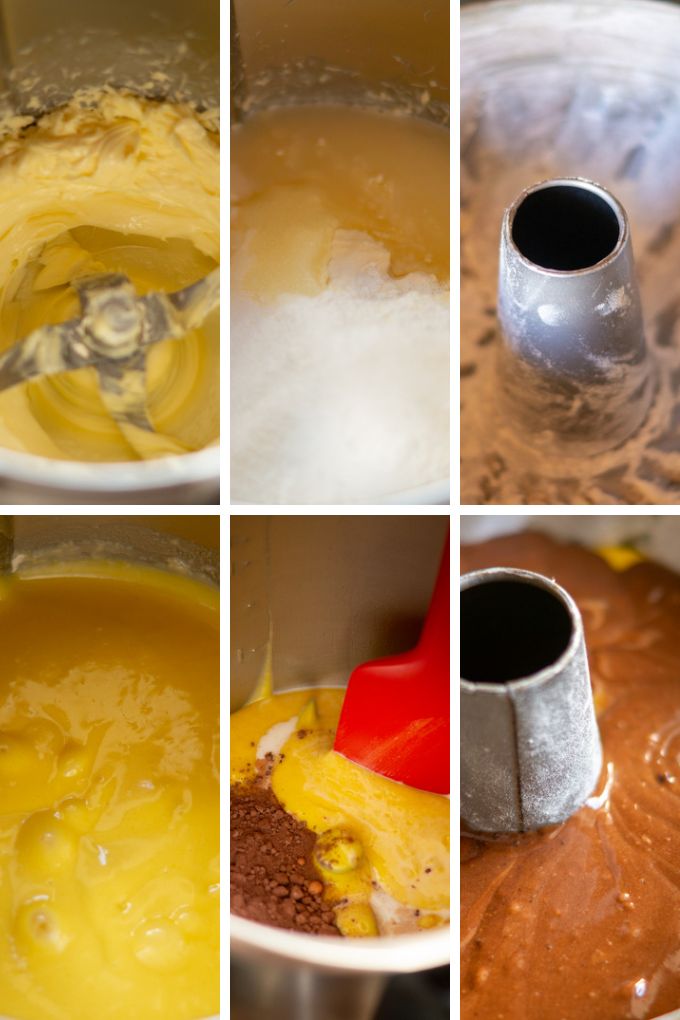
Cut the butter into pieces, place in the mixing bowl and beat for 50 seconds / speed 5 until soft and creamy.
-
2
Preheat the oven.
Preheat the oven to 180 °C top and bottom heat.
-
3
Grease and flour the tin.
Grease the bundt tin with butter and dust with flour.
-
4
Mix the batter.
Add 250 g sugar, vanilla sugar, salt, flour, baking powder and 40 g milk to the mixing bowl and mix for 2 minutes / speed 5. While mixing, drop the eggs one at a time through the lid opening into the mixing bowl. Pour half the batter into the prepared bundt tin.
-
5
Add the cocoa.
Add the cocoa powder and remaining milk to the mixing bowl, mix for 5 seconds / speed 5 and scrape down with the spatula. Mix again for a further 5 seconds / speed 5.
-
6
Fill the tin.
Spread the dark batter from the mixing bowl evenly over the light batter in the tin. Draw a fork through both layers in a spiral motion to create the marble effect.
-
7
Bake the cake.
Bake the cake on the middle shelf for 50 to 60 minutes. Check with a skewer.
Tip: All ingredients should be at room temperature before you start.
Video
Nutrition per serving
300 g soft butter at speed 5: how the batter starts
The 300 g of butter really must be soft, not just at room temperature. We cut the butter into pieces and beat it for 50 seconds at speed 5 until creamy. If the butter is too cold, the batter will stay lumpy and the cake will turn out denser. In summer, leaving the butter out for 30 minutes is usually enough. In winter, allow at least an hour, or briefly soften it in the microwave without melting it.
Eggs one at a time through the lid opening: the key to a lighter cake
The 5 eggs do not all go into the mixing bowl at once. While the Thermomix® combines the dry ingredients (250 g sugar, vanilla sugar, salt, 380 g flour, baking powder) with some of the 70 g milk at speed 5, we add the eggs one by one through the lid opening. Each egg is fully incorporated before the next one goes in. This beats in more air and produces a noticeably lighter cake than adding all the eggs at the same time.
Marbling: light batter first, do not swirl too many times
For the marble effect, we pour about half the light batter into the prepared bundt tin. We then add 30 g cocoa powder and the remaining milk to the mixing bowl and mix for 5 seconds at speed 5. Spread the dark batter evenly over the light batter in the tin. Draw a fork in a spiral through both layers 2 to 3 times. No more than that, otherwise the colours blend together and the marble effect is lost.
Bundt tin or loaf tin: which works better
We bake the marble cake in a bundt tin. The hole in the centre allows heat to reach the batter from all sides so the cake bakes evenly. Metal tins give a better crust than silicone because metal conducts heat more effectively. Silicone tins are easier to clean and the cake releases more easily, but the crust will be less golden. A loaf tin also works, but the cake will need an extra 5 to 10 minutes in the oven.
50 to 60 minutes at 180 °C: the skewer test is essential
Preheat the oven to 180 °C top and bottom heat (160 °C fan). Place the bundt tin on the middle shelf. After 50 minutes, insert a thin wooden skewer into the thickest part of the cake. If batter still clings to the skewer, bake for a further 5 to 10 minutes. If the skewer comes out clean, the cake is done. Do not take it out too early or the centre will sink. Leave to cool in the tin for 10 minutes, then turn out.
Advocaat, nut and double chocolate: 3 variations
- Advocaat marble cake: Replace part of the milk with advocaat. This makes the cake even more moist and adds a subtle flavour.
- Nut marble cake: Replace half the flour with ground almonds or hazelnuts. The cake turns out more moist and takes on a nutty flavour.
- Double chocolate: Add 50 g chocolate chips to the dark batter in addition to the cocoa powder. The chips melt slightly during baking and give a more intense chocolate flavour.
Stays fresh for 3 to 4 days: how to store the cake
Stored in an airtight cake tin at room temperature, the marble cake will keep for 3 to 4 days. It often tastes even more moist on the second day as the butter soaks further into the crumb. To freeze, slice the cooled cake, wrap each slice individually in freezer bags and thaw at room temperature for about an hour when needed. Keeps in the freezer for up to 3 months.
What to bake after the marble cake
If you enjoy marble cake, you will also love the advocaat sheet cake, which is large enough to serve the whole family. In summer, a Solero torte is a great choice, and during strawberry season the strawberry and rhubarb tray bake fits perfectly. For a quick bite with coffee, the speedy bread rolls are ready in just 25 minutes.