Easter lamb cake with the Thermomix® takes 60 minutes total (35 to 40 minutes of that in the oven) and yields 12 pieces from a classic lamb cake tin. The batter is a simple sponge with a hint of lemon that releases cleanly from the tin when the tin is prepared properly.
We have been baking the Easter lamb on Holy Saturday for years so it is ready for breakfast on Easter Sunday. The recipe works reliably when two critical points are right: prepare the tin properly and take the skewer test seriously. It goes well with homemade advocaat and coloured Easter eggs made with the Thermomix®.
Moist Easter Lamb Cake with the Thermomix®

Ingredients 0 / 8 ✓
- 200 g sugar
- 100 g butter
- 1 sachet vanilla sugar
- 2 tbsp lemon juice
- 2 eggs
- 140 g flour
- 1/2 sachet baking powder
- 2 tbsp milk
Instructions 0 / 8
-
1
Grease the lamb cake tin with a little butter and preheat the oven to 180 °C top and bottom heat.
-
2
Add sugar to the mixing bowl and grind to icing sugar for 10 sec / speed 10. Set aside 100 g of it.
-
3
Cut butter into pieces, add with vanilla sugar and 1 tbsp lemon juice and beat until fluffy for 30 sec / speed 4.
-
4
Add the eggs and mix for a further 30 sec / speed 4.
-
5
Add flour, baking powder and milk and mix for 10 sec / speed 3.
-
6
Pour the batter into the tin and bake on the middle rack of the oven for 35 to 40 minutes. (Do a skewer test.)
-
7
Leave the lamb to cool in the tin for 10 minutes, then carefully remove and leave to cool completely.
-
8
Stir 100 g icing sugar with 1 tbsp lemon juice until smooth and brush it over the lamb.
Nutrition per serving
The tin is the most common source of problems
Classic lamb cake tins are made from cast aluminium and have cavities for the head, legs and tail. If the tin is not greased thoroughly, the head stays stuck in the tin when you try to remove the finished lamb. That is the most common disaster when baking an Easter lamb.
We grease every cavity individually with soft butter and a pastry brush. For extra security, dust with flour as well (knock out any excess). This creates a barrier that prevents sticking. Non-stick tins need less butter but are rarely available in the classic lamb shape.
Making icing sugar yourself: 10 seconds, speed 10
Sugar (200 g) goes into the mixing bowl first, ground to icing sugar for 10 seconds at speed 10. 100 g is used for the batter and 100 g is set aside for the icing. This saves a shopping trip and gives you fresher icing sugar than the shop-bought kind.
Shop-bought icing sugar often contains around 3 per cent cornflour as an anti-caking agent, which makes the icing slightly cloudy. Home-made is crystal clear. If you prefer not to make your own: using 200 g of ready-made icing sugar (instead of grinding 200 g of sugar) works just as well and is simply a matter of what you have in the cupboard.
Beating butter until fluffy: 30 seconds, speed 4
Beat 100 g butter with vanilla sugar and 1 tbsp lemon juice for 30 seconds at speed 4 until fluffy. Important: the butter must be soft (left out for an hour at room temperature), otherwise it will be lumpy. Cold butter produces a lumpy batter that bakes unevenly.
Vanilla sugar rather than vanilla extract is standard for sponge cakes. The sugar binds the vanilla flavour better than liquid extract in the batter. If you use Bourbon vanilla sugar instead of synthetic vanillin, the flavour is noticeably better.
Eggs after the butter: why the order matters
The two eggs go in after the fluffy butter, another 30 seconds at speed 4. Then flour (140 g), baking powder (half a sachet) and 2 tbsp milk are mixed in for just 10 seconds at speed 3. Never mix flour for longer than 10 seconds: it develops the gluten too much and the batter becomes tough instead of light.
Speed 3 is the limit: higher speeds knock the air bubbles out of the butter and the cake comes out flat. Lower speeds do not mix evenly. Speed 3 for 10 seconds is the best combination for a light sponge batter.
180 °C top and bottom heat, 35 to 40 minutes
In a conventional oven use 180 °C top and bottom heat. Fan-assisted also works (160 °C) but dries out the lamb cake more easily. With lamb tins, the wall thickness varies (thicker at the body, thinner at the legs), so heat distribution is not entirely even.
After 30 minutes do a visual check: if the lamb is golden brown it is probably done. After 35 minutes do a skewer test. In our tin the lamb takes exactly 38 minutes as a rule. With thinner tins allow 35 minutes, with thicker tins up to 45 minutes.
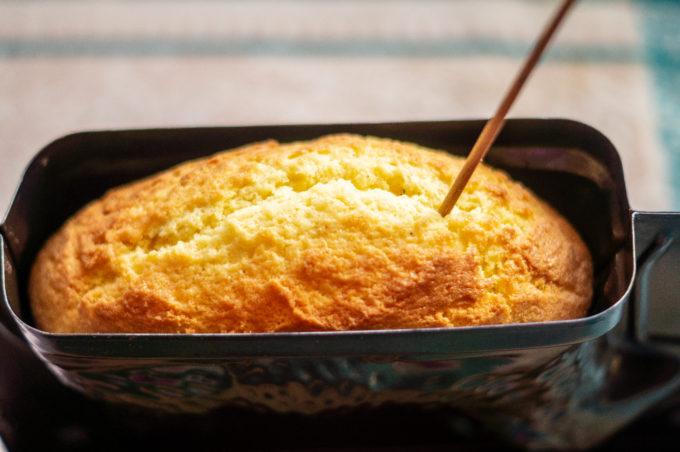
The skewer test is essential, not optional
Insert a wooden skewer or kebab skewer vertically into the thickest part of the lamb body. If it comes out clean, the lamb is done. If batter clings to it, bake for another 5 minutes and test again. Never take it out of the oven on a guess, or the centre will be raw.
If you use a probe thermometer, a core temperature of 95 to 98 °C indicates a fully baked sponge. Below that temperature the centre is not yet cooked through. This is the more precise method, but a skewer test is enough for most bakers.
10 minutes cooling time in the tin
After baking, leave the lamb in the tin for 10 minutes. Removing it straight away would break it because the hot batter is still too soft. Ten minutes is enough for the sponge to firm up. Then run a knife around the edges and carefully turn it out onto a wire rack.
If you leave it in the tin for more than 30 minutes the cake becomes sticky and releases less easily. You would then need to run a knife along the edge and tap the lamb gently. With practice, turning it out becomes straightforward.
Anti-stick coating: butter plus breadcrumbs for double protection
For extra reassurance, especially with older cast aluminium tins without a non-stick coating: after buttering, scatter 2 tbsp of breadcrumbs over the tin. Rotate the tin so the crumbs coat every surface, then knock out any excess. This creates a double barrier between the batter and the tin.
This method is common in the professional Vorwerk variation and is particularly reliable. Flour or ground almonds work instead of breadcrumbs. We do this when the tin is old or the cavities are very detailed.
Three variations: advocaat, marble and pecan-cranberry
Advocaat variation: A classic for Easter. Add 110 g of advocaat to the butter, egg and sugar mixture. Use 30 g more flour (170 g instead of 140 g) because the advocaat adds liquid. Baking time increases by 5 minutes. Tastes like a home-made advocaat cloud and works perfectly at Easter.
Marble lamb: Divide the batter in half, mix one half with 2 tbsp cocoa powder and 1 tbsp milk. Layer the dark and light batters alternately in the tin and marble them roughly with a fork. The classic marble pattern forms during baking. Baking time stays the same.
Pecan and cranberry lamb: Fold 50 g of roughly chopped pecans and 30 g of dried cranberries into the finished batter. This gives a fruity, nutty variation with a bit of bite. Almonds and raisins work just as well as a more traditional option.
Lemon icing: 100 g icing sugar, 1 tbsp lemon juice
Stir the reserved 100 g of icing sugar with 1 tbsp lemon juice until smooth. This gives a thick icing that sets evenly on the cooled lamb. If the icing is too runny, add 1 tsp more icing sugar. If it is too thick, add 1 tsp of water or a little more lemon juice.
For the classic look, dust the lamb in icing sugar (instead of icing). This gives a snow-covered effect and is the traditional method. Icing keeps the cake moister; plain icing sugar is more nostalgic.
Easter lamb keeps for 4 days and freezes well
Wrapped in cling film or stored in a cake tin the lamb keeps for 4 days. The icing should be completely dry before storing, otherwise it sticks to the film. If you need it to last longer than 4 days, freeze it without the icing and make fresh icing after defrosting.
A frozen lamb (in cling film and a freezer bag) keeps for 3 months. Defrost overnight in the fridge, then bring to room temperature before icing. The texture after defrosting is almost as good as fresh.
Also goes well with: icing glaze and vanilla ice cream.