This is one of the most-baked recipes on mixmyday.com. The German name Friss-dich-dumm-Brot literally means “eat-yourself-silly bread”, and once you try it you will understand why. Four different flours (wheat 550, wheat 1050, rye 1150, spelt 630), fresh yeast, 5 minutes on kneading mode in the Thermomix®, 1 hour to prove, 55 minutes in the oven. The result is a rustic mixed loaf with a firm crust and a moist, open crumb.
Moreish Quick Bread with the Thermomix®

Ingredients 0 / 8 ✓
- 300 g water lukewarm
- 1/2 cube yeast fresh
- 1 tsp sugar
- 2 tsp salt
- 250 g wheat flour type 550 a little extra for working the dough
- 40 g wheat flour type 1050
- 120 g rye flour type 1150
- 70 g spelt flour type 630
Instructions 0 / 6
-
1
Dissolve the yeast.
Add water, yeast, sugar and salt to the mixing bowl and warm for 4 min / 37°C / speed 1.
-
2
Knead the dough.
Add the remaining ingredients and knead for 5 min / kneading mode.
-
3
Prove the dough.
Transfer the dough to the bread baking tin, close the tin, cover and leave to prove at a warm spot for 1 hour.
-
4
Preheat the oven.
Preheat the oven to 240°C top and bottom heat.
-
5
Fold the dough.
Turn the dough out onto a floured work surface. With floured hands, stretch it out, fold it over itself and stretch again. Repeat this at least 5 times.
-
6
Bake.
Shape the dough into a loaf and place it in the bread tin. Drizzle with a little water and dust with a little flour. Close the tin and place in the oven together with a heat-proof dish of water. Bake the bread for 45 minutes in the centre of the oven. Open the tin, reduce the temperature to 200°C and bake for a further 10 minutes until done.
Tip: You can also bake the bread in any other tin or dish you like. A clay baker works particularly well. The key point is that the bread should be covered (with a lid or a sheet of foil) for the first 45 minutes of baking. After reducing the temperature, finish baking the bread uncovered.
If you would like a seeded or herb loaf, add the seeds or spices of your choice to the mixing bowl in step 2.
Video
Nutrition per serving
Why four flours and not one
The blend of four flours is what makes this loaf special. Wheat 550 gives structure and volume. Wheat 1050 adds more flavour and a darker crumb. Rye flour 1150 provides the characteristic moistness that a pure wheat bread simply does not have. Spelt flour 630 makes the dough more pliable. If you only have one flour to hand, 480 g of wheat flour 550 will work, but the bread will be paler and go stale more quickly.
37°C and kneading mode: how the Thermomix® handles the dough
Start by warming 300 g of lukewarm water with half a cube of yeast, 1 tsp of sugar and 2 tsp of salt for 4 minutes at 37°C on speed 1. The yeast dissolves completely during this step. Then add all the flours and knead for 5 minutes on kneading mode. The dough is ready when it pulls away from the sides of the mixing bowl and forms a smooth, slightly sticky ball.
The dough tool attachment is useful for this recipe because it prevents dough from getting trapped under the blade. With 480 g of flour, the kneading can otherwise become uneven towards the end.
Proving time: 1 hour minimum, overnight is even better
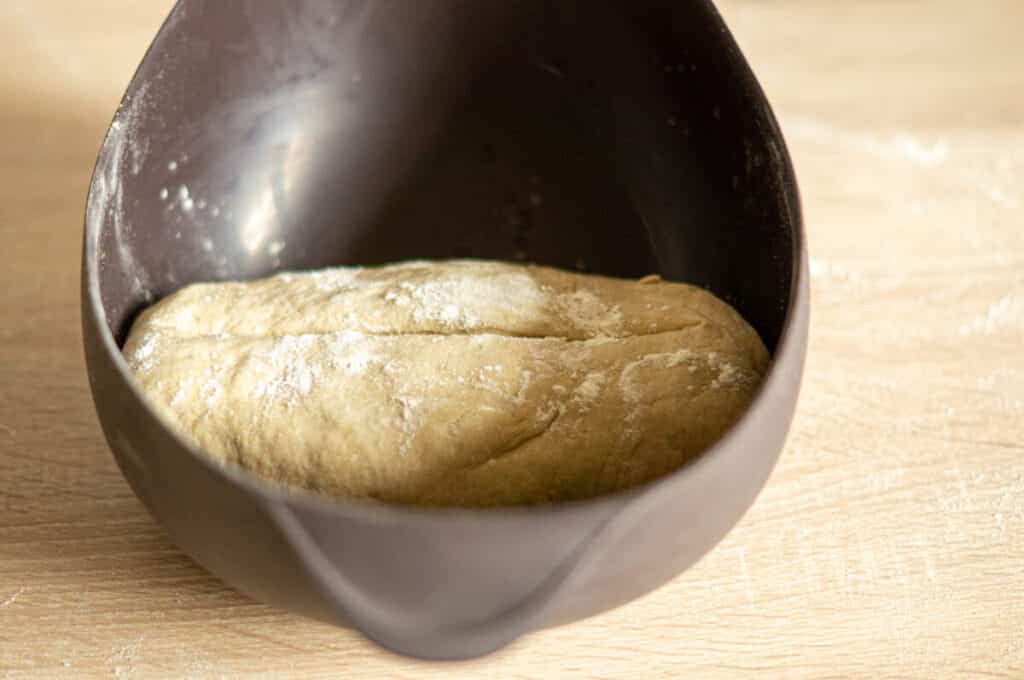
After kneading, transfer the dough to a lightly floured bowl, cover and leave to prove at a warm spot for 1 hour. It should visibly double in size. For even more flavour, knead the dough in the evening, cover and refrigerate overnight, then bake in the morning. The slow overnight fermentation makes the bread more aromatic and easier to digest.
4 to 5 folds: how to get an open, airy crumb
Before baking, turn the dough out onto a floured work surface and, with floured hands, stretch and fold it several times. This strengthens the gluten network and gives you the characteristic open, airy crumb. Do not be too gentle, but do not over-knead either. 4 to 5 folds is enough. A proving basket gives the loaf its shape during the final rest and leaves the classic ring pattern on the crust.
Baking: 240°C with steam
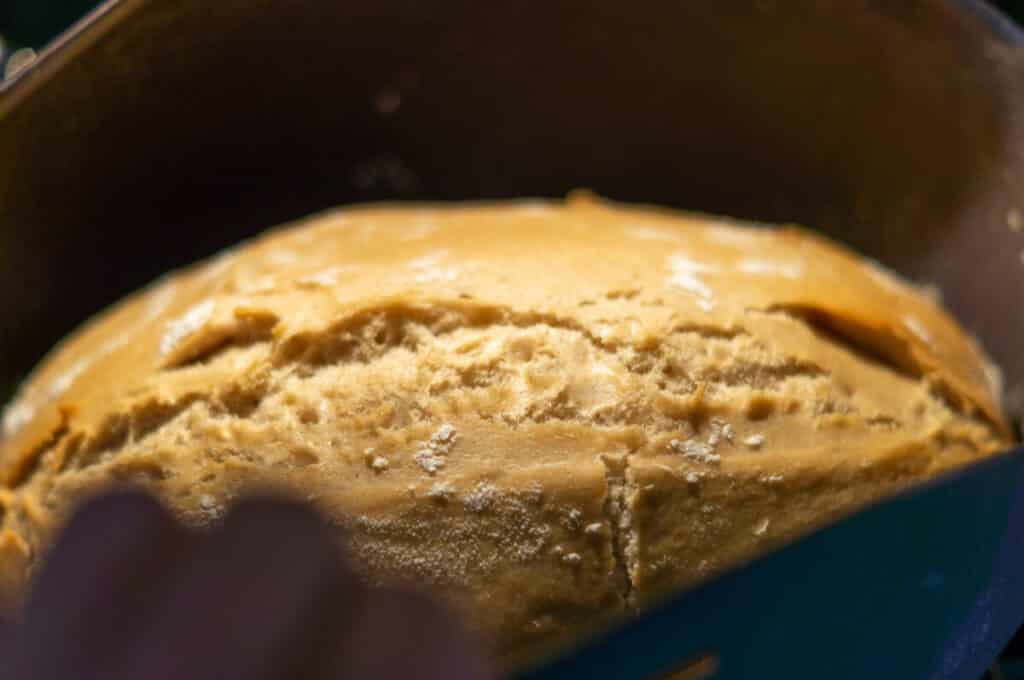
Preheat the oven to 240°C top and bottom heat. Drizzle the loaf with a little water and dust with flour. For the first 10 minutes, place a dish of water in the oven alongside the bread. The steam stops the crust from cracking too early and ensures it turns evenly crisp at the end. For even better results, a cast-iron casserole dish traps the steam and delivers consistent heat. Total baking time: 55 minutes.
Seeds, herbs, wholemeal: 3 variations
- Seeded loaf: add 50 to 80 g of mixed seeds (sunflower, pumpkin, linseed) before kneading.
- Herb loaf: add 2 to 3 tbsp of dried herbs (rosemary, thyme, oregano) together with the flours.
- Wholemeal version: replace up to 50% of the wheat flour with wholemeal flour and add 20 to 30 g extra water, as wholemeal absorbs more liquid.
How to keep the bread fresh for 3 days
Freshly baked, the bread keeps for 2 to 3 days at room temperature, best stored in a bread bag or beeswax wrap. Do not put it in the fridge as it will go stale more quickly there. To freeze, slice the loaf and freeze in individual portions. Frozen slices can go straight into the toaster.
Butter, soup, jelly: what we eat it with
We love this bread with homemade butter made in the Thermomix® or alongside a vegetable soup. If you enjoy spreads, tomato jelly made in the Thermomix® goes surprisingly well with this loaf.
Also great with: butter, cream cheese and cold cuts.
You might also enjoy Allgäuer Seelen rolls made in the Thermomix®.
Want to learn more? Guides on kneading and yeast doughs are in our Thermomix® tips section and our complete recipe guides overview.