Rosemary in a sponge cake is not an experiment, it is a deliberate choice. The essential oils in rosemary only release under mechanical pressure, so we grind it with the sugar at speed 10 rather than folding chopped needles into the batter. Only then does it give the cake its full flavour.
Orange and Rosemary Cake with the Thermomix®

Ingredients 0 / 11 ✓
- 2 sprigs rosemary
- 250 g sugar
- 3 oranges unwaxed
- 240 g butter
- 500 g flour
- 1 sachet baking powder
- 1 sachet vanilla sugar
- 4 eggs
- 70 g orange liqueur
- 100 g orange marmalade
- 200 g icing sugar
Instructions 0 / 6
-
1
Preheat the oven.
Preheat the oven to 180 °C top and bottom heat (fan 160 °C).
-
2
Make the rosemary sugar.
Wash and dry the rosemary, strip off the needles, add to the mixing bowl with the sugar and grind for 10 sec / speed 10.
-
3
Mix the batter.
Wash and dry 2 oranges and zest them. Set aside half the zest. Add the remaining zest to the mixing bowl together with the butter cut into pieces, flour, baking powder, vanilla sugar and eggs.
-
4
Juice the oranges.
Juice all the oranges, add 50 g orange juice and 50 g orange liqueur to the mixing bowl and mix for 30 sec / speed 4.
-
5
Bake.
Grease a Bundt tin with a little butter, pour in the batter and bake for 60 minutes on the middle shelf of the oven. Use a skewer to check whether the cake is done.
-
6
Glaze.
Mix 20 g orange liqueur, 30 g orange juice, orange marmalade and icing sugar together, then spread generously over the still-warm cake. Decorate with the reserved orange zest.
Tip: If you prefer not to use orange liqueur, simply replace it with the same quantity of orange juice.
Nutrition per serving
Why the rosemary sugar goes in before the butter
We do not add rosemary needles directly to the batter because they would come through as fibrous pieces. Grinding them with the sugar for 10 seconds at speed 10 turns them to powder and releases the essential oils at the same time. The sugar acts as an abrasive. The result is an evenly aromatic batter, with no sharp patches.
The rosemary must be dry, otherwise it clumps. After washing, spread the fresh needles on kitchen paper and wait 10 minutes. Frozen rosemary does not work here, it turns mushy instead of powdery.
Orange zest: two out of three oranges only
The recipe calls for three oranges: two for the zest, all three for the juice. The third orange contributes juice only, no zest. The reason: too much orange zest makes the batter bitter. Two zested oranges give plenty of flavour without the bitter compounds from the white pith taking over.
Half the zest is set aside before mixing and added later as decoration on top of the glaze. The rest goes into the batter. Take care to grate only the coloured skin, not the white pith underneath. A fine grater helps you catch the zest in thin strips.
Orange juice to liqueur ratio: 50 to 50 in the batter
From the three squeezed oranges we need 50 g of juice for the batter, plus 50 g of orange liqueur. This ratio is not a coincidence: the liqueur adds an alcohol note and intensifies the orange flavour without making the batter too loose. More juice would make the batter too thin, more liqueur too overpowering.
If you do not have orange liqueur, use 100 g orange juice instead. The cake will be slightly less aromatic but still moist. The remaining 30 g juice and 20 g liqueur go into the glaze.
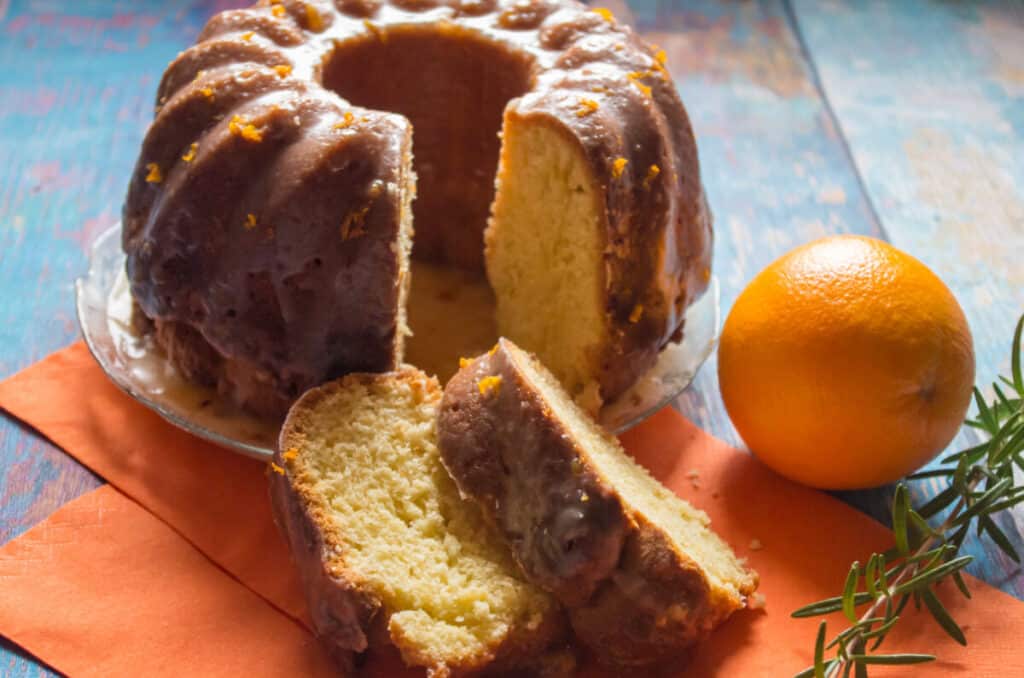
Greasing the Bundt tin properly
A Bundt tin has many corners and ridges. If you only grease it lightly, the batter sticks in the grooves after baking. Use soft butter and brush it into every indentation with a pastry brush. The tin must be fully coated, otherwise the cake breaks when you turn it out.
Alternative: baking spray. It is quicker and reaches narrow gaps as well. We use both methods depending on what is to hand.
Skewer test after 60 minutes
After 60 minutes at 180 °C top and bottom heat (160 °C fan), the cake is usually done. But ovens vary. So do the skewer test: push a wooden skewer or thin knife into the thickest part of the cake. If it comes out clean, the cake is ready. If moist crumbs cling to it, bake for another 5 minutes and test again.
Leave the cake in the tin for 10 minutes after baking before turning it out. Turn it out too early and it falls apart. Leave it too long and it sticks.
Glaze on a warm cake
The glaze goes on the cake while it is still warm. The reason: the icing sugar melts slightly and soaks into the surface. On a cold cake the glaze stays dull and sets faster. We mix the icing sugar with orange juice, liqueur and marmalade straight after turning out the cake, then spread it on with a spoon.
The reserved orange zest is scattered over the wet glaze as decoration. It sticks better while the glaze has not yet set.
If you notice after two or three days that the glaze has turned matt, that is normal. Icing sugar absorbs moisture and can crystallise slightly. The taste remains.
Keeping it moist
The cake keeps for three to four days at room temperature in a cake tin. The orange juice and butter in the batter mean it dries out more slowly than a classic sponge. It turns dense in the fridge, so leave it out.
Goes well with: vanilla ice cream and icing sugar.
Freezing works, but only without the glaze. Let the baked cake cool completely, wrap it in cling film and freeze. Keeps for three months. To defrost, leave at room temperature for 2 to 3 hours, then glaze.
Find more Thermomix® recipes with oranges and citrus fruits here: Grandma’s Rice Pudding Thermomix®, Best-Ever Advocaat Thermomix®.