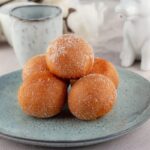
Quark doughnuts made with the Thermomix® almost never fail because of the dough. They fail because of the oil. We fried this recipe at 180°C for a long time and kept wondering why the doughnuts were turning dark on the outside before the centre was cooked through. The answer is right there in the recipe, you just have to take it seriously: 170°C, no higher.
The Thermomix® handles only the first part: butter, eggs, sugar, vanilla sugar and quark whisked until fluffy in 1 minute at speed 5, then flour, cornflour and baking powder added and mixed for another 1 minute at speed 5. That takes 10 minutes. The important part happens afterwards, in the pot.
Quark Doughnuts with the Thermomix®
Ingredients 0 / 12 ✓
- 50 g butter softened
- 2 eggs
- 50 g sugar
- 20 g vanilla sugar
- 1 pinch salt
- 250 g quark
- 200 g plain flour (type 405)
- 50 g cornflour
- 1/2 sachet baking powder
- 1000 g sunflower oil
- 1 tsp cinnamon
- 50 g sugar
Instructions 0 / 6
-
1
Whisk eggs and sugar until fluffy.
Place butter, eggs, 50 g sugar, vanilla sugar and salt in the mixing bowl and whisk until fluffy for 1 min / speed 5.
-
2
Stir in quark.
Add the quark and stir into the egg mixture for 30 sec / speed 5.
-
3
Mix the dough.
Add the flour, cornflour and baking powder and mix everything for 1 min / speed 5.
-
4
Heat the oil.
Heat the sunflower oil in a saucepan or deep-fat fryer to approximately 170°C.
-
5
Fry the quark doughnuts.
Use two tablespoons to shape small balls from the dough and carefully lower them into the hot sunflower oil. Do not fry too many doughnuts at once, as this can lower the temperature of the oil. Fry the quark doughnuts until golden brown, turning them occasionally. Lift the cooked doughnuts out of the oil with a slotted spoon and leave them to drain on kitchen paper.
-
6
Coat quark doughnuts in sugar and cinnamon.
Mix the ground cinnamon and the remaining sugar in a shallow bowl, then roll the still-warm quark doughnuts in the mixture. Serve the warm quark doughnuts straight away for best results.
Tip: Instead of cinnamon and sugar, you can also roll the quark doughnuts in honey.
Video
Nutrition per serving
Why 170°C is non-negotiable
Quark dough has a high moisture content thanks to the 250 g of quark. The doughnuts need time to set in the centre. At 180°C or above, the outer skin browns so quickly that the middle is still raw when you take them out. The result: golden brown on the outside, sticky inside.
At 170°C the heat moves evenly towards the centre. The doughnuts then need about 3 to 4 minutes per batch and will turn by themselves if you give them the occasional nudge with a spoon. That is the temperature threshold that makes all the difference.
How do we check that the oil has reached 170°C? We drop a small piece of dough into the oil. If steady bubbles rise after 3 to 4 seconds and the piece turns golden in 90 seconds, the temperature is right. If it darkens immediately, the oil is too hot. If barely any bubbles appear, wait another 2 minutes.
Which quark for which result
The recipe simply says quark without specifying fat content. The difference is noticeable, though. Low-fat quark (0%) makes a firmer dough that is less rich. It shapes easily and sticks less. Full-fat quark (20%) makes the doughnuts moister inside, but the dough is softer and requires a little more patience when shaping with two tablespoons. We use low-fat quark because it holds its shape better and gives a more consistent result.
Important: use quark straight from the fridge. Quark at room temperature makes the dough softer than necessary and the doughnuts are harder to portion.
Shaping: two spoons or a scoop
Two tablespoons work if you briefly dip them in hot water first. The dough then releases cleanly. A small ice cream scoop (about 3 cm in diameter) makes the job faster and the doughnuts more even. Consistent size is not just an aesthetic detail: unevenly sized doughnuts cook at different rates and you have to watch every single one. We dip the scoop in warm water every three to four doughnuts to prevent sticking.
Do not put too many in the oil at once. Five to six doughnuts per batch is the maximum for a standard saucepan. More than that pulls the oil temperature down noticeably and the doughnuts absorb oil instead of frying properly.
If you enjoy frying and like pastries in this style: our Thermomix® Donuts follow the same frying technique, just with a yeast dough. And for quark dough baked in the oven rather than fried in oil, it is worth trying our Quark Oil Bunnies, which we bake from the same basic dough.
Eat fresh, do not store
Quark doughnuts taste best warm. The cinnamon-sugar mixture clings to the warm dough; once they cool down, the coating turns dry. You can store the uncooked dough covered in the fridge for up to two days and fry fresh portions as needed. Finished doughnuts will keep in an airtight container for one day at room temperature, but they lose their crispness. Reheating in the oven at 160°C for 5 to 6 minutes brings them close to their original texture, but it is no substitute for eating them fresh.
More sweet baked goods from the Thermomix®: Thermomix® Donuts with yeast dough and a similar frying technique, and Quark Oil Bunnies for Easter, baked in the oven rather than fried in oil.
What other recipes do differently
Serve with: vanilla sauce, apple sauce and icing sugar.
Also worth trying: White Chocolate Parfait with the Thermomix®.
Many recipes use full-fat or cream quark (20% fat) because the doughnuts turn out moister inside. We stick with low-fat quark because the dough holds its shape better and cooks more evenly. Lemon zest is often grated into the dough as well. It tastes fresh, but it overpowers the vanilla sugar, so we leave it out. For the oil, some sources recommend coconut fat or clarified butter: both work, but they have a strong smell and mask the quark flavour. Sunflower oil stays neutral. For the sugar coating, we often see plain icing sugar used. It dissolves immediately on the warm dough and forms a sticky layer. Cinnamon sugar stays slightly crisp and complements the sweetness of the doughnuts.