A salad dressing made with oil and vinegar separates within seconds the moment we stop stirring. That is exactly why our herb salad dressing made in the Thermomix® includes a spoonful of medium-hot mustard. The mustard is not there for the flavour, it is there for the physics. It keeps the oil and vinegar together so the dressing stays stable in the bottle in the fridge and does not separate again after two hours.
We have been making this dressing in a single batch for years. Three 250 ml bottles in five minutes, and then it sits in the fridge for a week ready to pour over leaf salad, tomato salad, cucumber salad, or pasta salad, or to use as a marinade on grilled vegetables. One basic recipe replaces the entire shelf of ready-made dressings, which all taste similar anyway and usually contain too much sugar.
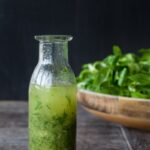
Quick Herb Salad Dressing with the Thermomix®
Ingredients 0 / 13 ✓
- 1 garlic clove
- 1 shallot
- 1/2 bunch chives
- 1/2 bunch flat-leaf parsley
- 1/4 bunch basil
- 1/4 bunch dill
- 300 g olive oil
- 100 g apple cider vinegar
- 40 g water
- 30 g medium-hot mustard
- 30 g honey
- 2 tsp salt
- 1 tsp pepper
Instructions 0 / 3
-
1
Prepare the ingredients.
Peel the garlic and shallot. Wash the herbs, shake dry, and pick off the leaves.
-
2
Chop the ingredients.
Add the garlic, shallot, and herbs to the mixing bowl, chop for 5 seconds / speed 8, and scrape down with the spatula.
-
3
Mix the dressing.
Add the remaining ingredients and mix for 30 seconds / reverse direction / speed 4. Pour the dressing into sealable jars or bottles and store in the fridge.
Note: Kept in the fridge, your dressing will last for approximately one week.
Video
Nutrition per serving
Why mustard holds the whole dressing together
Oil and vinegar are chemically incompatible. Oil is hydrophobic, vinegar is water with acid. If you pour both into a bottle and shake it, you have a dressing for about 30 seconds and then two clearly separated layers again. That is what the mustard solves. Mustard seeds contain natural emulsifiers, primarily mucilages and lecithins, which act as a bridge between water molecules and oil molecules. As soon as we add 30 g of mustard to the mixing bowl and blend it with oil and vinegar at speed 4 for 30 seconds in reverse direction, tiny oil droplets form that the mustard encases and holds in the vinegar phase.
The result is a stable emulsion. The dressing stays creamy in the bottle for a week without a visible oil layer floating on top. If a slight separation appears after three or four days, a quick shake is all it takes to bring it back together. That is normal, because our home emulsion is not industrially stabilised. We have deliberately left out thickeners and preservatives, and the mustard does the job on its own.
Reverse direction is essential, not a convenience
This is where the Thermomix® shows its real advantage. Making vinaigrette by hand means whisking for minutes and often still ending up with an unstable emulsion. Pouring oil and vinegar into a stand blender shreds the herbs to a paste and heats the essential oils. Running at speed 4 in reverse direction turns the blades so that the blunt edge leads. This stirs the dressing rather than chopping it. The parsley, chives, basil, and dill remain visible as green flecks in the dressing, still looking fresh after three days rather than grey and mushy.
We do the first step deliberately as a separate pass. Garlic, shallot, and the picked herbs go into the mixing bowl for 5 seconds at speed 8, where the blades can chop at full power. Only then do the oil, vinegar, water, mustard, honey, salt, and pepper go in, and the reverse direction takes over. This two-step process is the reason the herbs are small enough to distribute evenly but large enough that the dressing does not turn into pesto.
Acid ratio: 300 g oil to 100 g vinegar
The ratio in the recipe is not accidental. Three parts olive oil to one part apple cider vinegar is the classic French vinaigrette ratio, mild enough for leaf salad and strong enough for tomatoes. Once you know the ratio, you can adjust it in either direction. For a more robust salad with lamb’s lettuce or rocket, we go to 250 g oil and 120 g vinegar for more bite. For a very mild version with delicate tomatoes or Mozzarella, we use 350 g oil and 80 g vinegar.
The 40 g of water in the recipe matters and is often forgotten. The water slightly dilutes the acetic acid and makes the dressing more liquid so that it coats the salad evenly without needing to add more vinegar. Leave it out and you get a thick dressing that clumps in the bowl instead of flowing. Add too much and you water down the acidity. 40 g for this quantity is our tried and tested figure from regular use.
The honey is not there to sweeten
30 g of honey in 470 g of liquid does not produce a sweet flavour. The honey has a different role here: it rounds off the sharp peaks of the apple cider vinegar and ensures the dressing lands more gently on the palate. Without honey, the same mixture tastes noticeably more aggressive and bites at the front of the tongue. With the 30 g, that sharpness disappears without anyone at the table saying the dressing is sweet.
If honey is not an option, for example in a vegan version, we replace it with 25 g of maple syrup or 20 g of agave syrup. Maple syrup is sweeter than honey, so use a little less. Plain caster sugar also works but does not dissolve as well in reverse direction at speed 4 and can leave a gritty residue in the bottle. If you want to use sugar, go for fine icing sugar instead.
When the emulsion breaks
The most common question about this recipe is: why does my dressing separate even with mustard? In our experience, three causes come up. First, too little mustard, perhaps only a teaspoon instead of the full 30 g. The emulsifying effect scales with the quantity, and below 20 g for this amount of oil the emulsion becomes fragile. Second, mustard that is too cold straight from the fridge, in which case the blending process takes longer or needs to be repeated. We take the mustard out 10 minutes before mixing.
Third, and this is the most common mistake: the order of adding ingredients. If you put the oil into the mixing bowl first and then add the vinegar and mustard on top, the oil sticks to the bottom and reverse direction at speed 4 is not aggressive enough to lift it from there. We follow the order in the recipe and add the vinegar, water, and mustard first after the chopped herbs, then the oil in one go. This way the blending starts in an aqueous phase and the oil gets worked in drop by drop.
Swap herbs with the seasons
The combination of parsley, chives, basil, and dill is a summer version that works well with all classic salads. In spring we swap the basil for wild garlic, using only half a bunch because wild garlic is noticeably stronger. In autumn we add tarragon, which pairs well with mushroom dishes and chicken salads. In winter, when fresh potted herbs become scarce, the recipe also works with frozen parsley and chive mix from the supermarket. In that case, reduce the water to 30 g because thawed herbs release liquid of their own.
Another direction is the Mediterranean version: instead of apple cider vinegar we use 100 g of white wine vinegar and add 1/4 bunch of oregano and a few thyme leaves to the herbs. This version works especially well with tomato and Mozzarella salad or grilled halloumi. Also worth trying is the citrus version with the juice of half a lemon replacing half the vinegar, plus the zest of one organic lemon. The dressing becomes fresher and pairs well with asparagus and avocado salads.
Storing the dressing in bottles
Three 250 ml swing-top bottles are our standard because they shake well and take up little space in the fridge. It is important to rinse the bottles with boiling water or sterilise them briefly in the oven at 100 °C before filling. Filled cleanly, the dressing keeps easily for a week in the fridge, often ten days. You can tell when it has passed its best by the smell: as soon as the apple cider vinegar smells off or the dressing takes on a bitter note, discard it.
Freezing is not a good idea. When it thaws, the emulsion breaks for good and cannot be stabilised again by shaking. If we need larger quantities, for a barbecue party for example, we prefer to make two fresh batches the day before rather than freeze a batch in advance.
What we love serving this dressing with
The herb salad dressing is deliberately kept neutral, which means it goes with almost any salad. We particularly like it with classic coleslaw, because the acid softens the cabbage and the herbs add a fresh green note. It also goes well with a quick cucumber salad made in the Thermomix®, and half a bottle is enough for a whole cucumber. Pour it over fresh sliced tomatoes with some Mozzarella and the starter is done.
One use that many people overlook: the dressing also works as a marinade for grilled vegetables. Cut courgette, aubergine, and pepper into strips, pour half a bottle of dressing over them, leave to marinate for an hour, and put on the grill. The herbs caramelise lightly and the olive oil carries the flavours deep into the vegetables. The same works with chicken breast for a summery salad topping.
What other recipes do differently
Goes well with: Tomato and Mozzarella.
Many Thermomix® blogs make herb salad dressing with just oil and vinegar and no mustard, then wonder why the bottle separates overnight in the fridge. Others add yoghurt, soured cream, or buttermilk, but then the dressing lasts three days at most and tastes sour after one day. We deliberately stick with mustard as the emulsifier and honey as the sweetness balance against the acidity. The 5 seconds at speed 8 for the herbs and 30 seconds in reverse direction for the emulsion are the point where most recipes chop either too coarsely or too finely. Done this way, the dressing stays stable for a week and tastes just as good on day seven as it did on day one.
More recipes from our collection: Coleslaw with the Thermomix®, Cucumber Salad with the Thermomix®, and Tomato Salad with the Thermomix®.