Quince jelly with the Thermomix®: chop 1000 g of quinces in two batches, cook with 750 g of water for 30 minutes at 100°C, strain the juice through a sieve and reduce with 240 g of 3:1 jam sugar plus vanilla extract. Makes 4 jars in 110 minutes, keeps for up to 6 months.
Quince Jelly with the Thermomix®

Ingredients 0 / 5 ✓
- 1000 g quinces
- 2 tbsp lemon juice
- 750 g water
- 2 tsp vanilla extract
- 240 g 3:1 jam sugar
Instructions 0 / 7
-
1
Clean and cut the quinces.
Quinces: wash, quarter and remove the core and stalk.
-
2
Chop the quinces.
Place half the quinces with 1 tbsp lemon juice into the mixing bowl, chop for 10 sec / speed 5 and set aside.
Repeat with the second half in exactly the same way.
-
3
Cook the quinces.
Add the first half of the quinces and the water, then cook for 30 min / 100°C / reverse direction / speed 1. Place the steaming basket on top instead of the measuring cup to act as a splatter guard.
-
4
Leave the quince mixture to cool.
Leave the cooked quince mixture to cool for 1 hour, then pour through a sieve and collect the juice. Rinse the mixing bowl.
-
5
Bring the quince juice back to the boil.
Pour the juice obtained into the mixing bowl with the vanilla extract and jam sugar, mix for 5 sec / speed 4 and cook for 12 min / 100°C / speed 1.
-
6
Sterilise the jars.
Meanwhile, sterilise the preserving jars and lids with boiling water.
-
7
Fill the quince jelly into jars.
Do a set test, fill the jelly into the prepared jars, seal and leave upside down for 5 minutes.
Tip: We got 600 g of juice, which is why we used 240 g of 3:1 jam sugar. Depending on how juicy your quinces are, or how firmly you press them, the juice quantity may vary. If you get less juice, add a little apple juice. If you get more, reduce the juice to 600 g or calculate the jam sugar following the instructions on the packet. For a very clear jelly, line your sieve with a piece of muslin and strain the quince mixture through it.
Video
Nutrition per serving
10 seconds at speed 5: chop the quinces and cook for 30 minutes
Wash the quinces and rub off the fine fuzz with a rough cloth, as it contains bitter compounds. Quarter all 1000 g of quinces and remove the cores. Because 1000 g will not fit into the mixing bowl at once, we chop in two batches: place the first half with 1 tbsp of lemon juice into the mixing bowl and chop for 10 seconds at speed 5. Transfer to a bowl, then chop the second half with the remaining lemon juice in exactly the same way.
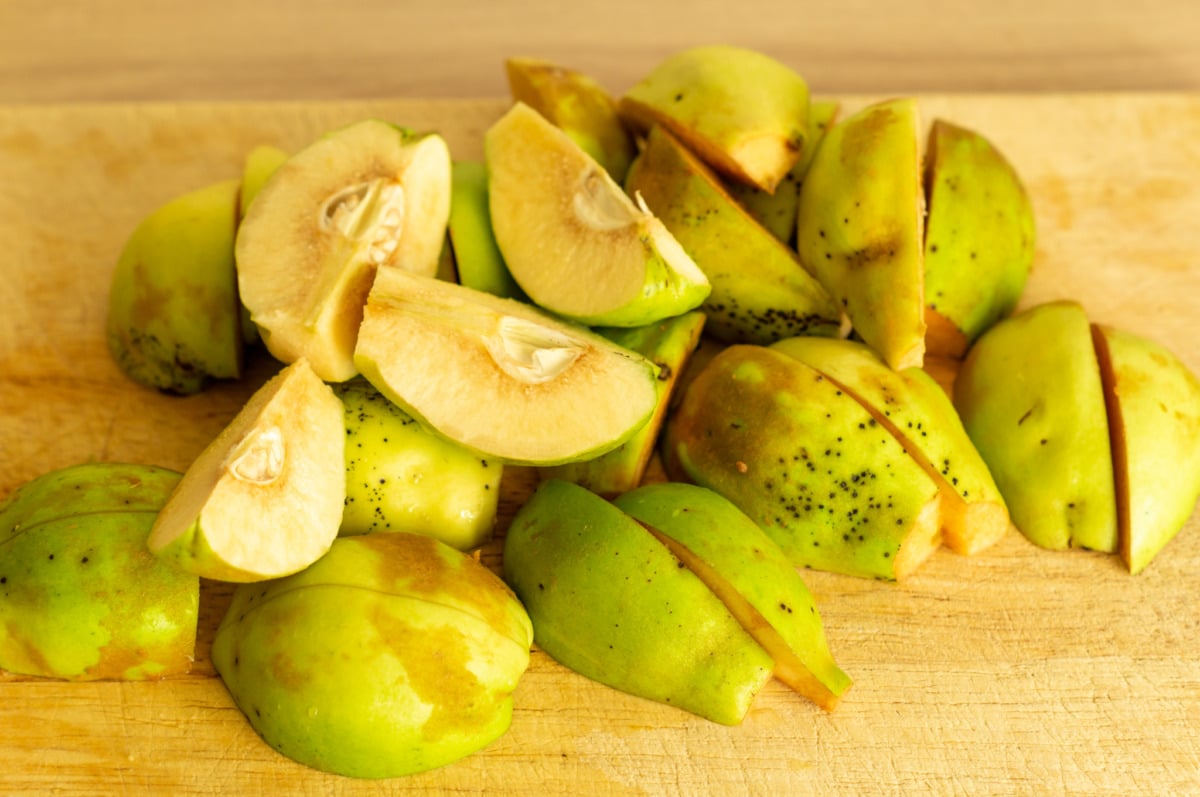
Add both batches back to the mixing bowl together with 750 g of water and cook for 30 minutes at 100°C in reverse direction at speed 1. Place the steaming basket on top instead of the measuring cup so the steam can escape. As they cook, the quinces release their natural pectin and aroma into the water, forming the base for a jelly that sets without any added pectin.
Through the sieve: why the juice needs 1 hour to cool
After cooking, leave the entire mixture to cool for at least 1 hour. Only then pour it through a fine sieve or a sieve lined with muslin and collect the juice. Cooling is important: hot liquid runs through too quickly, and fine fruit particles will cloud the jelly. For a particularly clear juice, leave it to drip through a muslin cloth in the fridge overnight.
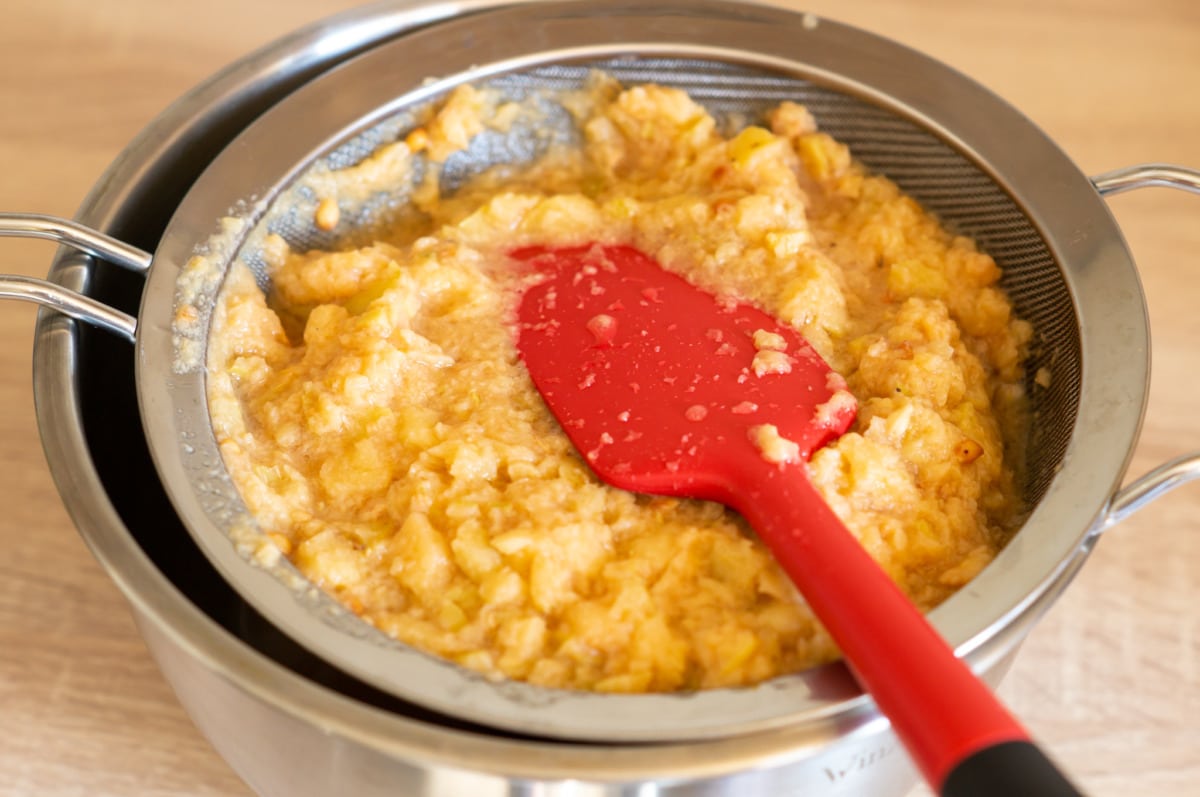
Rinse out the mixing bowl so that no fruit fibres cloud the jelly. Add the collected quince juice with 2 tsp of vanilla extract and 240 g of 3:1 jam sugar to the mixing bowl, mix for 5 seconds at speed 4 and cook for 12 minutes at 100°C at speed 1. Before filling the jars, do a set test: place 1 teaspoon of jelly on a cold plate. If it sets within a minute, the consistency is right.
3:1 jam sugar instead of 1:1: less sweet, more quince
We use 3:1 jam sugar, meaning 3 parts fruit to 1 part sugar. The jelly then tastes clearly of quince rather than just sugar. 2:1 jam sugar works just as well and makes the jelly a little sweeter and firmer. We advise against 1:1, as the quince flavour gets lost. Regular sugar cannot replace jam sugar because it lacks the pectin needed for the jelly to set.
Orange, chilli, rosemary: 3 variations
- Orange: Replace 200 g of water with freshly squeezed orange juice. The acidity pairs well with the tart quince and gives the jelly a fruity note.
- Chilli: Chop half a chilli (deseeded) together with the quinces. The gentle heat pairs particularly well with cheese on an autumn platter.
- Rosemary: Add 2 sprigs of fresh rosemary during the 30-minute cooking stage and remove before straining. The jelly takes on a herby, slightly bitter note.
Strawberry jam, apple sauce and more preserving recipes
If you enjoy preserving, we have plenty more to offer: Strawberry Jam, Apple Sauce, Blackcurrant Syrup, Plum Jam and Elderflower Syrup. Our Apple Juice also mixes beautifully with quince juice.
Keeps for 6 months in sterilised jars
Fill the hot jelly into sterilised jars straight away, seal and leave upside down for 5 minutes. This creates a vacuum that preserves the jelly. Stored in a cool, dark place it keeps for 6 months to a year. Once opened, store in the fridge and use within 4 weeks. Do not throw away the quince pulp left in the sieve: with a little sugar it can be turned into quince paste or quince cheese.
Why our recipe is different from other versions
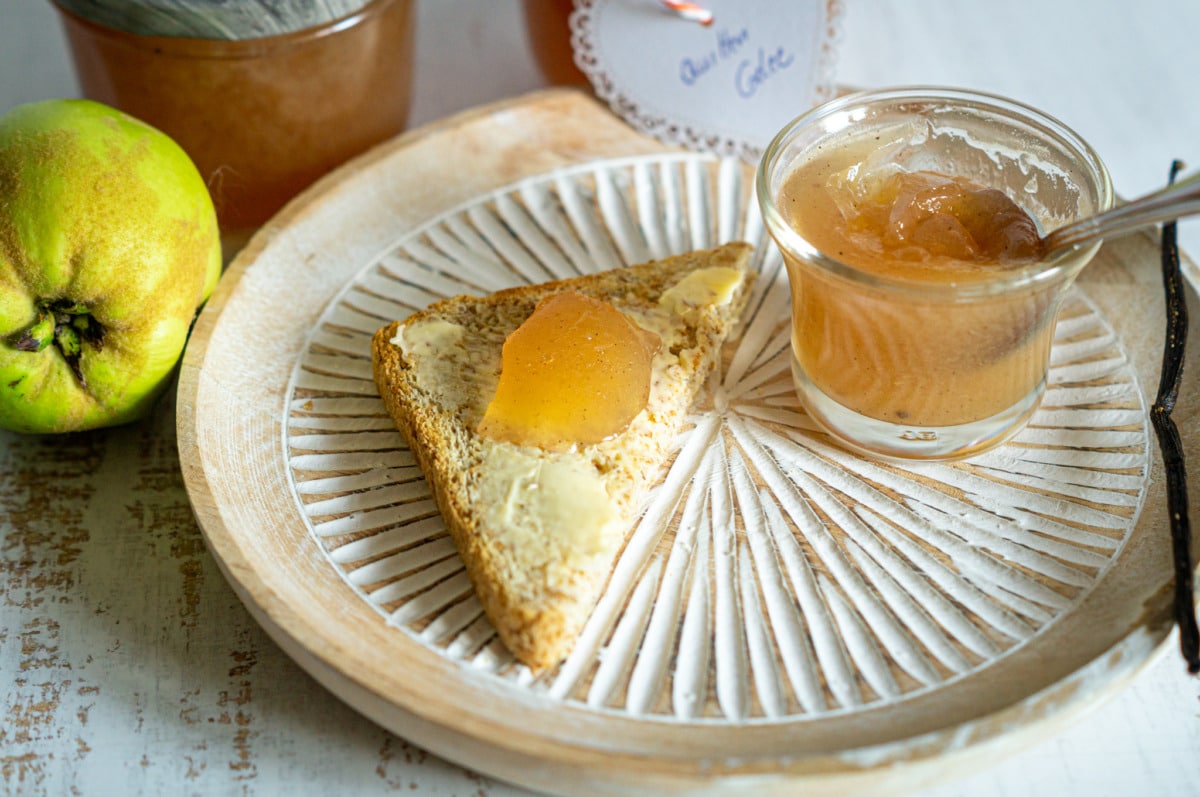
Goes well with: cheese, toast and bread rolls.
Some recipes use 1000 g of ready-made quince juice with 500 g of 2:1 jam sugar, which makes the jelly noticeably sweeter and masks the quince flavour. Older-style recipes even call for 1:1 jam sugar, meaning 1000 g of sugar per litre of juice, with a cooking time of 3 to 4 hours plus overnight draining through a cloth. We take a different approach: 1000 g of fresh quinces, 240 g of 3:1 jam sugar and 30 minutes of cooking time. The jelly tastes clearly of quince rather than sugar, and the whole process fits into 110 minutes rather than half a day. We rub the fuzz off dry, and we skip added pectin entirely because quinces harvested between October and November contain plenty of their own.