Raspberry Vinegar with the Thermomix® takes 25 minutes and yields 500 ml of finished vinegar. 400 g raspberries are processed with 400 g white balsamic at 90°C on speed 1, with 100 g sugar and 2 tsp vanilla extract to give it a full-bodied flavour.
We make raspberry vinegar every summer as a staple. One bottle lasts 2 to 3 months of salad dressings, and it also works as a gift in a pretty screw-top jar with a label. Shop-bought raspberry vinegar at an organic deli costs 8 to 12 euros for 250 ml; homemade works out at 3 to 4 euros per 500 ml.
Raspberry Vinegar with the Thermomix®

Ingredients 0 / 4 ✓
- 400 g raspberries
- 100 g sugar
- 2 tsp vanilla extract
- 400 g white balsamic vinegar
Instructions 0 / 4
-
1
Fruit.
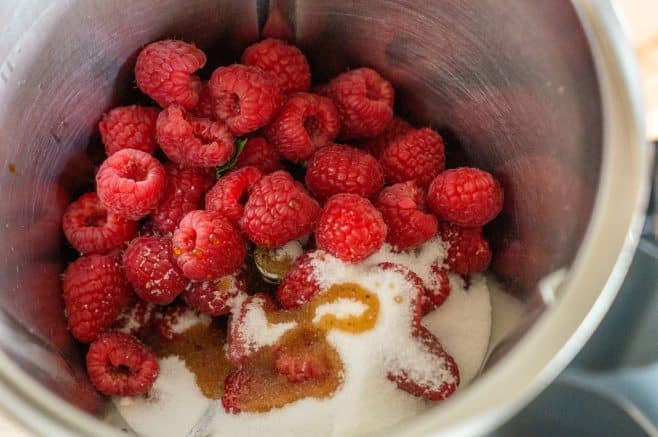
Add the raspberries to the mixing bowl together with the sugar and vanilla extract, blend for 5 sec / speed 5 and scrape down with the spatula.
-
2
Cooking.
Add the vinegar and heat for 20 min / 90°C / speed 1 without the measuring cup inserted.
-
3
Sterilising.
Meanwhile, sterilise the bottle with boiling water.
-
4
Straining.
Strain the vinegar through a tea strainer into the bottle, seal and store in the fridge.
Tip: You can also make this vinegar with strawberries. Reduce the sugar slightly if needed.
Video
Nutrition per serving
Frozen raspberries work just as well
July is raspberry season, and fresh berries are affordable then. Outside of season, frozen raspberries from the supermarket are the answer. They are harvested ripe and blast-frozen, and often carry more flavour than watery winter imports. Use them straight from the bag into the mixing bowl without thawing.
With frozen berries, simply process the water that collects as they thaw along with everything else. It dilutes the vinegar very slightly, but this is not a problem at all. Search data shows that many people look specifically for raspberry vinegar made with frozen raspberries. The method works.
White balsamic instead of apple cider or white wine vinegar
We use 400 g of white balsamic (also known as Aceto Balsamico Bianco). It is milder and less sharp than white wine vinegar and pairs better with raspberries. Apple cider vinegar (5 percent acidity) also works, though the resulting vinegar will be slightly cloudier and more tart.
Classic dark balsamic is too intense. It masks the raspberry flavour with its own barrel-aged notes. If you still want to use it, try 200 g dark balsamic combined with 200 g white wine vinegar. That gives a reasonable compromise.
90°C without the measuring cup: why the temperature matters
20 minutes at 90°C on speed 1 without the measuring cup. All three of these parameters matter. 90°C instead of 100°C prevents the vinegar from evaporating too quickly (acetic acid evaporates noticeably faster at 100°C). Speed 1 keeps things at a gentle simmer without foaming. Without the measuring cup, steam can escape and the vinegar concentrates.
If you cook with the measuring cup in place, the vinegar will be more diluted because moisture cannot escape. If you cook at 100°C, some of the acetic acid evaporates and the vinegar loses depth of flavour. 90°C without the measuring cup is the best combination.
100 g sugar balances the acidity
Without sugar, raspberry vinegar is sharply acidic and not really usable as it is. 100 g sugar to 400 g vinegar gives a 1:4 ratio that rounds off the sharpness without making the vinegar sweet. If you prefer a very dry vinegar (for a Champagne vinaigrette, for example), 50 g of sugar is enough.
The sugar also acts as a preservative. It extends shelf life from around 2 months (without sugar) to 6 months (with 100 g sugar). For a sugar-free version, erythritol works 1:1, or use 30 g agave syrup as a substitute. Both work, though neither preserves quite as effectively as sugar.
Vanilla extract: 2 tsp make all the difference
2 tsp of vanilla extract is the secret booster here. Vanilla amplifies the perception of the raspberry fruit without being detectable on its own. It is a background note that makes the vinegar more complex. If you prefer to use a vanilla pod, scrape out half a pod, mark and hull, for an even more intense flavour.
If you want to skip vanilla altogether, 1 tsp of cinnamon works as an alternative note, though it gives a more distinctive flavour. Leaving out any aromatic addition is fine, but the vinegar is noticeably more one-dimensional by comparison.
Pro tip: leave it to infuse for 3 days for more depth
After straining, leave the vinegar in the bottle in the fridge for 3 to 5 days before using it for the first time. During this time the aromas from the raspberry, vanilla and vinegar come together into a harmonious blend. Straight after straining the vinegar tastes sharp-edged; after 3 days it is smooth and rounded.
This is a maturation step that commercially produced raspberry balsamic also goes through (over weeks, however). Our 3 days deliver around 80 percent of the effect. Waiting a full week gives an even better result. Using it straight away tastes fine too, just not yet at its best.
Variation with brown sugar and citrus zest
For a more complex flavour profile, replace 50 g of white sugar with 50 g of brown sugar (so a 50/50 split). Brown sugar brings caramel notes that complement the raspberry and balsamic. Add 1 tsp of lemon zest or orange zest before cooking.
This extended version comes closer to the Italian raspberry balsamic tradition and tastes noticeably more sophisticated than the basic recipe. We make it for occasions such as dinner parties or as a quality gift.
Straining: fine-mesh sieve or tea strainer
After heating, the raspberry pieces and seeds need to be removed. We strain through a fine-mesh tea strainer into the sterilised bottle. For a completely clear version, pass it through a coffee filter as well. This takes 30 to 40 minutes by gravity, but gives a crystal-clear vinegar.
If you want some seeds and a little fruit pulp in the vinegar (which is rather nice in salads), just pass it through a coarser sieve. This gives a cloudy, fruity vinegar. There is no difference in flavour; it is simply a matter of visual preference.
Raspberry vinegar keeps for 6 months in the fridge
Filled hot into sterilised bottles and sealed immediately, the vinegar keeps for 6 months in the fridge. Stored at room temperature in a dark place, it lasts 3 months. After opening, it keeps for a further 6 to 8 weeks, provided the bottle stays in the fridge.
Signs that the vinegar has spoiled: mould on the surface or a vinegar mother (a gelatinous layer). Both are rare with this recipe as the sugar and acidity preserve it well, but they can occur if stored at warm temperatures.
What to do with raspberry vinegar
The classic use is a salad dressing for leafy salads (lamb’s lettuce, rocket, iceberg). 30 g raspberry vinegar plus 50 g olive oil plus salt and pepper gives a perfect summer vinaigrette. It also works with goat’s cheese salads, as a marinade for chicken breast (the acidity tenderises the meat) and in cocktails as a sharp accent.
If you are looking for more fruit and liqueur ideas, strawberry limes is the next summer classic. For the winter season, try cherry liqueur. We also have a dedicated cluster for more salad recipes with vinaigrettes.
Goes well with: yoghurt.
Also lovely: lemon salt with the Thermomix®.