Rosehip jam with the Thermomix® takes some work, but it is one of the most intensely flavoured winter jams you can make. 1,300 g of rosehips yields 6 x 250 ml jars. The essential step: freeze the berries for at least 48 hours before cooking. This converts bitter compounds into sugar and makes the flesh beautifully soft.
We make it every year at the end of October, when rosehips on hedgerows in parks and along paths are perfectly ripe. A genuine foraging jam with minimal cost and maximum seasonal character. About 1 euro per jar in ingredients, compared with 4 to 6 euros in organic shops.
Rosehip Jam with the Thermomix®

Ingredients 0 / 6 ✓
- 1300 g fresh rosehips
- 800 g water
- 250 g apple juice
- 1 cinnamon stick
- 1 lemon unwaxed
- 500 g 2:1 jam sugar (preserving sugar)
Instructions 0 / 6
-
1
Prepare the rosehips.
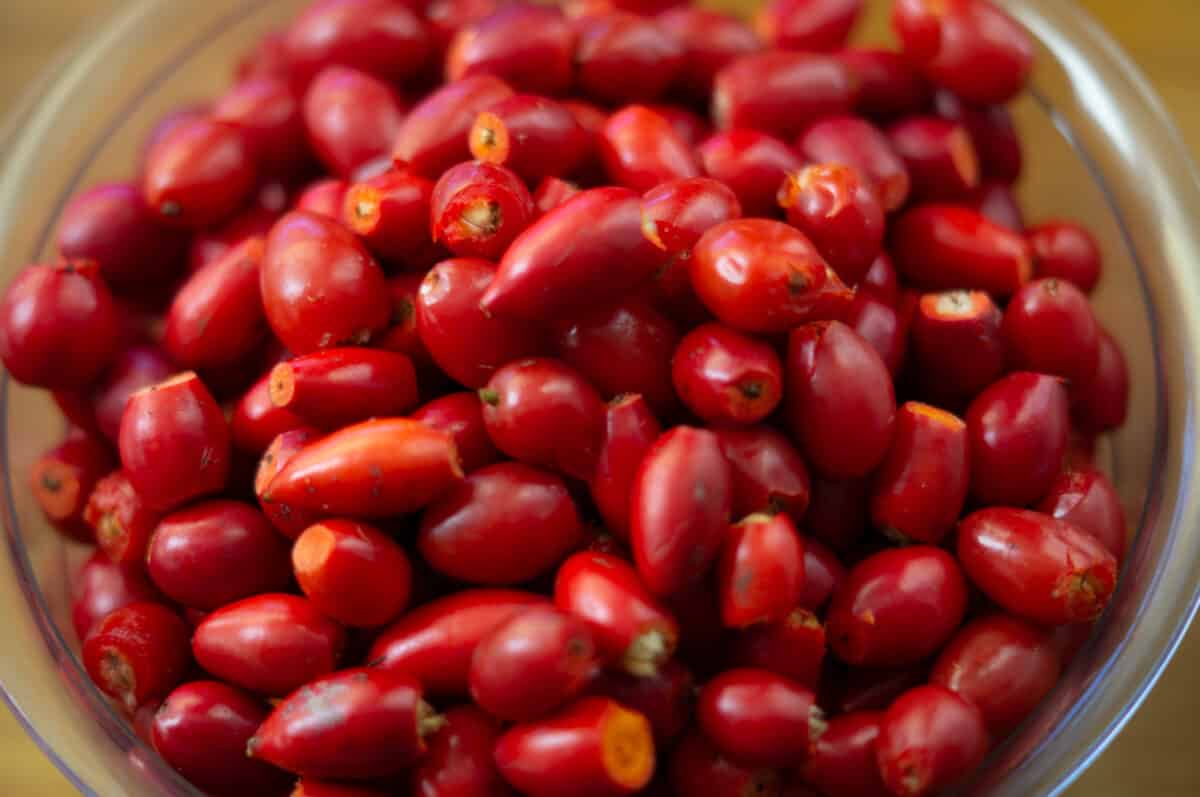
Rosehips: wash, remove the flower end and stalk, then leave to dry.
-
2
Freeze the rosehips.
Place the rosehips in freezer bags and freeze for at least 48 hours. This converts bitter compounds and tannins into sugars, and the flesh becomes much softer.
-
3
Cook the rosehips.
Add the thawed rosehips and water to the mixing bowl, cook for 45 min / 95°C / speed 1, then chop for 5 sec / speed 5.
-
4
Sieve the rosehips.
Press the rosehips through a fine sieve in several batches to remove the seeds. Add the resulting rosehip pulp to the mixing bowl together with the apple juice and cinnamon stick.
-
5
Cook the jam.
Wash the lemon in hot water, finely grate about 1 tsp of zest, squeeze the juice, add both to the mixing bowl with the jam sugar, and cook for 15 min / 95°C / reverse direction / speed 1.
-
6
Jar the jam.
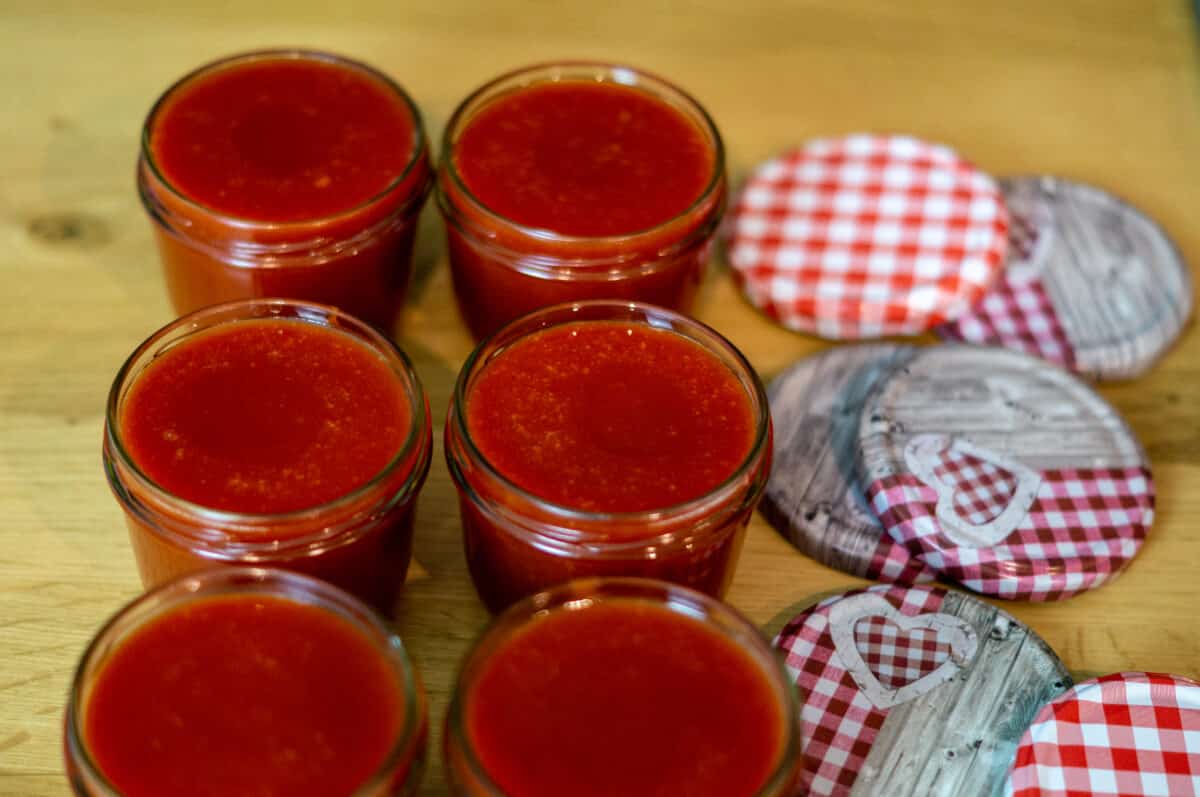
Remove the cinnamon stick. Do a setting test, fill into sterilised jars and leave upside down for 5 minutes.
Tip: Replace the apple juice with orange juice and you have a lovely rosehip and orange jam.
Video
Nutrition per serving
The 48-hour freeze trick: why it is not optional
Fresh rosehips contain bitter compounds and tannins that make the jam astringent and unbalanced. Freezing breaks down the cell walls, enzymes convert some of the bitter compounds into sugar, and the flesh becomes beautifully soft. This step is the main difference from quicker community versions that skip it and are then much harder to press through a sieve.
If you are in a hurry: 24 hours will do at a pinch. Less than 24 hours brings hardly any benefit. If you buy the berries ready-frozen from a health food shop, use them straight away as the freezing is already done.
Preparing rosehips: removing the flower end and stalk
Before the rosehips go into the mixing bowl, you need to remove the flower end (the small black cap) and the stalk. We use a small paring knife or sharp scissors. About 5 seconds per berry. With 1,300 g (roughly 400 to 500 berries), count on around 30 to 40 minutes of prep.
Tip: make the prep a family activity with tea and music. It turns a chore into a pleasant autumn ritual. If you want to save the prep time, unprepped rosehips work too, but you will need to press through the sieve twice instead of once, as the caps end up in the pulp.
45 minutes at 95°C: why not 100°C
After thawing, 1,300 g of rosehips go into the mixing bowl with 800 g of water for 45 minutes at 95°C on speed 1. At 100°C the jam would foam and the aroma would be driven off. 95°C is the sweet spot: hot enough to soften the rosehips, but gentle enough to keep the flavours intact.
Afterwards, blend roughly for 5 seconds at speed 5, then press through a fine sieve. This is the most time-consuming step (around 15 minutes), but it is essential. The seeds are hard and covered in tiny hairs that can cause skin irritation, which is why rosehips are sometimes known as the itching-powder berry.
Apple juice, cinnamon, and lemon: three flavour boosters
In the second stage, 250 g of apple juice, 1 cinnamon stick, and 1 lemon (zest and juice) join the rosehip pulp. The apple juice provides natural pectin, which helps the jam set. Cinnamon adds a warm wintery note that pairs beautifully with rosehip. The lemon activates the pectin in the jam sugar.
Plus 500 g of 2:1 jam sugar. We use 2:1 (not 1:1) because the apple juice and rosehips together provide enough pectin that less sugar is needed. With 1:1 jam sugar the result would be too sweet and the rosehip flavour would be masked.
The uncooked version: cold-stirred rosehip paste
A southern German tradition (also called Hagenmark or Hagenbuttenmark) skips cooking entirely. The prepared and sieved rosehips are stirred cold with jam sugar and bottled immediately. The advantage: maximum vitamin C retention (rosehips contain 400 to 1,500 mg of vitamin C per 100 g, BLE data 2024). The drawback: it keeps for only 4 weeks, compared with 1 year for the cooked version.
If you try the cold-stirred version, use only fresh pulp and eat or give it away promptly. Traditionally, rosehip paste is served on gingerbread or alongside venison.
What to serve with rosehip jam
Classic with game (venison, red deer, wild boar) as a sweet and tangy contrast. Also great on fresh bread, in buttermilk pancakes, or as a filling for jam biscuits. As a glaze for cheesecake or as a topping for crepes. On gingerbread at Christmas as a southern German tradition. With vanilla ice cream as a quick winter topping.
If you are looking for more pancake ideas, our best pancakes with the Thermomix® are the perfect base for this jam.
Rosehip jam keeps for 1 year with proper sterilisation
Fill into sterilised jars while still hot and seal immediately. Leaving the jars upside down for 5 minutes creates the vacuum that extends the shelf life to up to 12 months stored in a cool, dark place. Once opened, keeps for 4 weeks in the fridge.
If you cannot fill a jar completely, use smaller jars or freeze the remainder. Rosehip pulp (before adding jam sugar) can also be frozen separately and turned into jam in spring with jam sugar. That way you can enjoy rosehip jam outside of season.
Also pairs well with: cream cheese, butter, and vanilla ice cream.