Sambal Oelek from the Thermomix® takes 40 minutes and lets you control the heat yourself. We toast the chilli flakes at Varoma before grinding them, and build the typical Indonesian depth with lemongrass.
Sambal Oelek belongs on our table whenever we cook Asian food. The paste from a jar tastes flat to us, and the heat cannot be adjusted. We now make Sambal every few weeks ourselves and adjust the chilli flake quantity as needed.
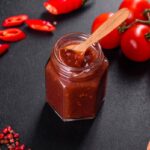
Sambal Oelek Chilli Paste with the Thermomix®
Ingredients 0 / 10 ✓
- 25 g chilli flakes
- 1 tsp salt
- 3 onion
- 3 garlic cloves
- 20 g ginger
- 3 stalks lemongrass
- 80 g rapeseed oil + a little extra for covering
- 100 g cherry tomatoes
- 10 g sugar
- 40 g apple cider vinegar
Instructions 0 / 9
-
1
Toast the chilli flakes.
Add the chilli flakes to the mixing bowl and toast for 3 min / Varoma / speed 2.
-
2
Grind the spices.
Add the salt and grind for 1 min / speed 8.
-
3
Add the vegetables.
Peel and halve the onions, peel the garlic, peel the ginger and cut the lemongrass into pieces, removing the outer leaves. Add the onion, ginger, garlic and lemongrass to the mixing bowl, chop for 8 sec / speed 6 and scrape down with the spatula.
-
4
Steam.
Add the oil and cook for 5 min / Varoma (120°C) / speed 1.
-
5
Prepare the tomatoes.
Meanwhile wash the tomatoes, quarter them and remove the stalks.
-
6
Cook the tomatoes.
Add the sugar and tomatoes and cook for 2 min / Varoma (120°C) / speed 1.
-
7
Blend.
Add the vinegar, blend for 40 sec / speed 8 and scrape down with the spatula.
-
8
Cook the chilli paste.
Cook the mixture without the measuring cup for 15 min / 100°C / speed 1.
-
9
Fill into jars.
Fill the paste into sterilised jars, cover with oil, seal and store in the fridge.
Tips:
- You can use your Sambal Oelek for cooking, in sauces and dips, or spread it straight onto baguette.
- Store the paste in the fridge covered with oil, and top it up with a little oil after each use. This way the Sambal Oelek keeps for at least one month.
Video
Nutrition per serving
Why toast the chilli flakes before grinding
The first step is the most important: 25 g chilli flakes go into the mixing bowl alone and are toasted for 3 minutes at Varoma on speed 2. Only then does the salt go in, and we grind for 1 minute at speed 8.
Toasting releases the essential oils in the dried chillies. Without this step, the Sambal stays one-dimensionally hot. With toasting, smoky notes and an aromatic depth develop that European chilli oil simply does not have. The difference is noticeable in the very first spoonful.
If you grind straight away, you get hot powder. If you toast first, you get Indonesian Sambal.
Lemongrass is not an optional extra
After toasting and grinding, in go the aromatics: 3 onions, 3 garlic cloves, 20 g ginger and 3 stalks of lemongrass. We remove the outer leaves of the lemongrass, cut the rest into pieces and chop everything together with the other aromatics for 8 seconds at speed 6.
Lemongrass provides the citrusy freshness and distinguishes Sambal Oelek from a plain chilli paste. Without lemongrass the paste becomes heavy and one-dimensional. With lemongrass it gains lift and balance against the heat.
Fresh lemongrass is available at Asian grocery shops or well-stocked supermarkets. Frozen lemongrass works too, but the flavour is weaker.
Steaming builds flavour, cooking sets it
We cook the chopped aromatics for 5 minutes at Varoma (TM5/TM6: 120°C) at speed 1 with 80 g rapeseed oil. Then 100 g cherry tomatoes and 10 g sugar go in and cook for a further 2 minutes. After that, add 40 g apple cider vinegar and blend for 40 seconds at speed 8.
The final stage: cook for 15 minutes at 100°C at speed 1 without the measuring cup. The open lid allows moisture to evaporate, the paste thickens and gains body. If we leave the measuring cup in, the consistency stays too thin.
Cherry tomatoes bring umami and a balance of acidity. The sugar rounds out the heat without making the paste sweet. Apple cider vinegar at the end preserves and lifts the flavours.
Oil covering keeps Sambal fresh for a month
After cooking, we fill the Sambal hot into sterilised jars and cover the surface with a thin layer of rapeseed oil. The oil seals the paste airtight and prevents mould from forming.
After each use, we add a little more oil on top. This way our Sambal keeps for at least one month in the fridge. Without the oil covering, the paste dries out on the surface and turns rancid after about 2 weeks.
We sterilise the jars for 5 minutes in boiling water. The lids go in at the same time. Cleanliness is the critical factor for shelf life when making your own paste.
Controlling heat through the chilli flake quantity
The recipe with 25 g chilli flakes delivers medium heat. For a milder result, reduce to 15 to 20 g. For a hot Sambal, we go up to 30 to 35 g.
The other ingredients stay the same. They carry flavour, not heat. More or less lemongrass changes the character but not the intensity.
Our standard is 25 g for Asian stir-fry and wok recipes. As a dip with vegetables or meat we use the milder 15 g version.
How we use Sambal
Sambal Oelek seasons our Asian chicken, Asian vegetable rice and Peking soup. We add 1 to 2 tsp directly to the pan or stir it into sauces.
As a dip, we spread Sambal straight onto baguette or mix it 1:1 with crème fraîche. We serve it in small bowls alongside grilled meat or steamed fish.
The paste also works in non-Asian dishes. 1 tsp in a tomato sauce or chilli con carne lifts the flavours without overpowering heat.
What other recipes do differently
Other recipes start with fresh red chilli peppers, which are simply hot. We use dried chilli flakes and toast them, which creates smoky notes and real depth instead of flat heat. Most versions leave out garlic and ginger or make them optional. In our recipe both are essential, because they carry the Indonesian aromatics. Apple cider vinegar gives a rounder acidity than lemon juice, which makes the heat feel sharp and edgy. For a Sriracha-style version, add 20 g extra sugar and 1 tbsp soy sauce. The oil layer in the jar gives us one month of shelf life; without an oil covering it is only two weeks.
More Asian basic recipes: Asian chicken, Asian vegetable rice, Peking soup.