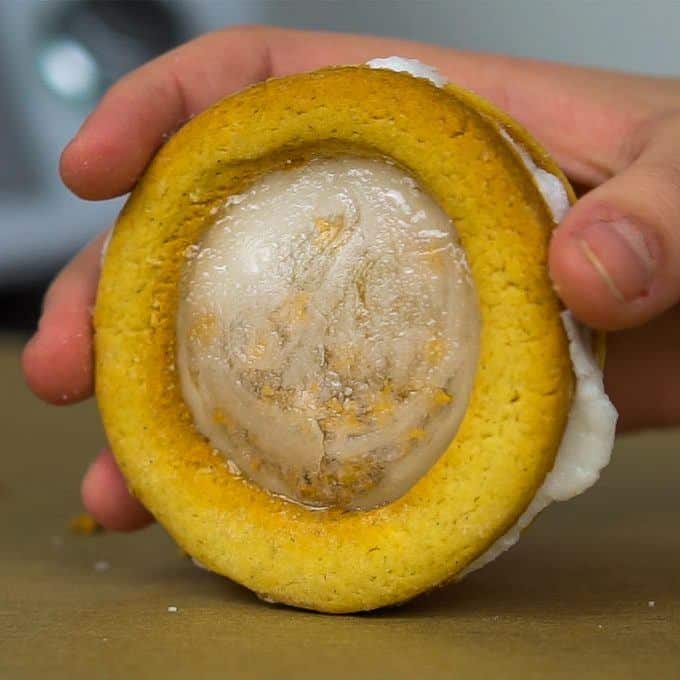
Rattling cookies made in the Thermomix® are biscuits with a clear sugar glass window and a loose filling inside. The pearls or stars rattle when you shake them. We bake these every year at Christmas and know by now exactly where the line is: 12 minutes at 120°C is the sweet spot for the sugar syrup. Any less and the glass stays too soft and runs out when you add the filling. Any more and it becomes so hard that it cracks on the first shake. The 2 mm depth is not a decorative choice but a matter of physics: thinner and the filling does not hold, thicker and the glass breaks during transport.
The recipe has three parts: baking the shortcrust rings, pouring the sugar glass, and sticking everything together with royal icing. The Thermomix® makes the dough in 4 minutes and cooks the syrup to exactly the right consistency. Without precise temperature control, the syrup ends up either too runny or caramelised.
Shaka Shaka Rattling Cookies with the Thermomix®
Ingredients 0 / 13 ✓
- 100 g butter soft, at room temperature
- 90 g sugar
- 1 pinch salt
- 1 egg
- 10 g milk
- 200 g flour
- 1/2 tsp ground cinnamon
- 140 g water
- 50 g sugar
- sugar pearls or stars
- 1 egg white
- 1 tsp lemon juice
- 350 g icing sugar
Instructions 0 / 10
-
1
Cream the butter and sugar.
Add butter and sugar to the mixing bowl and cream for 1 minute / speed 4.
-
2
Add salt, egg and milk.
Add salt, egg and milk and mix for 30 seconds / speed 4.
-
3
Knead the dough.
Add flour and cinnamon, mix for 30 seconds / speed 5, then knead for 2 minutes / kneading mode.
-
4
Chill the dough.
Wrap the dough in cling film and place in the fridge for 1 hour. Meanwhile, line a baking tray with baking paper.
-
5
Roll out the dough and cut out rings.
Roll out the dough on a lightly floured surface to about 0.5 cm thick and cut out circles using two glasses of different sizes. Preheat the oven to 180°C.
-
6
Bake the rings.
Place the rings on the baking tray and bake for 7 minutes. (Keep a close eye on them so they do not get too dark.)
-
7
Cook the sugar syrup.
Add water and sugar to the mixing bowl and cook for 12 minutes / 120°C / speed 1.
-
8
Pour the sugar syrup into the rings.
Pour the thick sugar syrup about 2 mm deep into the rings and leave to set in the fridge.
-
9
Mix the icing.
Meanwhile, add the icing ingredients to the mixing bowl and mix for 10 seconds / speed 8.
-
10
Fill the rings.
Spread the icing around the edge of one ring, fill with pearls, stars or other edible decorations, then place a second ring on top and press down gently. Repeat with the remaining rings and leave to dry.
Video
Nutrition per serving
Why 12 minutes at 120°C for the syrup
The sugar syrup made from 140 g water and 50 g sugar needs to become thick enough to set firm once poured into the biscuit rings, but not so hard that it shatters. We cook it for 12 minutes at 120°C at speed 1. That is the threshold for the right viscosity.
At 10 minutes the syrup stays too thin. It runs straight out the bottom when you add the pearls and sticks to the baking paper. At 14 minutes it becomes too concentrated and starts to caramelise. The glass turns amber instead of clear and cracks on the first shake.
The 120°C is essential. At 100°C only the water evaporates, but the sugar does not dissolve completely and the syrup stays watery. Speed 1 ensures the syrup cooks evenly without sugar crystals forming around the edges.
The 2 mm rule when pouring
We pour the syrup directly after cooking into the cooled biscuit rings. 2 mm depth is the optimum. We tested different depths: at 1 mm the glass tears when you lift it off the baking paper. At 3 mm it becomes too thick and cracks when shaken.
The syrup must still be hot when you pour it, at least 90°C. Otherwise it starts to set in the spoon and cannot be spread evenly. We place the biscuit rings on baking paper and pour the syrup into the centre of each hole. It spreads out on its own to the edges.
In the fridge the glass sets in 20 minutes. At room temperature it takes 2 hours. The glass must be completely firm before we add the pearls. If it is still sticky, the pearls will cling to the surface instead of rolling freely.
Shortcrust rings: why 1 hour in the fridge
The dough made from 100 g butter, 90 g sugar, 1 egg, 200 g flour and half a teaspoon of cinnamon is ready in the Thermomix® in 4 minutes. 1 minute at speed 4 to cream the butter and sugar, 30 seconds at speed 4 for the egg and milk, 30 seconds at speed 5 to combine, 2 minutes on kneading mode.
We wrap the dough in cling film and chill it for 1 hour. This is not optional, it is essential. Warm dough sticks to the work surface when rolled out and cannot be cut cleanly. The butter must firm up, otherwise the biscuit rings spread in the oven.
We roll the dough out to 5 mm thick. Thinner rings break when lifted off the baking tray, thicker ones do not bake evenly. Using two glasses of different sizes (roughly 7 cm diameter for the outer cut and 5 cm for the inner) we cut out the rings. The rings bake for 7 minutes at 180°C, top and bottom heat. Longer and they go too dark, shorter and they stay too soft.
Royal icing: egg white rather than water
The royal icing holds the two biscuit halves together. We mix 1 egg white, 1 tsp lemon juice and 350 g icing sugar for 10 seconds at speed 8. The icing needs to be thick enough not to run out from between the biscuits, but fluid enough to spread.
Egg white is the base, not water. Water-based icing dries too slowly and stays tacky. Egg white icing sets in 30 minutes and keeps the biscuits firmly together. The lemon juice stops the egg white from coagulating and gives the icing a shine.
We spread a thin layer of icing around the edge of one ring, place 5 to 10 sugar pearls or stars inside and set the second ring on top. Press gently but do not squeeze, otherwise the icing runs into the centre and glues the filling in place. The biscuits need to dry for at least 1 hour before being transported or packaged.
Which fillings work
Sugar pearls and sugar stars are the classic filling. They are small enough to move freely but large enough to make a sound when shaken. We use 5 to 10 pieces per biscuit. More and they block each other, fewer and you cannot hear them.
Not suitable: chocolate buttons (they melt at room temperature and stick to the glass), nonpareils (too small, no sound), chopped nuts (absorb moisture and go soft), sugar strands (stick together).
Edible glitter stars work, but only if they are made from hardened sugar. Glitter on a gelatine base sticks to the glass. We test this with one biscuit first: if the filling still rolls freely after 10 minutes, it is good to use.
Storage and transport
Shaka Shaka rattling cookies keep for 3 weeks in a tin at room temperature. The sugar glass is hygroscopic and draws in moisture. Left in an open bowl it goes soft and cloudy after 2 days. In an airtight tin it stays clear and firm.
When transporting, place baking paper between the biscuits. Without paper the biscuits knock against each other and the glass cracks. The biscuits are sturdy enough to post, but the tin must be well padded.
Freezing does not work. The sugar glass goes cloudy and sticky when defrosted and the filling gets stuck. The biscuits cannot be prepared ahead without the filling either: the glass must be freshly poured, otherwise it sets too hard and breaks when you press the halves together.
Goes well with: coffee and milk.
More biscuits with the Thermomix®: chocolate peanut cookies, vanilla crescents, walnut biscuits. All shortcrust recipes: shortcrust pastry in the Thermomix®.