Vanilla kipferl are not biscuits that happen to end up crescent-shaped by chance. Anyone who rolls them round is doing it wrong. The shape is not decoration, it is technique: the tapered ends of the crescent bake through more slowly than the centre, giving the biscuit its characteristic, delicate crumbliness at the tips. That is precisely why spelt flour type 630 combined with freshly ground almonds is a better starting point than plain wheat flour.
The quick summary for the Thermomix®: Pulverise 80 g sugar plus 1 tbsp vanilla sugar for 15 seconds at speed 10 to make vanilla icing sugar and set aside. Grind 50 g blanched almonds for 20 seconds at speed 10. Add 30 g of the vanilla icing sugar, 80 g spelt flour type 630 and 70 g cold butter, knead for 2 minutes on kneading mode. Chill the dough for 30 minutes, divide into three logs, cut into 3 cm pieces, shape into crescents and bake at 160°C top and bottom heat (fan 140°C) for about 20 minutes on the middle shelf. Roll in the remaining vanilla icing sugar while still warm. Makes about 30 pieces.
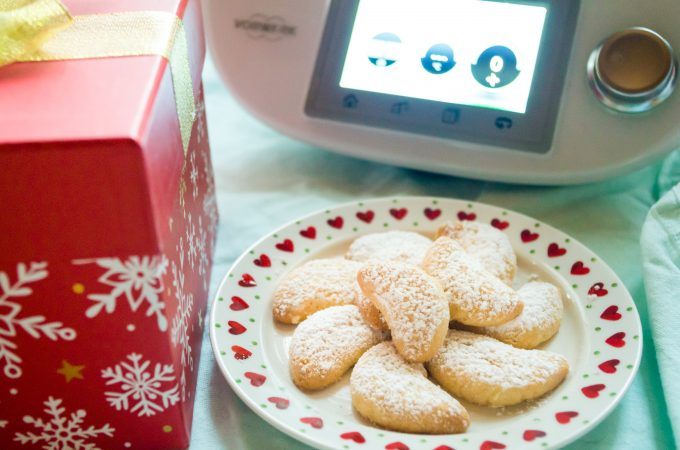
The difference compared with classic wheat kipferl: spelt flour 630 absorbs less liquid than wheat flour 405, so the dough stays workable after just 30 minutes of chilling without becoming sticky. You grind the 50 g of almonds directly in the mixing bowl at speed 10 for 20 seconds, which brings out far more flavour than shop-bought ground almonds. The result is kipferl that stay softer to bite than doughs made with pure wheat flour.
Spelt and Almond Vanilla Kipferl, Thermomix®

Ingredients 0 / 5 ✓
- 80 g sugar
- 1 tbsp vanilla sugar
- 50 g blanched almonds
- 80 g spelt flour, type 630
- 70 g butter cold
Instructions 0 / 6
-
1
Pulverise the sugar.
Add sugar and vanilla sugar to the mixing bowl, pulverise for 15 sec / speed 10 and set aside.
-
2
Grind the almonds.
Add almonds to the mixing bowl and grind finely for 20 sec / speed 10.
-
3
Knead the dough.
Add 30 g of the vanilla icing sugar, flour and butter and mix for 2 min / kneading mode. Chill the dough for 30 minutes.
-
4
Shape the dough.
Divide the dough into three equal portions, roll each into a log about 1 cm thick, cut into 3 cm pieces, shape into crescents and place on a baking tray lined with baking paper.
-
5
Bake the kipferl.
Preheat the oven to 160°C top and bottom heat (fan 140°C, gas mark 2) and bake the kipferl for approximately 20 minutes on the middle shelf, keeping an eye on them. The kipferl should not turn dark.
-
6
Roll the kipferl in icing sugar.
Roll the still-warm kipferl in the remaining vanilla icing sugar.
Video
Nutrition per serving
Why cold butter and spelt flour are the key
Many kipferl recipes start with room-temperature, softened butter. We do the opposite and add the 70 g butter straight from the fridge to the mixing bowl. The reason: shortcrust becomes short because cold butter coats the flour and slows gluten development. If the butter warms up during kneading, it combines too strongly with the flour and the biscuits turn hard instead of tender.
This is where the Thermomix® shows its decisive advantage. The kneading mode works without any heating function, so the dough is ready in 2 minutes without any warmth being added. Doing this by hand takes considerably longer, and the heat from your hands softens the butter. That is the one point where the machine genuinely makes a difference in this recipe.
Spelt flour type 630 is a deliberate choice here and not simply a health consideration. Spelt has a different gluten structure to wheat and absorbs less water. In a pure shortcrust without egg, as with these kipferl, that means less risk of the dough becoming tough from too much binding. Combined with freshly ground almonds, the result is the nutty, crumbly bite this recipe is made for.
The most common pitfalls with kipferl dough
The dough is sticky and won’t hold its shape
This is the most common frustration. Most of the time it is not caused by too little flour but by butter that is too warm or insufficient chilling time. If you cut the 30 minutes short, you end up wrestling with a sticky mass when shaping, and the crescents fray at the ends.
Our solution: Use the butter ice-cold, never at room temperature. If the dough is still sticky after chilling, put it back in the fridge for another 30 minutes, or a full hour if the kitchen is warm. Never simply add more flour, as that makes the kipferl dry and floury.
The dough crumbles and falls apart
The opposite of sticky dough. If the mixture crumbles when you try to shape it, the dough was usually kneaded for too long so the butter turned warm and greasy, or the almonds were ground too coarsely. Too much flour also causes this.
Our solution: Stick to the 2 minutes on kneading mode, no longer. If the dough still crumbles after chilling, press it together briefly with cool hands as the residual warmth is often enough. If it keeps splitting, work in a scant teaspoon of cold water, not an egg, otherwise the shortness of the dough will change.
The kipferl turn too dark
Vanilla kipferl should be only cream-white to the faintest golden colour, never brown. If they turn too dark, they lose their typical crumbliness and taste dry.
Our solution: Bake at 160°C top and bottom heat on the middle shelf, keeping a close eye on them. Start checking from minute 18 onwards, because the thin ends brown first. It is better to take them out a little early as the kipferl firm up as they cool on the tray.
The icing sugar won’t stick
Anyone who waits until the kipferl are completely cold will be disappointed: the vanilla icing sugar simply trickles off and does not adhere.
Our solution: Roll the kipferl in the remaining vanilla icing sugar while they are still warm but not hot. At this point the sugar melts slightly and bonds with the surface. That is exactly why we make the icing sugar generously when pulverising and keep the rest back for this step.
How to get the true crescent shape right
We divide the dough into three equal portions, roll each into a log about 1 cm in diameter and cut off 3 cm pieces. Then shape each piece with both hands so that the centre stays wider and the ends taper to a point. That is the difference between a round biscuit and a true kipferl: the thin tips give the characteristic, almost melting bite.
Work quickly and with cool hands. If you shape slowly, the dough warms up and the kipferl lose their form during baking. If your kitchen is warm, take only one third of the dough out of the fridge at a time and keep the rest chilled. Anyone who wants uniform pieces can use a kipferl mould, but they turn out just as well by hand and look more individual.
Variations we have tested
With a real vanilla pod: Instead of only vanilla sugar, knead the seeds from half a vanilla pod into the dough. This gives a noticeably more intense, rounded vanilla flavour. Keep the vanilla sugar for the icing sugar coating all the same.
Hazelnuts instead of almonds: Replace the 50 g blanched almonds with shelled hazelnuts and grind them in the same way, 20 seconds at speed 10. This makes the kipferl richer and more wintry in flavour, and they go well with mulled wine.
Larger batch for gifting: Double all the ingredients and the recipe yields about 60 kipferl. The mixing bowl of the Thermomix® handles the quantity without any trouble and the kneading time stays at 2 minutes. Handy for filling biscuit tins or giving as a gift.
Vegan version: The recipe already contains no egg. Anyone baking entirely plant-based can replace the butter with a firm plant-based baking fat, also used cold. The cold processing remains the key point here as well.
Biscuits that fit in the same tin
If you are planning several varieties for Christmas baking, the kipferl pair well with other classic shortcrust biscuits. Our Walnut Biscuits with the Thermomix® continue the nutty theme, our Colourful Christmas Butter Biscuits add colour to the plate, and the Chocolate Biscuits are the contrast for anyone who wants something chocolatey.
Anyone who wants to keep an overview of several shortcrust recipes will find a selection in our shortcrust hub. You can also make the vanilla icing sugar for the coating in advance, and the instructions are in our post on making vanilla sugar in the Thermomix®.
How long the kipferl and the dough stay fresh
Stored in a well-sealing biscuit tin in a cool, dry place, the finished kipferl keep for about three weeks. It is important that they are completely cooled before going into the tin, otherwise residual moisture will make them soft. A sheet of baking paper between the layers prevents the icing sugar from sticking together.
You can prepare the dough up to three days in advance and store it wrapped in cling film in the fridge. Let it come to room temperature briefly before shaping so it rolls without cracking. Frozen, the raw dough keeps for up to three months. To bake, leave it to thaw overnight in the fridge and then continue as normal.
Frequently asked questions about spelt vanilla kipferl
Does the recipe work in the TM31, TM5® and TM6®?
Yes, identically in all three models. The pulverising (15 seconds, speed 10), grinding the almonds (20 seconds, speed 10) and kneading (2 minutes, kneading mode) all work the same way. No heating function is required, so there is no difference between models.
Can I use wheat flour instead of spelt flour?
Yes, it works with wheat flour type 405 as well. Because wheat absorbs more liquid, the dough may be slightly softer. In that case, simply chill it for 5 to 10 minutes longer. The slightly nutty spelt note is missing in terms of flavour, but it works just as well technically.
Why grind the almonds yourself instead of buying ground ones?
Freshly ground almonds have noticeably more flavour because the essential oils have not yet oxidised. Grinding 50 g blanched almonds for 20 seconds at speed 10 gives exactly the right fineness. Shop-bought ground almonds often sit on the shelf for weeks and taste flatter.
Do vanilla kipferl need an egg?
No. This recipe works without egg, and the cold butter alone provides the binding. That makes the dough particularly crumbly and at the same time suitable for vegetarians, or vegan if you use a plant-based baking fat. An egg would make the kipferl firmer.
How long does the dough need to chill?
At least 30 minutes in the fridge. During this time the butter firms up again and the dough can be shaped cleanly. If the kitchen is warm or the dough is still sticky, 60 minutes is better. Too long does no harm, as a very cold dough just needs a brief moment on the work surface before it rolls out.
How many kipferl does the recipe make?
Goes well with: Coffee and mulled wine.
The quantities given make about 30 pieces. For a full biscuit tin or to give as a gift, simply double all the ingredients to get about 60 kipferl with the same kneading and baking time.
If you are looking for more Christmas baking ideas, take a look at our shortcrust hub or try our Walnut Biscuits with the Thermomix®.