Spelt absorbs more water than wheat. That sounds like a minor detail, but it is exactly why many spelt baguettes turn out dry and dense: the recipe was simply copied 1:1 from a wheat flour version. Our recipe corrects that. The combination of 150 g spelt flour and 350 g wheat flour needs exactly 220 g of water to keep the dough smooth and allow the baguettes to rise properly in the oven. The Thermomix® kneads it all together in 3 minutes on kneading mode.
Spelt Baguette with the Thermomix®
Ingredients 0 / 7 ✓
- 1/2 cube fresh yeast
- 50 g olive oil
- 220 g water
- 1 pinch sugar
- 1 tsp salt heaped
- 150 g spelt flour, type 630
- 350 g plain flour, type 405
Instructions 0 / 6
-
1
Dissolve the yeast.
Add yeast, oil, water, sugar and salt to the mixing bowl and heat for 3 minutes / 37°C / speed 1.
-
2
Knead the dough.
Add spelt flour and wheat flour and knead for 3 minutes / kneading mode until you have a smooth dough.
-
3
Leave to prove.
Transfer the dough to a bowl and leave to prove, covered, in a warm place for 1 hour.
-
4
Shape and prove again.
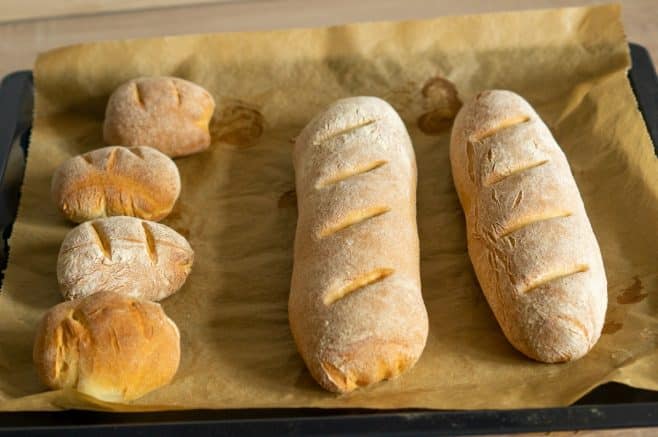
Line a baking tray with baking paper. Divide the dough into three pieces, shape into baguettes or rolls and place on the tray. Cover with a kitchen cloth and leave to prove for 30 minutes.
-
5
Preheat the oven.
Meanwhile, preheat the oven to 200°C top and bottom heat.
-
6
Bake.
Bake the baguettes and rolls for approx. 20 minutes on the middle shelf of the oven.
Tip: Adjust the flour quantities to your taste.
Video
Nutrition per serving
Flour mix: why 150 g of spelt and not more
Pure spelt flour makes baguette dough more temperamental. Spelt gluten is more delicate than wheat gluten and tears more easily if the dough is kneaded for too long or too roughly. The gluten structure then collapses, and the dough barely rises. The wheat content stabilises it. With 150 g spelt flour type 630 and 350 g wheat flour type 405, you get the nutty spelt flavour without the typical spelt baking problems.
If you want to increase the spelt content, you need to add proportionally more water: around 10 g more water for every extra 50 g of spelt flour. This is exactly where many standard recipes fail because they do not adjust the water ratio.
37°C: why the Thermomix® is more precise than your hand
First, the Thermomix® warms the yeast, olive oil, water, sugar and salt to exactly 37°C. This is the temperature at which yeast is most active. Too cold and the yeast works sluggishly. Too hot and it dies. Hitting the right temperature by hand is a trap that almost everyone falls into at some point. The Thermomix® holds the temperature precisely. It then kneads the dough for 3 minutes on kneading mode, which is the equivalent of 10 to 15 minutes by hand.
After kneading, spelt dough is naturally slightly sticky. This is not a mistake. Damp hands when shaping the dough help more than adding extra flour, which dries out the surface and makes the crust patchy later.
Two proving times and why you should not cut them short
The recipe calls for 60 minutes proving time after kneading, then a further 30 minutes after shaping. If you cut the first phase short, you lose flavour. During the first hour, the yeast produces carbon dioxide and at the same time the flavour compounds that give the baguette its taste. The second proving time ensures that the shaped loaves rise again in the oven. Skip this phase and you end up with flat, dense baguettes.
Cover the dough with a damp kitchen cloth so the surface does not dry out. A good spot is the oven with just the light switched on. This reliably gives around 30°C. Above 40°C the yeast will be damaged.
Steam in the oven for the crust
The crust determines the final result. The trick: place a heatproof dish of hot water on the oven floor before you slide the baguettes in. The steam keeps the dough surface moist during the first few minutes of baking. The baguette continues to expand before the crust sets. Once the steam evaporates, the characteristic crispy outer crust forms. In the last 5 minutes you can open the oven door a crack to speed up crust formation.
The cuts on the top are not just decorative: they allow steam to escape in a controlled way so the loaves rise evenly.
Overnight option: more flavour with less effort
If you want fresh baguettes in the morning: prepare the dough in the evening and leave it covered in the fridge overnight. The cold fermentation produces more flavour compounds than the quick room-temperature version. Professional bakers use exactly this technique. In the morning, let the dough acclimatise for 30 minutes, then shape it, leave it to rest for another 20 minutes and bake. You do not need more active time, just more passive waiting time.
We use the same approach for our Tomato Focaccia with the Thermomix®: yeast dough overnight, ready the next day in under 30 minutes.
Compatibility: TM31, TM5, TM6 and TM7
This recipe uses 500 g of flour in total. On the TM5, TM6 and TM7 this runs without any restriction. The TM31 is still within the safe range at 500 g (safe up to 500 g, Vorwerk maximum 700 g). Keep an eye on the dough consistency during kneading. The yeast activation at 37°C works identically on all four models.
If you regularly bake yeasted goods with the Thermomix®: the Pretzel Rolls with the Thermomix® follow the same kneading principle, but the crust is created by a bicarbonate of soda bath before baking.
Which bread suits which baking situation? Bread with the Thermomix® sorted by occasion and proving time.
Goes well with: Butter and cheese.
Also worth trying: Olive and Tomato Bread with the Thermomix®.