Heart cakes made with the Thermomix® are a sponge bake with one key difference: We whip the eggs with hot water for 5 minutes at speed 4 until light and fluffy. The hot water helps the egg white structure to whip up more stably, making the batter airier than a classic butter cake. The result is light, airy little cakes that stay soft inside and form a thin crust on the outside.
The preparation takes 50 minutes from start to finish. The Thermomix® handles the milling of the icing sugar (10 seconds, speed 10) and the whipping of the egg mixture with the butterfly whisk. The batter is then poured into silicone moulds and baked in the oven at 180°C top and bottom heat for 20 to 25 minutes.
Valentine Heart Cakes with the Thermomix®

Ingredients 0 / 10 ✓
- 10 g Butter
- 250 g sugar
- 5 eggs
- 2 tbsp hot water
- 1 sachet vanilla sugar
- 150 g flour (Type 550)
- 1 tsp baking powder
- 80 g jam
- 2 tbsp amaretto
- 2 tbsp lemon juice
Instructions 0 / 6
-
1
Mill the icing sugar.
Preheat the oven to 180°C top and bottom heat. Grease the silicone mould with butter. Place 50 g of sugar in the mixing bowl and mill for 10 seconds / speed 10, then set aside.
-
2
Whip the eggs until fluffy.
Insert the butterfly whisk, add the eggs and hot water to the mixing bowl and whip for 5 minutes / speed 4 until light and fluffy. While mixing, gradually pour in the sugar and vanilla sugar through the mixing bowl lid.
-
3
Mix the batter.
Mix the flour and baking powder together, add to the bowl and mix for 10 seconds / speed 3.
-
4
Bake the cakes.
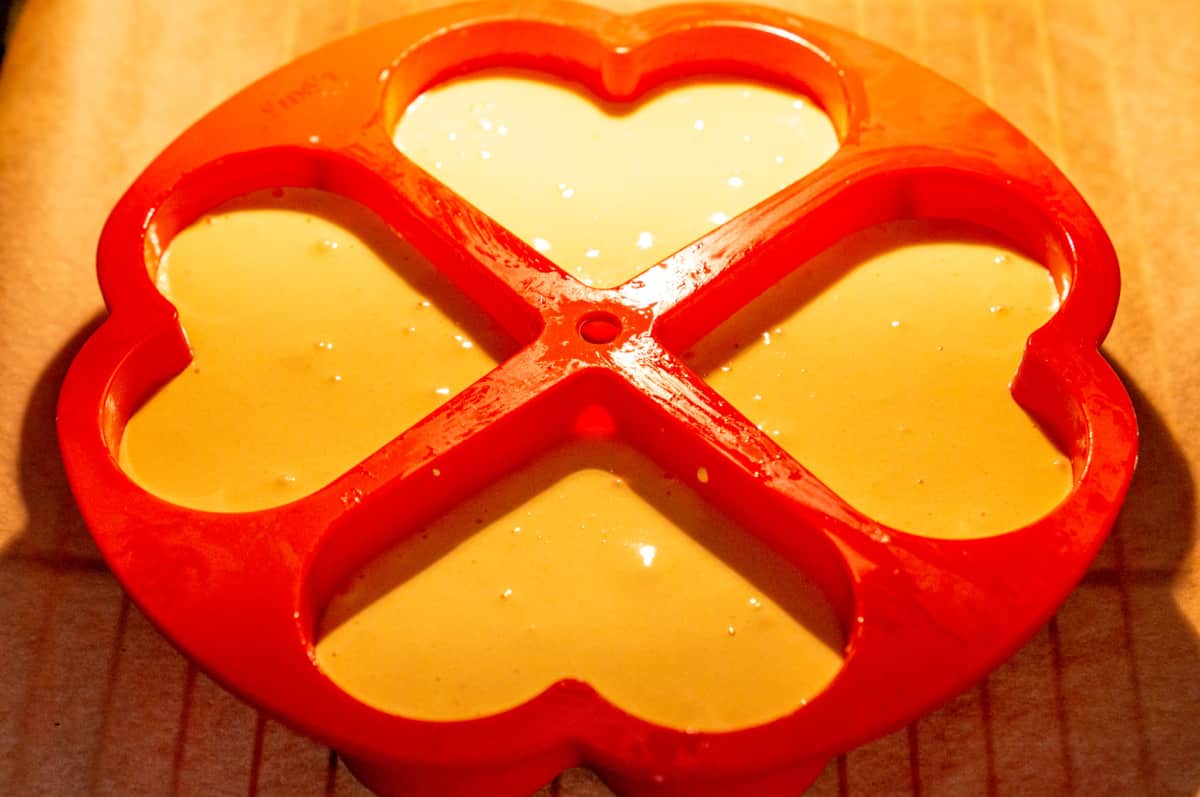
Distribute the batter evenly into the heart-shaped moulds and bake on the middle shelf of the oven for approximately 20 to 25 minutes.
-
5
Spread the heart cakes with jam.
Carefully remove the heart cakes from the mould and leave to cool. Stir the jam together with the amaretto until smooth, slice the heart cakes in half horizontally, spread one half with jam and press back together.
-
6
Decorate the heart cakes.
Mix the icing sugar with lemon juice and food colouring, then spread over the heart cakes. Leave to dry before serving.
Tip: When it comes to decorating your heart cakes, there are no limits to your imagination. You can also use sugar pearls, sugar flowers or marzipan hearts.
Video
Nutrition per serving
Butterfly whisk and hot water
The butterfly whisk whips the egg mixture more evenly than the standard blade. The 5 eggs are added to the mixing bowl together with 2 tbsp of hot water and whipped for 5 minutes at speed 4. While whipping, 250 g of sugar and 1 sachet of vanilla sugar are poured in through the lid. The hot water allows the egg white molecules to unfold more quickly and trap more air. The mixture must be pale and voluminous at the end.
Important: once whipped, the egg mixture should not stand for too long or it will collapse. That is why the flour and baking powder should be added straight away and folded in briefly (10 seconds, speed 3). Mixing for longer would drive out the trapped air.
Baking time and skewer test
The heart-shaped moulds are baked on the middle shelf at 180°C. After 20 minutes, do the skewer test: insert a wooden skewer into the centre of one cake. If it comes out clean, the cakes are done. If there is still wet batter on the skewer, bake for a further 3 to 5 minutes. The surface should be lightly golden but should not turn dark.
After baking, leave the cakes in the mould for 5 minutes to cool, then carefully remove from the silicone mould. Removing them while too hot can cause them to tear or collapse. Leave to cool completely before slicing them in half horizontally.

Jam with amaretto
The filling consists of 80 g of jam stirred together with 2 tbsp of amaretto until smooth. The amaretto adds a hint of almond and thins the jam slightly so it spreads more easily. You can use any variety of jam. Strawberry jam is the classic choice, while apricot jam is a milder alternative.
Slice the cooled heart cakes in half horizontally, spread the bottom half with jam and place the top half back on. Do not use too much jam or it will squeeze out at the sides when you press the halves together.
Colouring the icing sugar glaze
For the glaze, stir the 50 g of freshly milled icing sugar together with 2 tbsp of lemon juice and food colouring. The consistency should be thick but still drip from a spoon. If the glaze is too stiff, add a few more drops of lemon juice. If it is too thin, stir in a little more icing sugar.
Spread the glaze over the filled heart cakes and leave to dry for at least 30 minutes before serving. The glaze will set and form a smooth surface. If you like, scatter sugar pearls or sugar flowers over the top before it dries.

Works without a heart-shaped mould
These heart cakes also work well in other small silicone moulds (muffin moulds, round mini moulds). The baking time stays the same at 20 to 25 minutes. The key is to make sure the moulds are not too large, otherwise the centre will not cook through while the edges are already turning too dark.
Alternatively, pour the entire batter into a greased springform tin (20 cm diameter) and bake at 180°C for approximately 30 to 35 minutes. Once cooled, cut into pieces and fill and glaze as usual.
Storage
Filled and glazed heart cakes will keep in an airtight tin at room temperature for 2 to 3 days. The icing sugar glaze stays firm, though the cakes will become slightly drier over time. We do not store them in the fridge, as the sponge goes stale more quickly when chilled.
Unfilled heart cakes can be frozen. Pack the cooled cakes individually in freezer bags and freeze for up to 3 months. Leave to thaw at room temperature (about 1 hour) before filling and finishing as usual.
Pairs well with: Vanilla ice cream and coffee.
More Thermomix® baking recipes: basic jam recipe, homemade vanilla sugar.