Wild garlic paste is our store cupboard staple for the eleven months when we cannot find fresh wild garlic in the woods. 150 g leaves, 80 g sunflower oil, 1/2 tsp salt: those are the quantities we use every April and May to fill several jars. 1 tbsp of paste replaces about five fresh wild garlic leaves from spring.
Over the years we have narrowed it down to two protective layers, because everything else (freezing, drying, pesto with cheese) either loses the fresh sharpness or turns in the fridge too quickly. Salt and oil work through two completely different mechanisms, and that precise combination is why a good jar keeps for up to twelve months.
Wild Garlic Paste with the Thermomix®
Ingredients 0 / 3 ✓
- 150 g wild garlic
- 80 g sunflower oil
- 1/2 tsp salt
Instructions 0 / 3
-
1
Prepare the wild garlic.
Wash the wild garlic leaves, remove any thick stalks and place in the mixing bowl.
-
2
Blend.
Add the oil and salt, chop for 7 sec / speed 8, scrape down with the spatula and blend for a further 5 sec / speed 8.
-
3
Fill into jars.
Sterilise a screw-top jar with boiling water, fill in the paste, cover with a little oil and store in the fridge.
Tip: To keep the paste fresh, always cover it with a little oil after each use. You can use the paste to make dips and herb sauces, or stir it into soups, vegetables, rice and pasta for seasoning.
Video
Nutrition per serving
Why salt and oil work together
Salt draws water out of the wild garlic leaves. The enzymatic processes that normally break down the aroma within a few days need free water to function. We use 1/2 tsp of salt to 150 g of wild garlic. That is enough to stop the cells osmotically, without making the paste taste too salty when seasoning later. When we season a risotto with it, we add less salt to the stock.
Oil protects the surface from oxygen. Wild garlic oxidises within seconds once the cells are broken open. That is why chopped wild garlic in a jar turns brown within two days if nothing covers it. The 80 g of sunflower oil in the mixing bowl coats every piece of leaf, and the extra layer of oil on top of the jar seals the paste completely from oxygen. Sunflower oil is neutral enough here that the wild garlic flavour comes through. Olive oil works too, but its own flavour is clearly noticeable in the finished product.
The Thermomix® does both steps in 12 seconds in a single bowl. 7 seconds at speed 8, one scrape down with the spatula, then a further 5 seconds at speed 8. That is all it takes. Blending for longer heats the paste through friction and destroys exactly the fresh aroma we are trying to preserve.
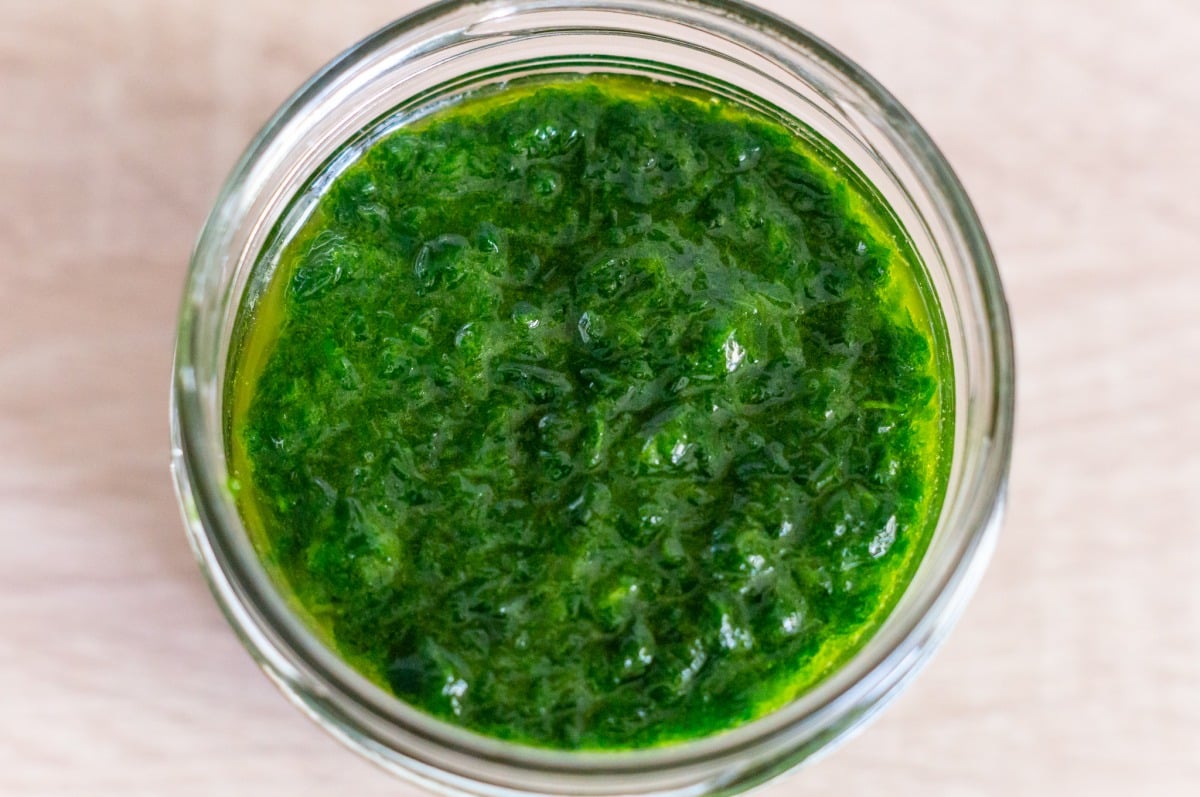
Preparing the jar properly
We use a 300 ml screw-top jar and pour boiling water over it, lid included. Three minutes is enough, then turn it upside down on a clean cloth to drain. Many recipes skip this step. We have seen twice, though, that residual bacteria in an unwashed jam jar produced white streaks in the paste after three weeks. Since then, sterilising is non-negotiable.
When filling, we press the paste down firmly with a spoon to remove any air bubbles. Then we pour 2 to 3 mm of oil on top. This layer must be restored every time you take some out. Anyone who spreads directly from the jar with a bread knife, or uses a damp spoon, introduces bacteria and the batch will be lost within two weeks.
What to watch out for when foraging
Wild garlic is regularly confused with lily of the valley and autumn crocus, both highly poisonous. The smell test is the simplest check: wild garlic smells clearly of garlic when you rub a leaf, the look-alike plants smell of nothing. We always rub each leaf individually between our fingers before it goes into the basket. Anyone who is not sure should join a guided foraging walk before going into the woods alone. The NDR guide shows the key identification features, and in our article on wild garlic pesto we have described the risks of confusion in more detail.
Before blending, we wash the leaves twice in cold water and remove the tough lower stalks. The fine upper stalk ends can stay in as they actually give a little more sharpness. We then dry the leaves in a salad spinner, because any remaining water significantly shortens the shelf life.
Storage and freezing
In the fridge, with a proper layer of oil and a clean spoon, the paste keeps for up to twelve months. We have opened jars from April that were still green, aromatic and perfectly safe in the following March. One important point: the paste must be kept on the lower, colder shelf of the fridge, not in the door. Temperature fluctuations cause the oil layer to crack, and that is exactly where the paste starts to turn.
If you have no fridge space or are storing larger quantities, freeze the paste in individual portions. Ice cube trays with lids are ideal for this. About 15 g per cube, which equals 1 tbsp. The frozen cubes keep for twelve to eighteen months and thaw directly in a hot sauce. Freezing straight from the jar also works, but only fill the jar three quarters full, as the paste expands when frozen. We label every freezer bag with a date, because wild garlic paste looks identical to pesto or parsley paste once frozen.
How we use the paste
1 tbsp of paste replaces about five fresh wild garlic leaves. That means you can make exactly the dishes in autumn and winter that there was no time for in April. We stir it into a risotto just before serving, mix it with soft butter to make wild garlic butter for steaks and bread, or add it to a wild garlic soup when the season is over. Even in homemade gnocchi, 1 tsp of paste per portion brings a clear spring flavour right into November.
Goes well with: Pasta.
Goes well with: Peppers roasted in the Varoma®.
If you want to use more wild garlic, we have recipes to cover the whole season. Wild garlic pesto for quick pasta, wild garlic salt as a dry preserve, wild garlic oil as a liquid seasoning, wild garlic rolls for a weekend breakfast, wild garlic cream as a bread spread, wild garlic Schupfnudeln, potato and wild garlic mash, and wild garlic dumplings.