You don’t make plum butter because you fancy plums. You make it because the tree is overloaded, the season is ending, and otherwise two kilos of plums would go to waste. This is larder logic, not a breakfast impulse. Our approach: 10 minutes of active work in the Thermomix®, then the oven takes over for an hour to reduce it down. You get three screw-top jars that keep until spring.
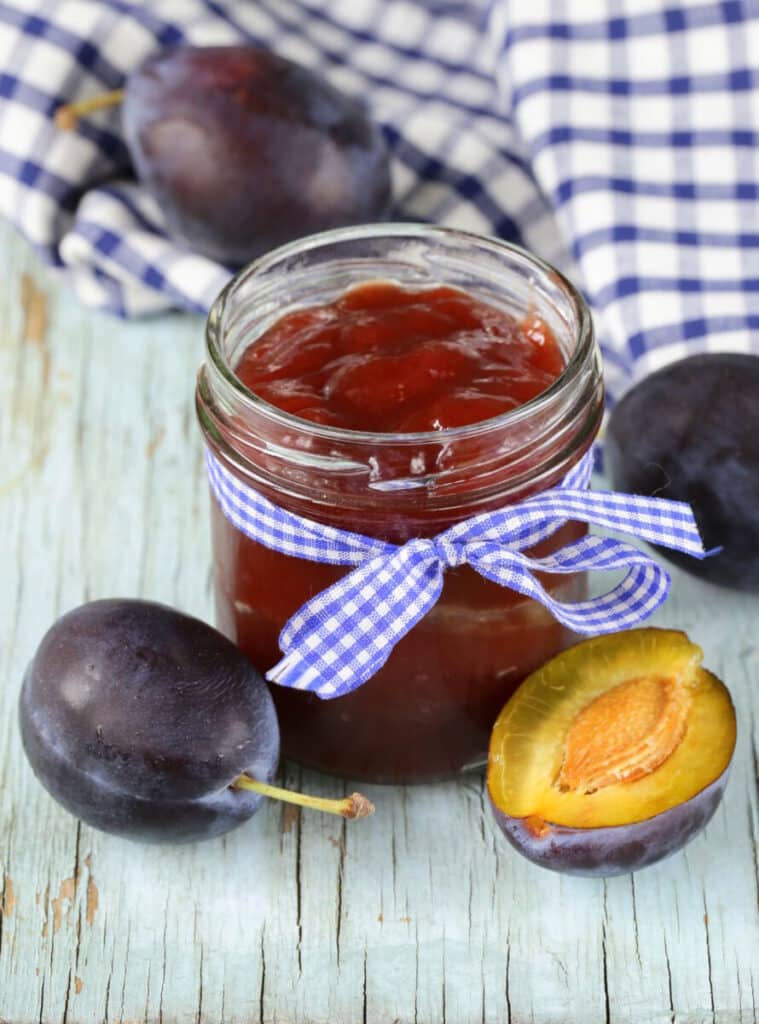
Plum Butter with the Thermomix®

Ingredients 0 / 5 ✓
- 80 g sugar
- 1 tsp ground cinnamon
- 1 whole clove
- 1000 g plums
- 3 tbsp rum
Instructions 0 / 5
-
1
Pulverise the sugar and spices.
Add sugar, cinnamon and clove to the mixing bowl and pulverise for 1 minute / speed 10.
-
2
Prepare the plums.
Wash, halve and stone the plums, add to the mixing bowl, chop for 5 seconds / speed 4, then cook for 10 minutes / 100°C / reverse direction / speed 2.
-
3
Preheat the oven. Meanwhile, preheat the oven to 160°C.
-
4
Reduce the butter. Pour the contents of the mixing bowl into an ovenproof dish and leave to reduce in the oven for 1 hour.
-
5
Fill the jars.
Drizzle the rum over the plums, stir through with the spatula, fill into sterilised jars and leave upside down on the lids for 5 minutes.
Tip: Depending on your oven, you can wedge the handle of a wooden spoon in the oven door during step 4. This lets steam from the plum butter escape more easily, helping it reduce faster.
Video
Nutrition per serving
Why the oven does the reducing
The critical point with plum butter is not the cooking, it is the reducing. In the mixing bowl, a thick fruit spread can easily catch and burn at high temperatures. So here we only cook the plums briefly to soften them, at 100°C on reverse direction, until they have released their juice and broken down. The job of reducing to the right consistency goes to the oven at 160°C. One hour, no stirring, no watching. The butter reduces evenly, and the mixing bowl is clean again within ten minutes.
Leaving the oven door open a crack speeds up evaporation noticeably. The handle of a wooden spoon wedged in the door holds it open at just the right gap without letting heat escape unnecessarily. Whether this works with your oven depends on the model, but it works well with most.
Damsons or plums: which works better?
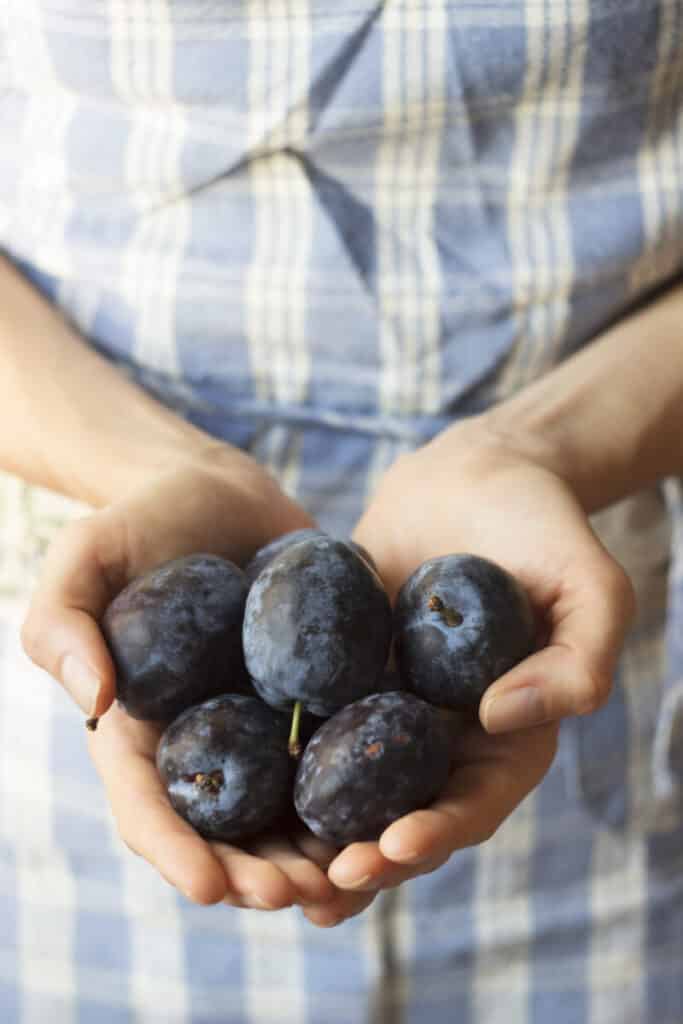
Damsons are the better choice for this butter because they contain less water and more flesh than round plums. The stone comes away more easily and pitting is quicker. Damsons also contain more pectin, so the butter sets more firmly on its own. Our recipe works with both varieties, but damsons need 10 to 15 minutes less in the oven.
Round plums (such as greengages) give off more juice. The butter is fruitier but takes longer to reduce. If you have a mix of both: process them together, the firmer damsons balance out the softer plums.
Why the order of ingredients matters
The sugar, ground cinnamon and whole clove go into the mixing bowl first on their own, one minute at speed 10. Skip this step and add everything together, and you risk biting into a whole clove. The pulverised spice mix distributes evenly through the butter instead.
We add the rum after the oven, not before. Anything cooked in will evaporate. What is stirred in at the end stays aromatic. With three tablespoons, that is a real difference you can taste in a direct comparison: one version has a hint in the background, the other is barely detectable.
Without sugar: only for very ripe fruit
Our recipe uses only 80 g of sugar per kilo of plums. That is low compared to jam (1:1 or 2:1 ratios). Anyone who wants to work completely without sugar needs overripe fruit. Plums that are already starting to wrinkle and are almost soft on the tree have enough natural sweetness.
Without sugar, the butter will be more tart and keeps for less time (3 months instead of 6). Sugar preserves because it binds water and removes the conditions bacteria need to survive. Anyone working without sugar must be especially thorough when sterilising. An alternative: freeze the jars rather than preserve them.
If the butter is still too runny after an hour
Very ripe plums give off more juice than compact, firm fruit. If your butter still looks thin after the oven time, simply leave it in for another 20 to 30 minutes. You do not need jam sugar for this. Plum butter thickens through reduction, not through pectin. Important: the butter firms up further as it cools. What flows a little while warm will set noticeably as it cools down.
Rule of thumb: Draw a spoon through the hot butter. If the line closes within 3 seconds, it needs longer in the oven. If it holds for 5 seconds, the consistency is right. As it cools, it will become spreadable like jam.
Shelf life and sterilising
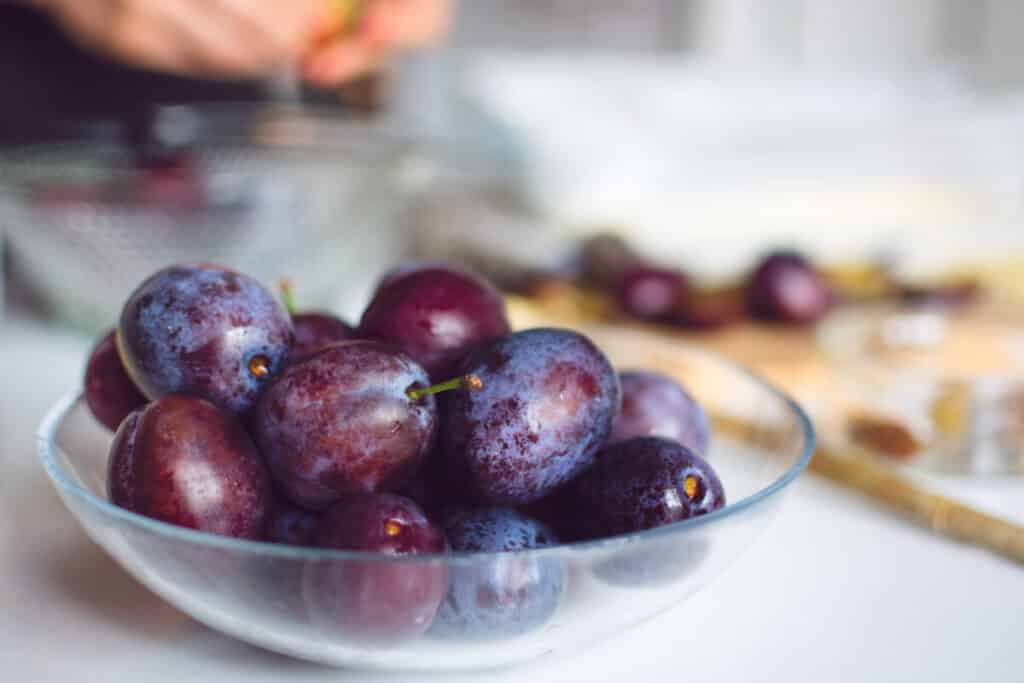
We fill the butter while still hot into sterilised screw-top jars, seal immediately and leave them upside down on their lids for five minutes. Sterilising is the key step: place jars and lids briefly in boiling water or in the oven at 120°C. Skip this and you have plum butter for three weeks. Do it properly and you have plum butter for six months, often longer. Once opened, it keeps well for three to four weeks in the fridge.
Vacuum test: If the lid is slightly concave after cooling and does not click when pressed, a vacuum has formed. That is the sign of a clean preserve. If the lid clicks, use the contents within a week.
Uses: not just on bread
On pancakes: A tablespoon of plum butter on a fresh pancake is better than any chocolate spread alternative. The tartness of the butter cuts through the buttery batter.
As a filling for Germknödel: Place a teaspoon of cold plum butter in the centre of the dough, seal it and cook. The classic Austrian filling.
With cheese: Plum butter on a cheeseboard alongside Camembert or blue cheese. The sweetness of the butter balances salty, strong cheese.
In sauces: A tablespoon of plum butter stirred into a roasting sauce or game dish adds a fruity depth without a recognisable plum flavour. It works like redcurrant jelly with venison.
More preserves from the Thermomix®
If you like the oven method, here are similar recipes with the same logic: short active time, great yield, long shelf life.
- Apple sauce with the Thermomix® using the same preserving logic.
- Strawberry jam for the June season.
- Advocaat as a gift with a similar shelf-life approach.
- 17 liqueurs with the Thermomix® as a preserving overview.
Compatibility: TM31 ✓ · TM5 ✓ · TM6 ✓ · TM7 ✓ (The Thermomix® cooks only up to 100°C. The 160°C is the oven, not the mixing bowl.)
Why the oven method beats cooking everything in the mixing bowl
Most Thermomix® recipes (including those on Cookidoo) cook plum butter entirely in the mixing bowl: 15 minutes at Varoma speed 3, then another 25 minutes at Varoma speed 3 after blending. That is 40 minutes of constant stirring at 120°C in the enclosed mixing bowl, during which the thick fruit spread can stick to the base and burn. Anyone who wants a thicker result has to keep cooking for even longer, often resorting to jam sugar as a fix.
In our recipe, the plums are only cooked briefly in the mixing bowl to soften. The actual reducing happens in the oven at 160°C for one hour. The heat comes from all sides evenly, the butter reduces without any stirring, and the mixing bowl is free again after ten minutes. Compared with traditional Austrian Powidl, which is stirred in a pot for two to twelve hours, we save the whole standing-at-the-stove part. Compared with a pure mixing bowl recipe, we get deeper, lightly caramelised flavours rather than just softened fruit. No jam sugar, no risk of burning, no constant supervision.
Goes well with: vanilla ice cream and Kaiserschmarrn.
Also pairs nicely with rosehip jam made in the Thermomix®.