Apple jam made in the Thermomix® comes out right every time, as long as you choose the right variety. Floury apples such as Boskoop or Cox Orange contain enough pectin to set without any tricks. Firm varieties like Braeburn often stay runny, even with 2:1 jam sugar.
We have been making this jam for years using windfalls from the garden. By now we know exactly what matters. The variety counts for more than the sugar.
Apple Jam with the Thermomix®

Ingredients 0 / 4 ✓
- 500 g apples tart variety
- 1 tsp vanilla extract
- 10 g lemon juice
- 250 g 2:1 jam sugar
Instructions 0 / 3
-
1
Quarter the apples.
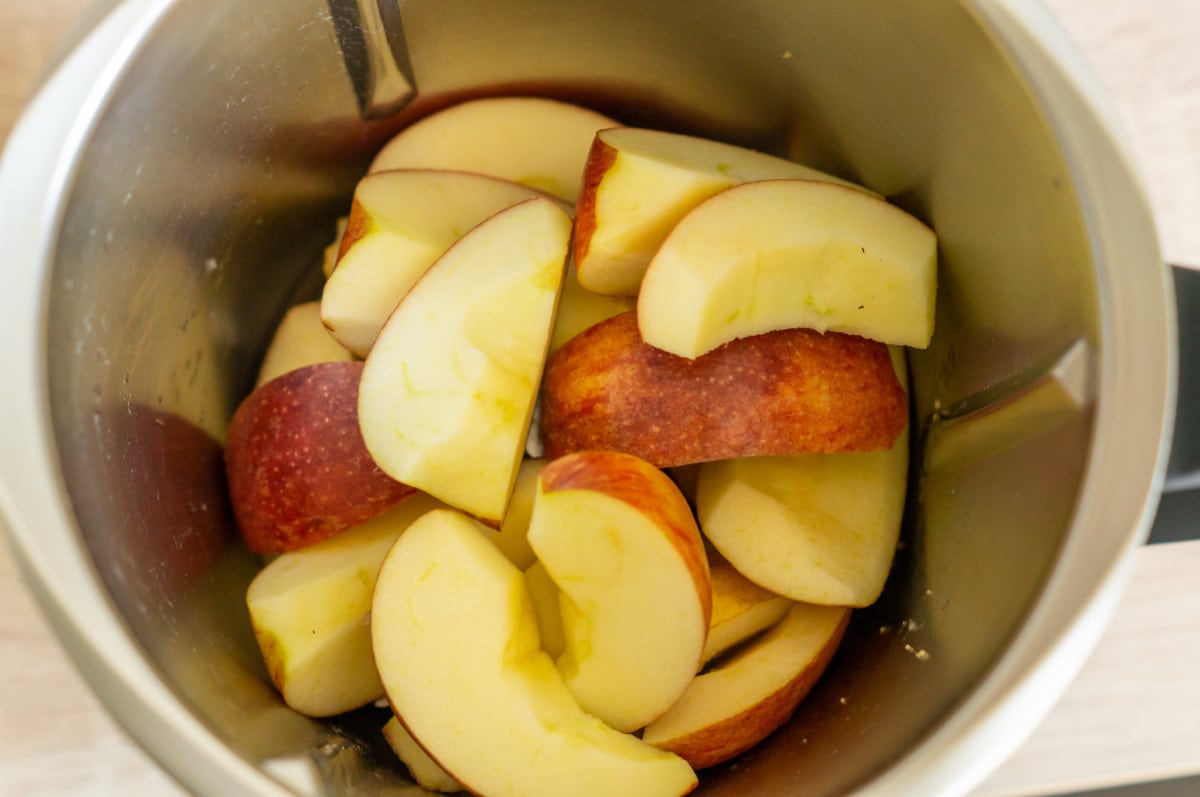
Wash the apples, quarter them, remove the core and pips, then place in the mixing bowl.
-
2
Chop and cook the apples.
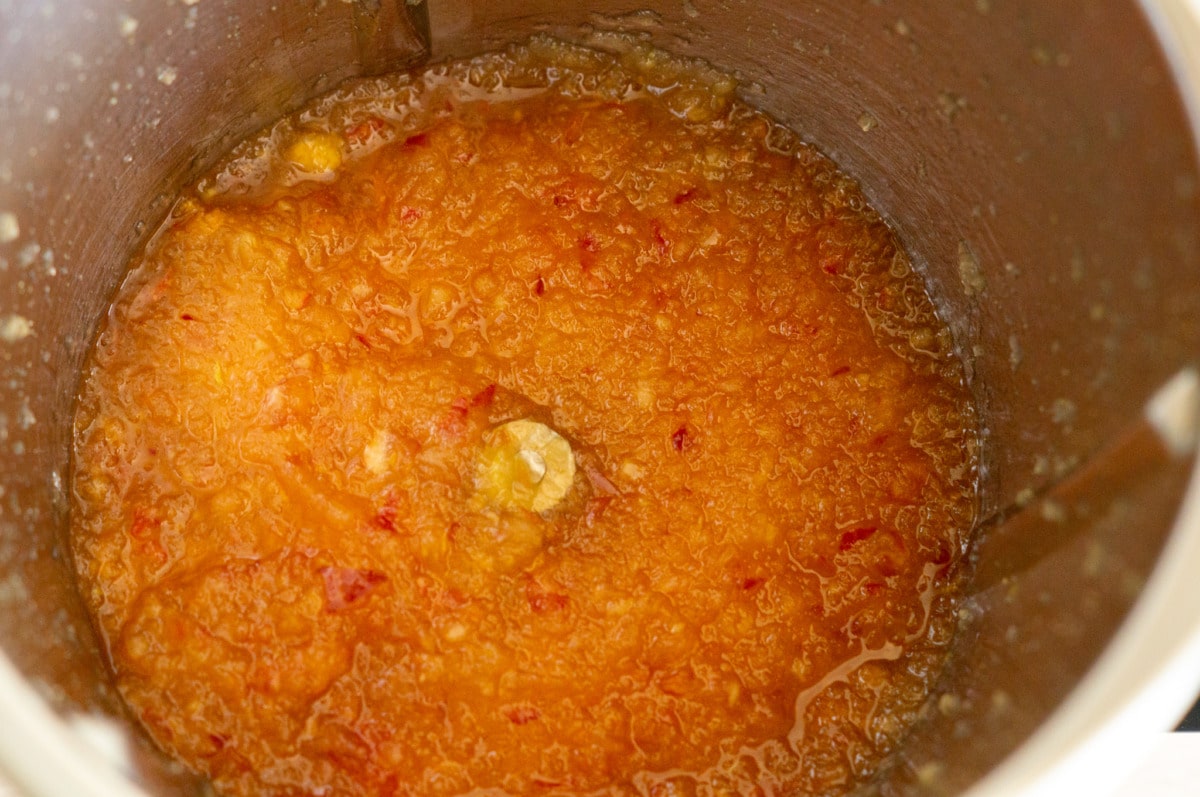
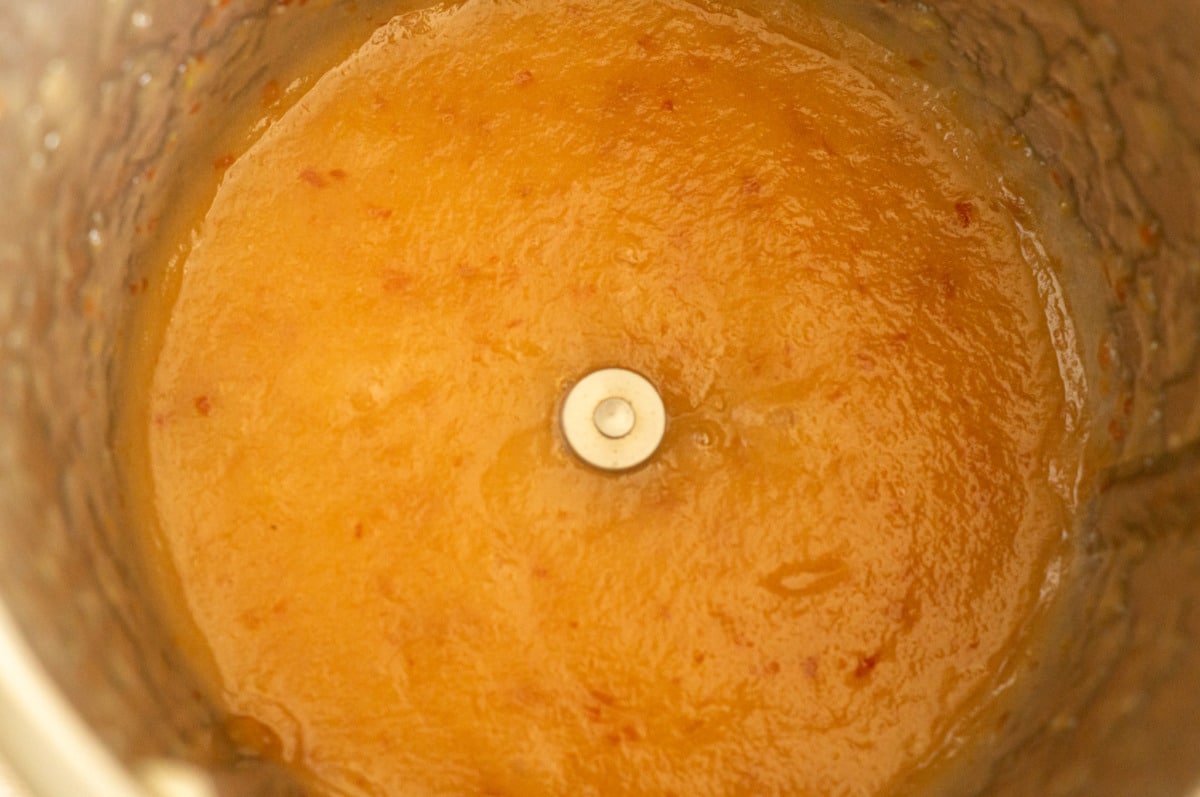
Add the remaining ingredients, chop for 10 sec / speed 5, push down with the spatula, then cook for 10 min / 100°C / speed 2.
-
3
Fill the jars.
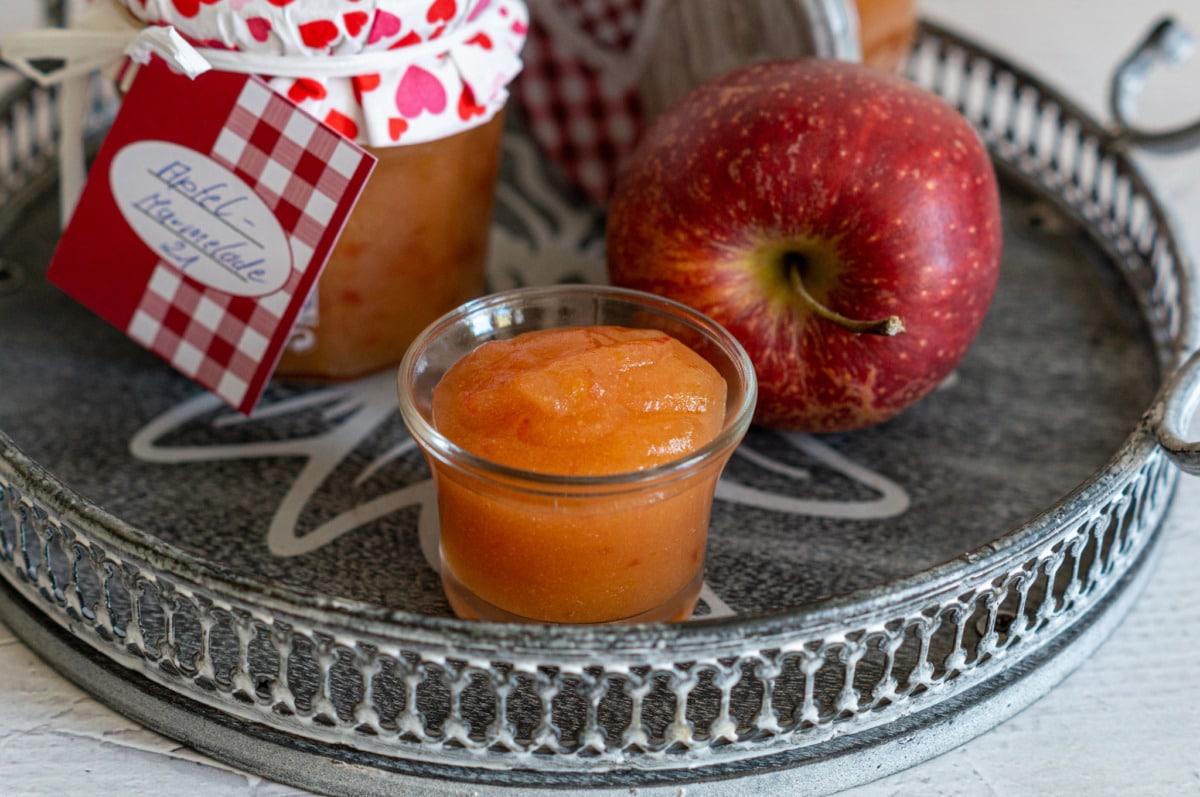
Do the setting test, fill into sterilised jars, leave upside down for 5 minutes, then leave to cool.
Tip: You can vary the flavour by adding a splash of Amaretto, Cointreau, or a pinch of cinnamon.
Video
Nutrition per serving
Why floury apples and not firm ones
Floury varieties such as Boskoop, Cox Orange, or Jonagold contain 0.4 to 0.6 per cent pectin (Deutsche Gesellschaft für Ernährung, 2023). That is the natural setting agent that makes jam firm. Firm varieties such as Braeburn or Gala only provide 0.2 to 0.3 per cent. Even with 2:1 jam sugar, the mixture often stays too runny with firm apples.
Floury apples also have more acidity. The combination of pectin and acidity is the basis for a firm set. If you can only find Braeburn or Elstar at the supermarket, pick up 10 g of extra apple pectin as well.
Our favourite is Boskoop from the garden. The variety is sharp enough for jam and sets on its own. Jonagold works well too, but it is sweeter. In that case a little extra lemon juice is worth it.
Peel on or off
With organic apples we leave the peel ON. The peel contains 30 per cent more pectin than the flesh (Max Rubner Institut, Obstverarbeitung 2019). That gives a firmer set and means you need less jam sugar.
With non-organic apples we peel them. Pesticide residues sit mainly in the peel and can give the jam a slight bitterness. Wax from storage can also affect the taste.
The peel gets roughly chopped at speed 5, not blended smooth. Anyone who prefers a smoother texture should peel the apples. Windfalls often have bruised patches with brown peel. We cut those out generously.
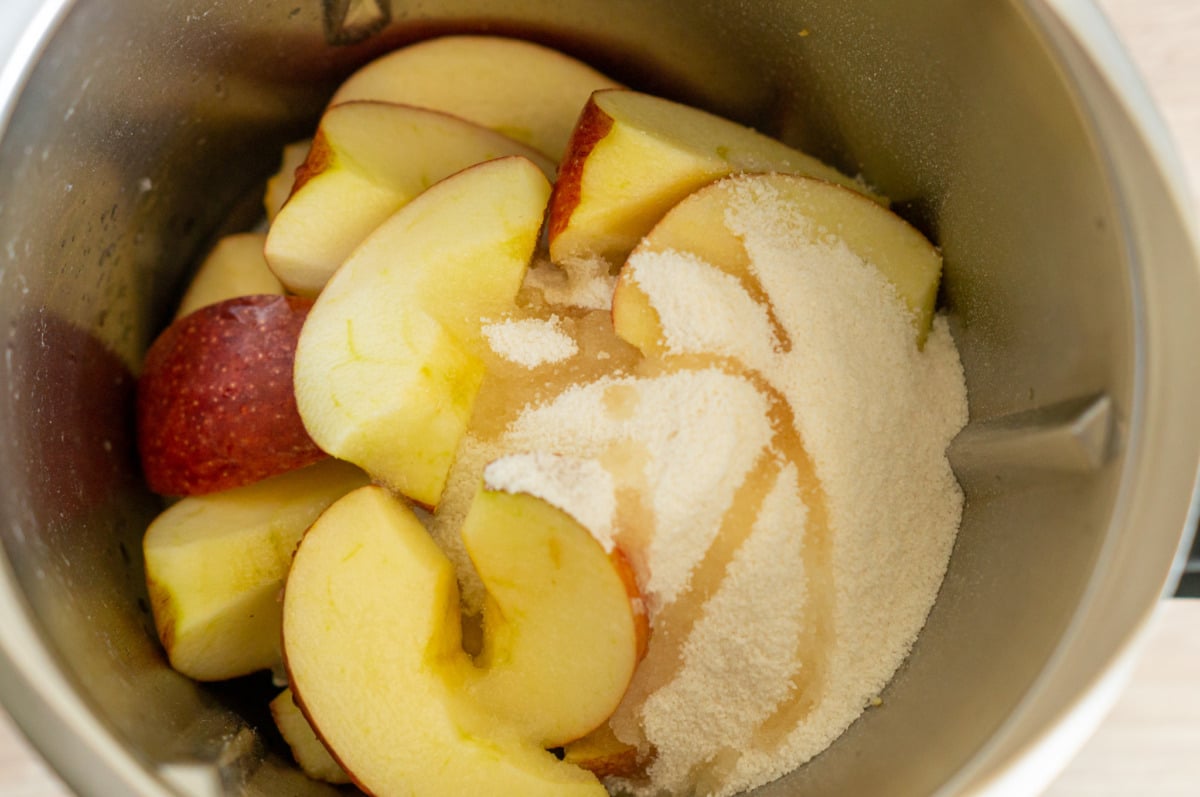
Speed 5 rather than speed 8
The recipe uses 10 seconds at speed 5, not speed 8. That is a deliberate choice for texture. At speed 5 rough apple pieces are left intact. The jam has body and looks like jam, not apple sauce.
Speed 7 or 8 would blend the mixture too smooth. That works for apple sauce, but for jam we want structure. The pieces soften during cooking yet remain visible.
Anyone who still prefers a smooth consistency can blend again for 10 seconds at speed 6 after cooking. At that point it is more of an apple spread than a classic jam.
How to do the setting test properly
After the 10 minutes of cooking we do the setting test. Without it you have no way of knowing whether the jam will set firm or stay runny. The test takes one minute and saves a lot of frustration.
Take a cold plate from the fridge. Drop a teaspoon of jam onto it and wait one minute. Run your finger through the mixture. If the trail holds and does not run back together, the jam is ready.
If the trail runs back together, the mixture is still too runny. Cook it for a further 2 minutes at speed 2 and 100°C, then test again. It cannot become too firm. The jam loosens slightly in the jar once it cools.
With floury apples and 2:1 jam sugar, 10 minutes is almost always enough. With firm varieties it sometimes needs 2 to 4 minutes extra.
Sterilising jars in the oven
Without sterilisation the jam will go mouldy within 4 weeks. Mould spores do not survive cooking in the mixing bowl, but they sit on the jars and lids.
We use the oven. Jars and lids go in for 10 minutes at 120°C top and bottom heat. That kills all spores (Robert Koch Institut, Lebensmittelhygiene-Leitlinien 2021). The jars stay hot until the jam is ready.
Boiling water works as an alternative. Place jars and lids in a pot of vigorously boiling water for 10 minutes. Lift out with tongs and leave to drain.
Fill the hot jam straight into the hot jars. Wipe the rim clean with a damp cloth, put the lid on, then stand upside down for 5 minutes. That creates the vacuum that keeps the jam shelf-stable.
Shelf life with 2:1 jam sugar
2:1 jam sugar means 2 parts fruit to 1 part sugar. That is 50 per cent sugar. Less than with 1:1, but it does shorten the shelf life.
Stored in a cool, dark place the jam keeps for 6 to 12 months (Bundesamt für Verbraucherschutz und Lebensmittelsicherheit, 2022). With 1:1 jam sugar it would keep for 12 months or longer, but the jam becomes too sweet.
An opened jar belongs in the fridge and keeps there for 3 to 4 weeks. If mould appears, throw the whole jar away rather than scraping off the surface. The spores go deeper.
Without jam sugar, freezing is the only option. The jam then keeps for 3 months, but the texture suffers when it thaws.
Adding cinnamon and vanilla
Classic with vanilla extract: The recipe uses 1 tsp of vanilla extract. It is more intense than vanilla sugar and contains no starch. 1 tsp of extract is roughly equivalent to 1 sachet of vanilla sugar (Stiftung Warentest, Vanilleprodukte-Test 2020), but extract is alcohol-based and releases more aroma.
Christmas variation: Add 1 tsp of cinnamon and half a tsp of cardamom to the jam sugar. The spices get chopped together with the apples. The result is an autumnal jam that goes well with gingerbread.
With fresh ginger: Peel 10 g of fresh ginger, dice it roughly, and add it to the mixing bowl with the apples. The ginger gets finely chopped at speed 5 and adds a gentle heat. This works well with very sweet apples.
Vanilla sugar instead of extract: If you only have vanilla sugar, use 1 sachet (8 g) in place of the teaspoon of extract. The jam will be very slightly less intense, but the difference is barely noticeable.
Making the most of windfalls
Windfalls are cheaper than shop-bought fruit and work well for jam. Floury autumn apples such as Boskoop or Gravenstein often fall before they can be sold. We cut out the bruised patches generously and use the rest as normal.
Cut away any brown, mushy flesh. Do not use apples that are completely soft, as they will already be fermenting and will taste sour. Firm apples with small dents are ideal.
With windfalls we recommend organic quality or your own garden harvest. Without pesticides you can leave the peel on and benefit from the extra pectin.
Without jam sugar, using apple pectin
If you prefer not to use jam sugar, apple pectin is an option. The jam will be less sweet, but the shelf life drops. Without sugar as a preservative it only keeps for 3 months in the freezer.
Use 10 g of apple pectin and 200 g of regular sugar instead of the 250 g of 2:1 jam sugar. The method stays the same: quarter the apples, chop them with the pectin, sugar, vanilla extract, and lemon juice, then cook for 10 minutes.
The setting test matters even more here. Apple pectin sometimes takes 2 to 4 minutes longer to thicken than jam sugar. Cook for 2 extra minutes rather than leave the jam too runny.
After filling the jars, freeze them straight away rather than storing them on the shelf. The jam keeps for 3 months at minus 18°C. Thaw overnight in the fridge, not in the microwave.
Works on all Thermomix® models
The recipe runs identically on the TM7 (from 2024), TM6, TM5, and TM31. The settings stay the same throughout: 10 seconds at speed 5 to chop, then 10 minutes at 100°C at speed 2.
The TM31 has no automatic modes, but the manual settings work just as well. On the TM7 and TM6 you can read the temperature on the display. On the TM5 and TM31 you set 100°C and the Thermomix® holds the temperature.
No adjustments are needed. The 10-minute cooking time is sufficient on all models because the heating output is identical.
More Thermomix® recipes for homemade spreads: Quick Breakfast Rolls and Vanilla Extract.
What we do differently from typical apple jam recipes
Most Thermomix® guides online simply say “950 g tart apples” (Rezeptwelt) or “1 kg apples” (Just Spices) and leave the variety choice to chance. Even the ZauberTopf jam basic course gives no specific apple recommendation. That is exactly why so many apple jams stay runny. We name the varieties and include the pectin figures: Boskoop and Cox Orange bring 0.4 to 0.6 per cent pectin, Braeburn only 0.2 to 0.3 per cent. Second point: Just Spices peels the apples completely, whereas we deliberately leave the peel on organic fruit because it holds 30 per cent more pectin. Third, we chop at speed 5 rather than speed 8 so the jam has texture and does not turn into apple sauce.
Goes well with: Toast, butter, and quark.