Preparing Bircher muesli for 5 days only works without fresh apple in the base, as the apple oxidises after 2 days despite the lemon juice. We combine the walnuts, oats, yoghurt and milk, portion into 4 jars and slice a fresh apple into each one every morning. This keeps the muesli crisp rather than soggy and brown.
We have been making Bircher muesli several times a week for years. The meal prep question always comes up: can you prepare it for the whole week? Yes, but with one critical detail. The 240 g jumbo rolled oats, 250 g milk, 260 g Greek yoghurt and 60 g walnuts keep in the fridge without any problem for 5 days. The 2 apples do not. After 48 hours the apple turns brown and soft despite the lemon juice. Our solution: prepare the base without the apple, and slice a fresh apple in each day.
Bircher Muesli with the Thermomix®

Ingredients 0 / 7 ✓
- 60 g walnuts
- 2 apples
- 240 g jumbo rolled oats
- 250 g milk
- 260 g Greek yoghurt (10% fat)
- 2 tsp lemon juice
- 2 tbsp honey
Instructions 0 / 3
-
1
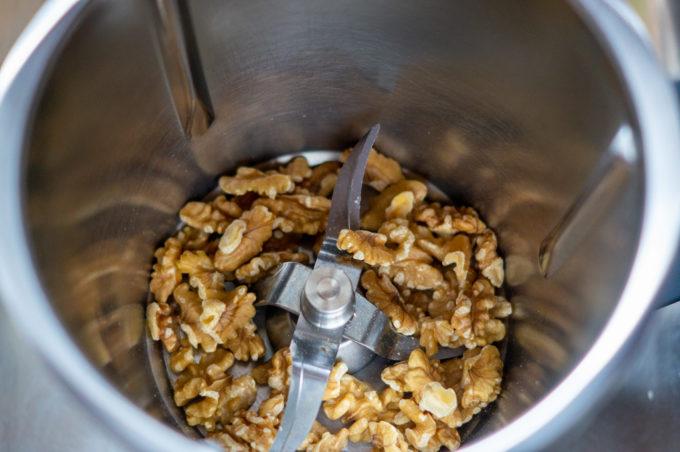
Chop the nuts.
Add the walnuts to the mixing bowl and chop for 5 sec / speed 8.
-
2
Apples.
Wash the apples, quarter them, remove the cores, add to the mixing bowl and chop for 5 sec / speed 4.
-
3
Muesli.
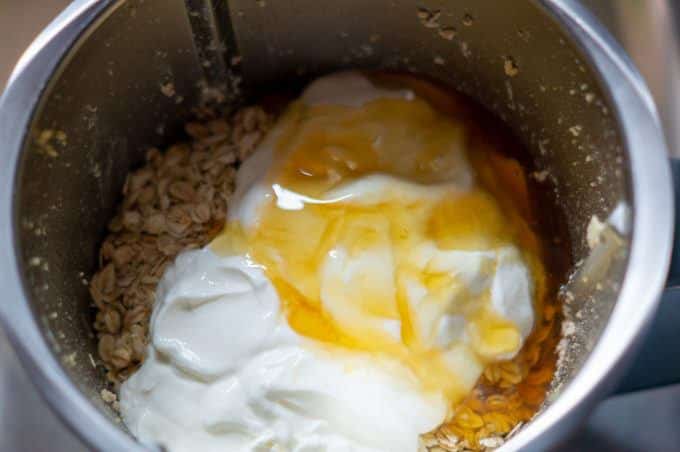
Add the oats, milk, yoghurt, lemon juice and honey and mix for 10 sec / reverse direction / speed 4.
Tip: The muesli tastes great fresh, but even better after it has been left in the fridge overnight and had a chance to soak through properly.
Video
Nutrition per serving
Why jumbo rolled oats and not quick oats
Jumbo rolled oats need at least 4 hours of soaking time, with 8 to 12 hours overnight being ideal (German Federal Centre for Nutrition, 2023). Quick oats swell up fully within 30 minutes and turn soggy after 2 hours. This comes down to structure: jumbo oats are only steamed and rolled, whereas quick oats are additionally cut. Our recipe uses 240 g jumbo oats with 250 g milk and 260 g yoghurt, because this quantity soaks up perfectly overnight without becoming watery.
If you use quick oats, reduce the liquid by 50 g (200 g milk instead of 250 g) and leave the muesli to soak for a maximum of 2 hours. Longer than that makes it mushy. With jumbo oats it is the opposite: under 4 hours they stay too firm. The bite comes from the longer soaking time, not from shorter soaking.
Reverse direction instead of normal speed: the Thermomix® technique
The recipe card says 10 seconds reverse direction speed 4 for the mixing step. This is not optional; it is a physical necessity. Reverse direction turns the blades against the usual direction and prevents the oats from being cut (Vorwerk TM6 User Guide, 2019). Normal speed 4 would chop the oats and make the muesli watery. Reverse direction only stirs, it does not cut.
The same principle applies to the 60 g walnuts: 5 seconds speed 8 chops them into small pieces that add texture without any shell sensation. Longer (7 to 10 seconds) would start creating a nut butter consistency, while shorter (3 seconds) leaves large chunks that get stuck in your teeth. 5 seconds is the threshold for the best texture.
The recipe works identically on the TM7, TM6, TM5 and TM31. Reverse direction has been standard since the TM31 and the speed settings remain the same.
Meal prep: 5 days of muesli in the fridge
The key lesson from hundreds of batches: apple oxidises after 2 days despite 2 tsp of lemon juice. We portion the base (walnuts, oats, milk, yoghurt, honey, lemon juice) into 4 jars of about 250 ml each and store them sealed in the fridge. This way the base keeps for 5 days. Each morning we slice a fresh apple (quartered, core removed, chopped for 5 seconds at speed 4) straight in just before serving.
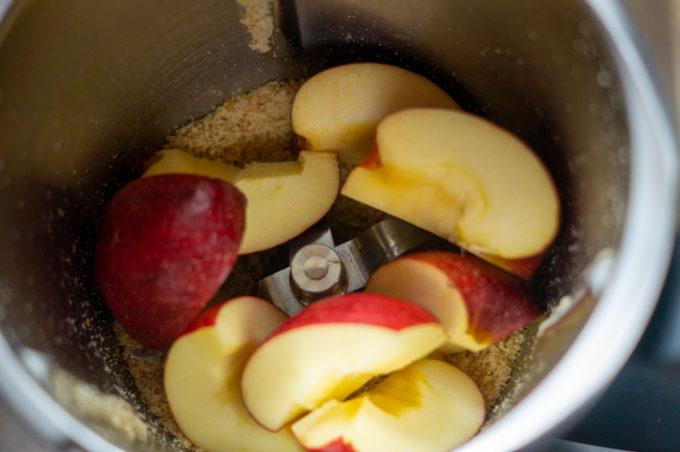
If you add the apple directly to the base, you have a maximum of 2 days. After 48 hours the apple turns brown and loses its bite, even with airtight storage. The citric acid only slows oxidation, it does not stop it. With the meal prep method the muesli stays crisp rather than mushy.
Greek yoghurt 10% fat: why fat matters here
Greek yoghurt with 10% fat contains roughly three times more fat than natural yoghurt at 3.5% (German Nutrient Database BLS 3.02, 2024). This makes the muesli creamier and more filling. The fat binds the oat starch and prevents a watery consistency. At 0.2% fat-free, the muesli becomes thin and watery because the oats cannot absorb the liquid.
The 260 g of Greek yoghurt in the recipe is a deliberate choice: combined with 250 g milk and 240 g jumbo oats, this gives a creamy but not watery result after an overnight soak. If you use natural yoghurt at 3.5%, increase to 280 g yoghurt and reduce the milk to 230 g, otherwise it will be too runny.
Apples with the skin on: organic only
We leave the skin on the 2 apples because roughly 70% of the fibre sits there (USDA FoodData Central, 2024). The skin also provides pectin, which binds the liquid and gives the muesli structure. But only with organic apples. Conventionally grown apples are often treated with pesticide residues that concentrate in the skin. Washing only removes the residues in part.
With organic apples: wash, quarter, remove the core with a knife, leave the skin on. With non-organic apples: peel first, then quarter and remove the core. The 5 seconds at speed 4 chops both variations equally well. With the skin on, the muesli has a slightly firmer bite; without the skin it is creamier.
Sweetening without sugar: ripe apple and raisins
The recipe uses 2 tbsp of honey for natural sweetness. If you want to work completely without added sugar, replace the honey with 30 g of raisins. Add these in step 3 together with the oats, milk, yoghurt and lemon juice. The raisins swell up overnight and release their natural fruit sugars. A very ripe apple also helps: Elstar or Jonagold varieties from October to November have a noticeably higher natural sugar content than unripe apples in July.
This variation tastes less sweet than with honey, but not sour. If you want more sweetness, increase the raisins to 50 g. More than 50 g makes the muesli sticky.
Shelf life in the fridge: 2 versus 5 days
With fresh apple in the base: up to 2 days in the fridge, sealed. After 48 hours the apple oxidises despite the lemon juice and turns brown. Without apple in the base (adding a fresh apple daily): 5 days in the fridge, sealed. The walnuts, yoghurt and oats remain stable. The oats continue to swell slightly over the days, but with jumbo oats that is not a problem. They become softer, not mushy.
Freezing does not work. After thawing the yoghurt becomes watery and the oats lose their structure. Bircher muesli is made for fridge meal prep, not the freezer.
The original recipe by Bircher-Benner (1900) uses oats soaked overnight with lemon juice (Bircher-Benner: Wendepunkt im Leben, 1929). Our recipe follows this principle with modern ingredients: Greek yoghurt instead of condensed milk, walnuts instead of hazelnuts, but the core method remains the same.
Original Swiss Bircher-Benner: grated apple instead of diced
In the original from the Zurich sanatorium (1900), the apple was coarsely grated rather than diced. This is not a minor detail but central to how it works: grated apple releases juice, and this juice blends with the lemon juice and the soaked oat mixture to form a creamy, slightly sweet base. Diced apple stays separate, whereas grated apple integrates fully. For the classic version we use 5 seconds reverse direction speed 5 with the quartered apples, which gives a rough grated texture without reducing the pieces to a puree. If you want it fully authentic, replace the 260 g Greek yoghurt with 200 g milk and 2 tbsp sweetened condensed milk, as Bircher-Benner served it to his patients. Hazelnuts instead of walnuts are also true to the original, though which you prefer is a matter of taste.
Goes well with: Smoothie, yoghurt and honey.
More breakfast recipes with oats: Overnight Oats soak completely cold without the Thermomix®, rice pudding is the warm alternative with a similar creaminess, and the quick breakfast rolls go perfectly alongside the muesli as a second option at the weekend.