Sweet and sour chicken stands or falls by a single ratio: sugar to vinegar, 1:1. Shift that balance and you end up with either a sticky toffee sauce or a sharp brine. We have been making this dish regularly in the Thermomix® for years and spent a good while getting the quantities right.
For us this is a reliable Thursday dinner when the weekly fridge is half empty and something warm needs to be on the table quickly. It works because the rice and chicken cook in parallel in the same machine. While the 300 g of jasmine rice sit in the simmering basket, the marinated chicken steams above in the Varoma. One fewer pot, one fewer timer, nothing burning.
Sweet and Sour Asian Chicken with the Thermomix®

Ingredients 0 / 19 ✓
- 500 g chicken strips
- 2 tbsp light soy sauce
- 1 tsp salt
- 2 spring onions
- 1 yellow pepper
- 1000 g water
- 1 tsp salt
- 300 g jasmine rice
- 1 tin of pineapple chunks small
- 1 lime
- 2 tsp Chinese five-spice
- 1/2 tsp salt
- 1 tbsp tomato puree
- 3 tbsp raw cane sugar
- 2 tbsp curry ketchup
- 2 tbsp soy sauce
- 1 tbsp apple cider vinegar or another fruit vinegar
- 10 g cornflour
- 160 g soya bean sprouts jar 350 g, drained weight 160 g
Instructions 0 / 10
-
1
Marinate the chicken.
Place the chicken strips in a bowl, add the light soy sauce and salt, and mix well. Cover the bowl and refrigerate for 1 hour.
-
2
Chop the vegetables.
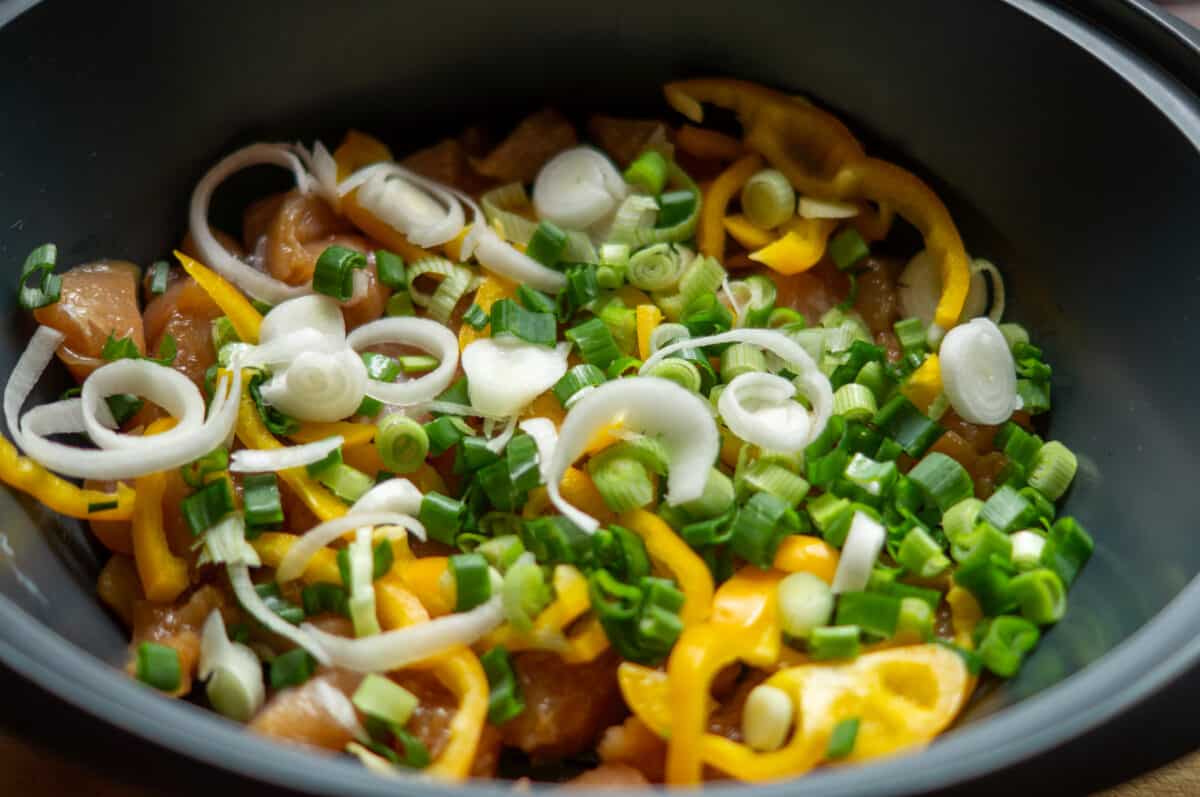
Meanwhile, wash and trim the spring onions and cut into rings. Wash the pepper, halve it, remove the stalk and seeds, and cut into strips. Set aside 2 tbsp of green spring onion rings.
-
3
Fill the Varoma.
Place the marinated chicken, spring onions and pepper strips into the Varoma.
-
4
Cook everything together.
Add the water and salt to the mixing bowl, weigh the rice into the simmering basket, place the Varoma on top and cook for 25 minutes / Varoma / speed 2.
-
5
Keep the rice warm.
Remove the Varoma, take out the rice and keep warm. Empty the mixing bowl, reserving 150 g of cooking liquid and returning it to the mixing bowl.
-
6
Add the pineapple.
Drain the pineapple through a sieve, collecting the juice and adding it to the mixing bowl. Squeeze the lime and add the juice to the mixing bowl.
-
7
Cook the sauce.
Add the remaining sauce ingredients, except the soya bean sprouts, to the mixing bowl, mix for 5 seconds / speed 4 and cook for 6 minutes / 100°C / speed 1.
-
8
Drain the soya bean sprouts.
Drain the soya bean sprouts in a sieve.
-
9
Add the chicken.
Add the chicken with the vegetables, pineapple and soya beans to the mixing bowl and heat for 4 minutes / reverse direction / 100°C / speed 1.
-
10
Serve.
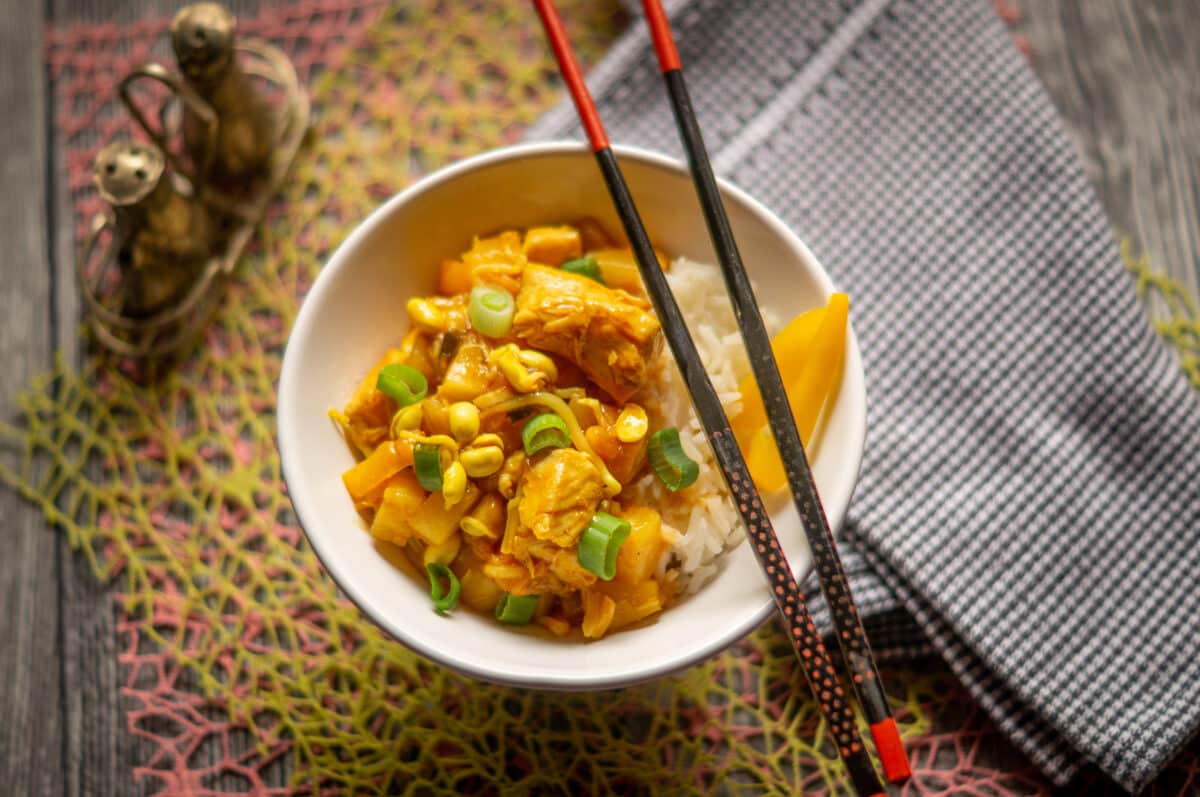
Plate up the Asian chicken with the rice and serve garnished with spring onion rings.
Tip: If you prefer more heat, stir 1 to 2 tsp of hot curry powder into the sauce.
Nutrition per serving
Why the 1:1 sugar-to-vinegar ratio is the key
Sweet and sour sauces from Chinese takeaways often taste off because the ratio tips the wrong way. More sugar than acid and everything becomes a sticky syrup. More acid and the sauce turns sharp and harsh. In our recipe we use 3 tbsp of raw cane sugar and balance the acidity with 1 tbsp of apple cider vinegar plus the juice of a lime. That gives roughly the same volume, so 1:1. Apple cider vinegar brings a softer acidity than rice vinegar, while the lime adds a fresh note on top.
If you have rice vinegar in the cupboard, you can swap it 1:1 for the apple cider vinegar. White wine vinegar works too, but it tastes a little sharper. What we never use: balsamic. It completely takes over the Asian flavour profile.
The salty element does not come from the salt alone; it comes almost entirely from the 2 tbsp of soy sauce in the sauce plus the 2 tbsp of light soy sauce in the marinade. Soy sauce carries glutamate, which means umami. That depth is precisely what a plain salt-sugar-vinegar mixture lacks. The tomato puree adds a second layer of umami and brings in the red-gold colour we know from restaurant dishes.
The cornflour trick: never add it to a hot sauce
Cornflour clumps the moment it hits hot liquid. If you pour 10 g of cornflour straight into a boiling mixing bowl, you get white lumps that will not blend smooth even at speed 4. Our approach: add the cornflour together with the remaining sauce ingredients before the mixing bowl gets hot. Then run 5 seconds / speed 4 to combine, followed by 6 minutes / 100°C / speed 1 to thicken.
If you forget and want to add the cornflour later, you have two options. Either let the sauce cool completely and start again, or stir the cornflour into 2 tbsp of cold water until smooth, then add it slowly while stirring at speed 1. The second method works, but it is fiddly. The clean approach is to mix the cornflour in from the start.
Reverse direction at the end protects the chicken pieces
The final step is the trickiest. The chicken, cooked vegetables, pineapple chunks and soya bean sprouts go back into the mixing bowl with the finished sauce. Reverse direction is essential here. In normal direction the blades would shred the tender chicken strips to fibres within seconds and turn the pepper strips to mush.
With 4 minutes / reverse direction / 100°C / speed 1, the blades turn blade-back-first. They move the contents around without cutting. The chicken heats through in the sauce and absorbs flavour while staying in whole pieces. This reverse direction step is the reason the dish looks the same as a wok version and not like a puree.
Tinned pineapple is no compromise here
Fresh pineapple sounds like the better choice, but in a sweet and sour context it is often too sharp and too firm. Tinned pineapple in its own juice works better for three reasons. First, it provides exactly the gentle sweetness the dish needs. Second, we use the juice from the tin directly in the sauce instead of adding extra liquid. Third, tinned pineapple chunks are always the same size and cook evenly.
If you do use fresh pineapple, cut it into 1.5 cm cubes and add 100 g of water or chicken stock to the sauce to replace the tin juice. Otherwise the sauce will be too thick.
Rice in the simmering basket, not in a second pot
The jasmine rice goes into the mixing bowl with 1000 g of water and 1 tsp of salt, the simmering basket holds the grains, and the Varoma sits on top with the marinated chicken and vegetables. 25 minutes / Varoma / speed 2, and both are done. We use 300 g of rice for 4 servings, which is generous, because the sauce absorbs a lot of it. If you prefer a smaller portion of rice, 250 g is enough.
One important point: rinse the rice thoroughly before cooking until the water runs clear. Otherwise it becomes sticky and the grains clump together in the simmering basket. We have put together separate tips on perfectly cooked rice in the Thermomix®. The Varoma guide is also worth a read if steaming is new to you.
Do not cut the marinating hour short
The full hour of marinating in the fridge is deliberate. During that time the light soy sauce works its way into the chicken fibres and seasons the meat from the inside, not just on the surface. If you shorten it to 15 minutes, the outside picks up flavour but the inside stays bland. You notice this in the finished dish because the sauce does a lot on the outside, but a bite into a plain piece is a letdown.
In practice we use the hour to wash the rice, cut the pepper and spring onions, and measure out everything for the sauce. If you plan ahead, you can marinate the chicken in the morning and in the evening you only need to allow 25 minutes of cooking time.
Heat, curry powder and other adjustments
The base recipe is mild and suitable for children. For more heat, stir 1 to 2 tsp of hot curry powder directly into the sauce. Sambal oelek also works well, and 1 tsp is enough. We would not use fresh chilli here because it sits too prominently in the foreground. Curry powder or sambal spread the heat more evenly.
Turkey strips work as a straight swap for the chicken. Pork tenderloin needs 5 extra minutes in the Varoma. A vegetarian version with smoked tofu also works well, and you can skip the marinating hour because tofu absorbs flavour much faster. If you cannot find soya bean sprouts, replace them with a small tin of bamboo shoots, or simply leave them out, though you will lose the satisfying crunch.
If you enjoy Asian-inspired recipes from the Thermomix®, we also have an Asian soup and a chicken curry on the site. Both follow a similar logic with the mixing bowl and Varoma together. For classic chicken dishes without the Asian angle, we have chicken strips in several variations.
Leftovers the next day
The finished dish keeps covered in the fridge for two days. When reheating, we recommend a saucepan rather than the microwave, otherwise the pepper strips go soggy. Store the rice separately, otherwise it soaks up all the sauce and the chicken ends up dry. Freezing works with some limitations: the chicken and sauce freeze well, but the soya bean sprouts and pineapple do not. Both turn unpleasantly soft when thawed.
The next day at lunch the dish often tastes even more rounded because the sauce has fully worked into the chicken. Just cook fresh rice and you are done.
How our recipe differs from the Vorwerk version
The official Cookidoo version uses dark balsamic vinegar and dry sherry in the sauce. Both ingredients overpower the typical Asian flavour and push the dish towards a Western-style braise. We stick with apple cider vinegar and lime juice, which keeps the acidity clear and fresh. The Cookidoo version also does not marinate the chicken at all, but only dusts it with paprika, and you can taste the difference. Our hour-long soy sauce marinade seasons the chicken from the inside, not just on the surface. We deliberately skip broccoli and mangetout in favour of pepper and soya bean sprouts, which are closer to the original takeaway dish.