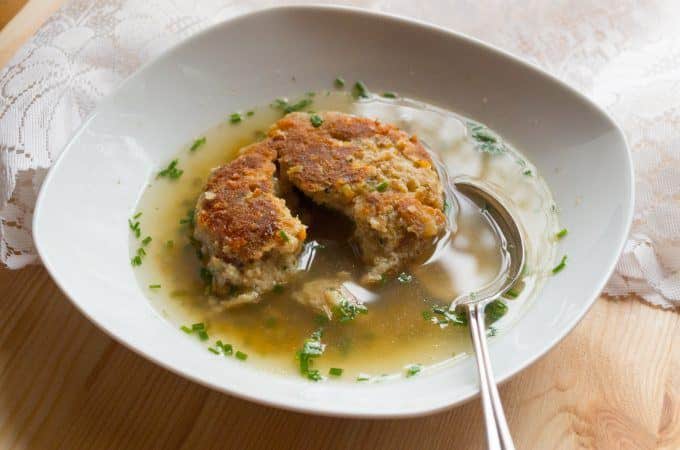
Kaspressknödel are to Tyrol what a fishcake is to a British seaside kitchen. They appear on the menu of every mountain hut between Kitzbühel and Sölden, usually floating in a clear beef broth, sometimes served as a main course with sauerkraut or a green salad.
We make them regularly whenever there are leftover bread rolls from the weekend and a piece of mountain cheese sitting in the fridge. The combination of stale dumpling bread, robust mountain cheese, and mild Emmental produces a dough that fries up crispy on the outside and soft inside. The flat shape is no accident, it is a necessity: a round dumpling would never cook through in the middle the way a pressed patty does, without burning on the outside.
Kaspressknödel with the Thermomix®
Ingredients 0 / 11 ✓
- 8 day-old bread rolls
- 1 bunch flat-leaf parsley
- 100 g Emmental cheese
- 100 g mountain cheese (Bergkäse)
- 1 onion
- 120 g butter
- 120 g milk
- 5 eggs
- 1 tsp salt
- 1 tsp dried marjoram
- etwas clarified butter for frying
Instructions 0 / 7
-
1
Chop the bread rolls.
Place half the bread rolls into the mixing bowl and chop for 5 sec / speed 5, then set aside. Repeat with the other half.
-
2
Prepare the parsley.
Wash and dry the parsley, place into the mixing bowl, chop for 4 sec / speed 6, then add to the bread rolls.
-
3
Chop the cheese.
Cut the Emmental and mountain cheese into pieces, place into the mixing bowl, chop for 6 sec / speed 5, then add to the bread rolls.
-
4
Chop the onion.
Peel the onion, halve it, place into the mixing bowl and chop for 3 sec / speed 5.
-
5
Warm the butter and milk.
Add the butter and milk and warm for 3 min / 50°C / speed 1.
-
6
Mix all the ingredients.
Add the eggs, salt and marjoram, mix for 5 sec / speed 5, then pour over the bread rolls. Knead everything together well by hand and leave to rest, covered, for 30 minutes.
-
7
Fry the Kaspressknödel.
Heat a pan with clarified butter, shape the dough into dumplings, press them flat, and fry on both sides until golden brown.
Tip: Kaspressknödel can be served either with a fresh salad or floating in a clear soup. They also make a great packed lunch for on the go.
Video
Nutrition per serving
What saves the dough in the Thermomix®: reverse direction and short mixing times
A dumpling dough has one big risk, and in the Thermomix® it has a name: over-mixing. When the bread pieces end up between the sharp blades and run for more than 30 seconds in normal direction, they get cut into crumbs. From the crumbs you get breadcrumbs, from the breadcrumbs you get mush, and the dumplings fall apart in the pan. That is exactly why we work with reverse direction at two points here and keep the intervals very short.
- The bread rolls are torn, not ground. 5 seconds at speed 5 is enough to turn the 8 dry rolls into rough chunks. The half-and-half approach (twice, 5 seconds each) prevents flour at the bottom and whole pieces at the top.
- The cheese is chopped cold. Emmental and mountain cheese straight from the fridge, in rough pieces, 6 seconds at speed 5. If you let them warm up, you get a clump of cheese on the blade.
- The final mix is done by hand. In the Thermomix®, the eggs, salt and marjoram are distributed for just 5 seconds at speed 5, then everything is poured over the bread chunks and worked through by hand. This is the point where the machine deliberately does not do everything.
The 30-minute soaking time after mixing is not a suggestion in this recipe, it is essential. During that time the warm butter-milk mixture soaks into every single piece of bread. Starting earlier means pressing dumplings that fall apart in the pan because the bread is still dry inside and there is nothing to hold them together.
Mountain cheese and Emmental: why the combination matters
The 100 g of mountain cheese provides the bold, almost nutty flavour that sets Kaspressknödel apart from ordinary cheese dumplings. The 100 g of Emmental contributes the melting fat and helps bind the dough together. Using only mountain cheese gives a very intense but slightly dry result. Using only Emmental gives a mild, rather characterless dumpling. The half-and-half combination is the standard Tyrolean approach, and after years of testing we do exactly the same.
If genuine Tyrolean mountain cheese is not available, a well-aged Comté or an Allgäu Bergkäse also works well. What does not work: young Gouda or mild butter cheese. Both are too fatty and too bland, the dough becomes soggy and tastes of nothing. For more on cheese varieties and how to use them with the Thermomix®, see our post on grating cheese with the Thermomix®.
Where the dough falls apart or becomes too firm
1. Bread chunks are chopped too fine
If you put all 8 rolls into the mixing bowl at once and run it for longer than 5 seconds, you get breadcrumbs instead of dumpling bread. The result is that the dough becomes too pasty during soaking and the dumplings do not hold together in the pan.
Our solution: Always work in two halves, each half for 5 seconds at speed 5. Better to check and give it another 2 seconds than to run it too long even once.
2. Soaking time is cut short
Starting to shape the dumplings after just 10 minutes because of time pressure is the most common mistake. The bread is still dry inside and already soft on the outside, and the dough has no even binding.
Our solution: Take the 30 minutes seriously. If you are still not sure whether the dough will hold, shape a single test dumpling after 30 minutes and fry it. If it holds, the rest can go in the pan. If it falls apart, simply wait 5 more minutes, then knead in a handful of breadcrumbs or a tablespoon of flour.
3. Pan too hot and turned too soon
Kaspressknödel need medium heat and patience. If you preheat the pan on a high setting and turn them after 2 minutes, you get dumplings that are burnt on the outside and raw inside.
Our solution: Non-stick pan on medium heat, with a good amount of clarified butter. About 4 to 5 minutes per side, without lifting or pressing them in between. The dumplings will release themselves once they have a golden-brown crust.
4. Too much cheese
If you think more cheese means more flavour, the greasy result will disappoint you. Above 250 g of cheese in total, the dumplings no longer hold together, the fat runs out during frying and the pan becomes a swimming pool.
Our solution: Stick to 200 g in total (100 g mountain cheese, 100 g Emmental). The cheese-to-bread ratio of 1:2 is the Tyrolean rule of thumb.
Variations: with Tyrolean grey cheese, squash, or vegetarian
- With bacon: Cut 80 g of streaky bacon into small dice, render it in the pan and mix it into the dough before the soaking time. The bacon becomes more subtle during frying but gives the dumpling a second layer of flavour.
- Chives instead of parsley: We often use 1 bunch of chives in addition or replace the parsley entirely. Chives pair better with mountain cheese and give the dumpling a mild sharpness. 4 seconds at speed 6 is enough here too.
- Spinach dumpling version: Add 150 g of blanched spinach (squeezed very dry) to the bread chunks. This gives greenish Kaspressknödel with a milder cheese flavour. If you use spinach from the freezer, make sure to squeeze out the water particularly thoroughly.
- With Tyrolean grey cheese: Replace the 100 g of Emmental with 50 g of mild grey cheese and 50 g of cream cheese. This gives the most regionally authentic version, but also the most intense one.
What to serve alongside
In Tyrol, Kaspressknödel are served classically either in soup or alongside a green salad. Both appear regularly on our table. As a soup garnish they work well in a simple clear broth or with pumpkin soup made with the Thermomix®, whose sweetness balances the bold cheese flavour beautifully.
As a main course we serve them with coleslaw or leftover sauerkraut made with the Thermomix®. For a truly Alpine meal, pair them with lentils and bacon or a bean stew. If you have any leftover dumpling bread, you can use it next time for bread dumplings made with the Thermomix®, which work just as well but are shaped into rounds and cooked in salted water.
1 day in the fridge, frozen for 2 months
Raw dough keeps in the fridge, covered, for two days. We often prepare it the evening before, so the dumplings are ready in the pan within 10 minutes the following lunchtime. Shaped, unfried patties can also be frozen: pre-freeze them individually on a tray, then transfer to a bag. They keep in the freezer for three months. No need to defrost, just place them frozen into the pan and fry for about 6 minutes per side over medium heat.
Fried dumplings keep in the fridge for two days. To reheat, use the oven at 160°C for about 8 minutes rather than the microwave. The microwave makes the crust soggy and the cheese rubbery.
Why Kaspressknödel are a dish in their own right in Tyrol
Goes well with: Soup and goulash.
Kaspressknödel do not appear on every mountain hut menu between the Zillertal and Ötztal by chance. The dish came about when farming families had to make the most of stale dumpling bread, leftover milk and robust mountain cheese when the day was long and the larder was modest. The name “press” reveals the key difference from a bread dumpling: the patties are not cooked in salted water but pressed flat and fried in clarified butter. That is how the crust forms, the one that is served with the broth in the mountain inn. The finest version uses Tyrolean Graukäse PDO, a skimmed-milk cheese with just 2% fat and a sharp character. If you want the full regional depth, mix 50 g of it through the Emmental.
More Tyrolean and Austrian recipes with the Thermomix®:
- Bread Dumplings with the Thermomix®
- Kaiserschmarrn with the Thermomix®
- Pumpkin Soup with the Thermomix®
- Sauerkraut with the Thermomix®
- Grating Cheese with the Thermomix®