Focaccia lives and dies by its olive oil. Not as one ingredient among many, but as a structural principle: part goes straight into the dough, the rest is brushed into the pressed dimples just before baking. What comes out of the oven at 240°C is a soft, moist crumb with a crisp base and cherry tomatoes that lightly caramelise. The Thermomix® handles the kneading in 5 minutes; the rest is down to proving time.
How to bake tomato focaccia in the Thermomix®: Warm 20 g fresh yeast with 300 g water for 3 minutes at 37°C, speed 2. Add 500 g plain flour (Type 405), 1/2 tsp salt and 20 g olive oil and knead for 5 minutes on kneading mode. Leave the dough to prove for 1 hour, shape into a flatbread, prove for a further 20 minutes. Press in dimples, brush with the remaining olive oil, press in 200 g halved cherry tomatoes and bake at 240°C top and bottom heat for 18 minutes. Basil goes on only after baking.
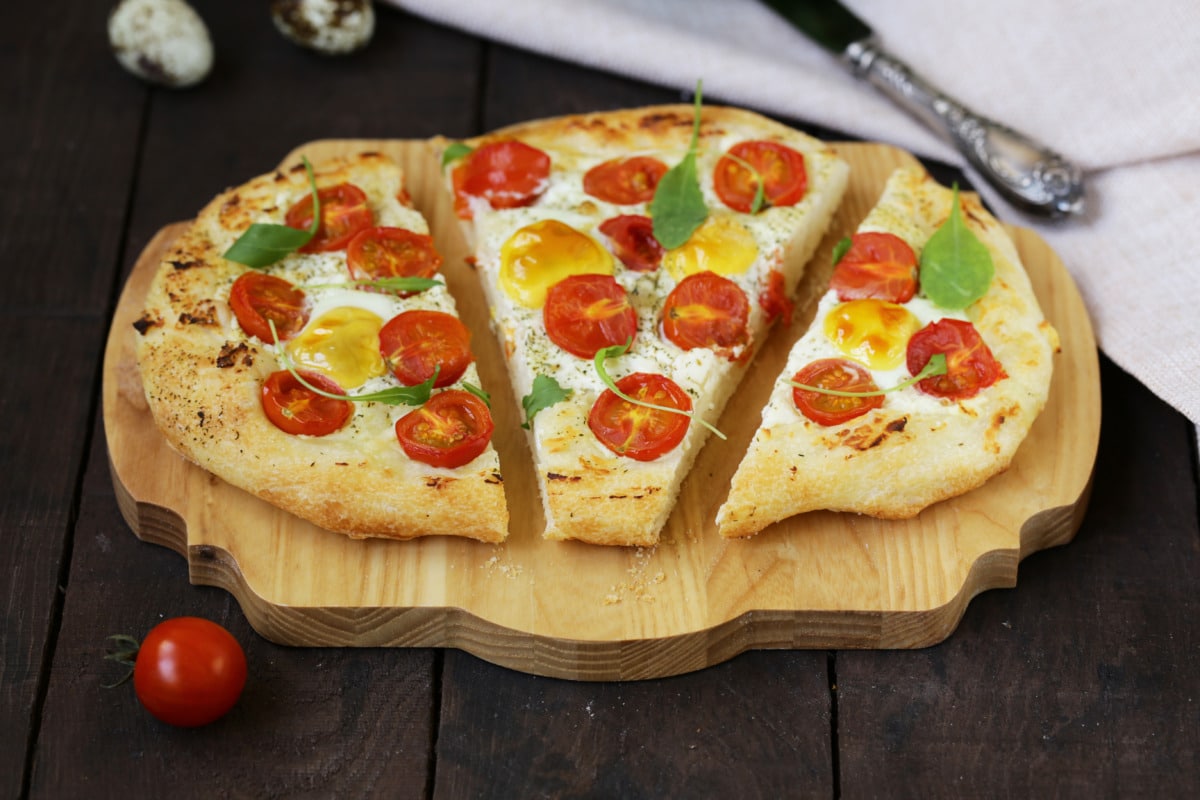
We bake this focaccia whenever we have guests or need a side for the barbecue that does more than a shop-bought baguette. From 500 g of flour you get 12 slices, each with around 193 calories. It goes brilliantly with a quick basil pesto, for which you only need the Thermomix® and 5 minutes.
Tomato Focaccia with the Thermomix®

Ingredients 0 / 7 ✓
- 20 g fresh yeast
- 300 g water
- 500 g plain flour (Type 405)
- 1/2 tsp salt + a little extra for sprinkling
- 50 g olive oil
- 200 g cherry tomatoes mixed red and yellow
- 10 leaves basil
Instructions 0 / 8
-
1
Dissolve the yeast.
Place yeast and water in the mixing bowl and heat for 3 min / 37°C / speed 2.
-
2
Knead the yeast dough.
Add flour, 1/2 tsp salt and 20 g olive oil and knead for 5 min / kneading mode.
-
3
Prove the dough.
Shape the dough into a ball, dust with flour and leave covered in a bowl in a warm place for 1 hour.
-
4
Flour the work surface.
Line a baking tray with baking paper. Flour the work surface.
-
5
Shape the flatbread.
Lightly knead the dough on the work surface, shape into a flatbread and place on the baking paper. Cover the flatbread and leave to prove for a further 20 minutes.
-
6
Prepare the tomatoes and basil.
Meanwhile, wash the tomatoes, halve them and remove the stalks. Wash the basil and shake dry.
-
7
Preheat the oven.
Preheat the oven to 240°C top and bottom heat.
-
8
Shape and bake the focaccia.
Press small dimples into the flatbread, brush with the remaining oil, top with cherry tomatoes and bake for 18 minutes. Serve garnished with basil and a sprinkling of salt.
Tip: You can bake your focaccia with all kinds of vegetables and herbs.
Video
Nutrition per serving
Why 240°C instead of 200°C makes all the difference
Most focaccia recipes bake at 200°C, and some websites don’t even mention a temperature. We deliberately go to 240°C top and bottom heat, and that is the difference between a pale, soft slice and a focaccia with a genuinely crisp base. At 240°C a firm underside forms in 18 minutes while the crumb stays soft inside. At 200°C you would need longer, and by then the crumb dries out before the base gets any colour.
Three things make this focaccia in the Thermomix® work well:
- The yeast is activated at exactly 37°C. The first 3 minutes at speed 2 bring the yeast and water to precisely the temperature at which yeast works without dying off. You would never hit this temperature so accurately by hand.
- Kneading mode works through a sticky dough in 5 minutes. Focaccia dough, at 300 g water to 500 g flour, is noticeably softer than pizza dough. By hand it would be almost unmanageable; the Thermomix® kneads it into a smooth, stretchy dough in 5 minutes.
- The olive oil is used in two stages. 20 g goes into the dough to keep the crumb tender; the remaining 30 g goes into the dimples just before baking to create the characteristic surface.
Why the dough needs a full 80 minutes of proving time
Our dough proves twice: one hour in a covered bowl, then a further 20 minutes as a flatbread on the tray. That is 80 minutes in total. Many recipes cut this to two lots of 30 minutes, but then the crumb lacks its airy structure. If you cut the proving time short, you end up with a dense, chewy bread rather than the open, soft crumb that makes focaccia worth baking in the first place.
When shaping: the flatbread can look uneven, but it should not be thinner than about two centimetres. Too thin and it will come out flat after baking and lose its crumb structure. Anyone who knows our pizza dough will notice the similarity: same logic, a little more oil, a different shape. For a full guide to how the Thermomix® handles yeast doughs in general, see our kneading guide.
Press the cherry tomatoes in, do not just place them
A mix of red and yellow cherry tomatoes gives the focaccia colour and acidity. The key point: the halves are actively pressed into the dimples, not simply set on top. That way they sit firmly in the dough during baking and cook in, rather than drying out on the surface. We use 200 g for one flatbread made from 500 g of flour, which is plenty of topping without weighing the dough down.
The remaining olive oil and a little extra salt go on just before the focaccia goes into the oven. Basil goes on only after baking. At 240°C it would burn to black, bitter leaves in seconds.
These common mistakes will cost you the crumb
The yeast dies in water that is too hot
If you skip the 3 minutes at 37°C or heat the water too much by hand, you kill the yeast. Above 42°C the yeast cells die and the dough will not rise at all.
Our solution: Set the Thermomix® to exactly 37°C and trust the display. That is precisely what the temperature function is there for. Fresh yeast (20 g) activates more reliably than dried yeast.
The dough is too dry and tears when shaping
If you use too little water or too much flour when dusting, you get a stiff dough that can no longer be stretched into a flatbread and develops cracks.
Our solution: Stick to 300 g water for 500 g flour. The dough should feel slightly sticky, that is correct. When shaping, use only as much flour on the work surface as needed to stop it sticking, no more.
The tomatoes dry out on top instead of cooking in
If the tomatoes just sit loosely on the dough, they shrivel to dry skins in the 240°C oven while the dough beneath them stays pale.
Our solution: Halve the cherry tomatoes and press them cut-side down firmly into the dimples. That way they release their juice into the dough and caramelise at the edges rather than drying out.
How to vary the topping
The flatbread dough stays the same; only the topping changes. These are the variations we make regularly:
- Olives and rosemary: Black or green olives pressed into the dimples with rosemary needles in between. The classic from Liguria, with no tomatoes at all.
- Red onions: Sliced into fine rings and tossed with a little olive oil before baking, they turn sweet and soft in the oven.
- Tomato and Mozzarella: Cherry tomatoes as in the basic recipe, plus small pieces of Mozzarella. Add the Mozzarella only in the last 5 minutes, otherwise it melts away too early.
- More vegetables: Peppers, courgette or thin potato slices all work on the same principle. Soft, water-rich varieties are better sliced than left whole; otherwise they push the dough aside as it proves.
What we serve the focaccia with
Focaccia is rarely a standalone dish for us. Most often we serve it instead of a baguette alongside a barbecue, cut into slices while still warm for dipping. With a basil pesto or olive oil it becomes a starter. Sliced and filled it makes a hearty sandwich. And next to a soup or salad it replaces bread entirely.
More bread ideas with the Thermomix®? Check out our bread cluster for a compact overview.
How long the focaccia stays fresh
Focaccia tastes best on the day it is baked, warm and fresh from the oven. Stored in a bread bag or loosely covered with a cloth, it keeps for 2 days at room temperature. Do not store it airtight in cling film, as that makes the crisp base soft and chewy.
Frozen, focaccia keeps for 2 to 3 months. We cut it into pieces and freeze it in portions. To reheat, place it in the oven at 180°C for about 8 minutes and the base will be crisp again with a warm crumb. In the microwave it just turns rubbery, so we avoid that.
Common questions about tomato focaccia
Goes well with: Hummus.
Also pairs with: mulled wine tear-and-share bread made with the Thermomix®.
More ideas from the Thermomix®? Have a look at our bread cluster or try the matching pizza dough.