Macarons have a reputation as the most difficult thing to bake. For us they have become part of our regular routine, because we understand what really matters: the macaronage and the resting time.
The Thermomix® takes two of the most difficult steps off your hands: it pulverises the sugar (10 seconds / speed 10) and the almonds (20 seconds / speed 10) to a fine powder, and it whips the egg whites reliably stiff. What follows is handwork that is well worth the effort.
Macarons with the Thermomix®

Ingredients 0 / 9 ✓
- 120 g sugar
- 130 g blanched almonds
- 2 egg whites
- 1 pinch salt
- 5 drops orange flavouring
- 2 drops orange food colouring
- 80 g white chocolate couverture
- 30 g quark (40% fat)
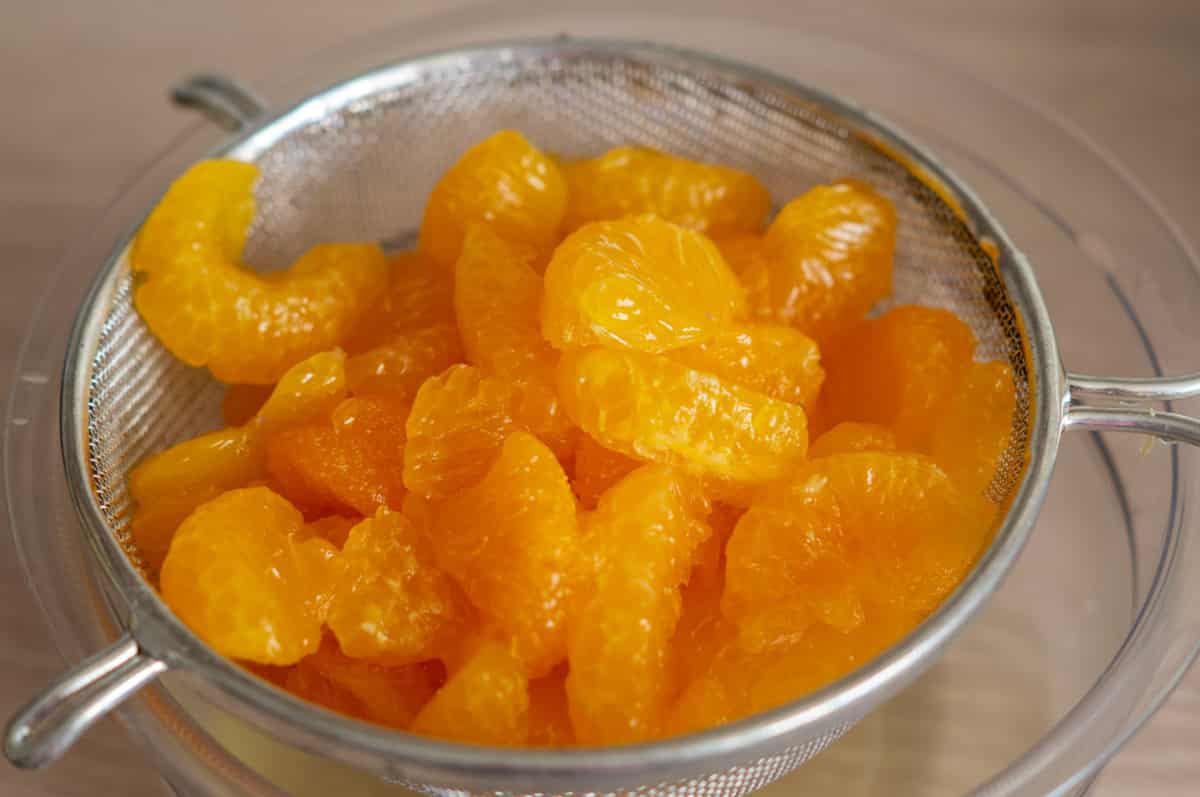
- 30 g tinned mandarin segments well drained
Instructions 0 / 10
-
1
Preheat the oven.
Preheat the oven to 140 °C (fan 120 °C, gas mark 1). Line a baking tray with baking paper.
-
2
Pulverise the sugar.
For the batter, place the sugar in the mixing bowl and pulverise for 10 seconds / speed 10.
-
3
Pulverise the almonds.
Add the almonds to the mixing bowl, pulverise for 20 seconds / speed 10 and set aside.
-
4
Whip the egg whites.
Insert the butterfly whisk. Place the egg whites and salt in the mixing bowl and whip on speed 3.5 until stiff peaks form.
-
5
Colour the batter.
Add the sugar-almond mixture, orange flavouring and food colouring and mix for 20 seconds / speed 1.
-
6
Pipe the macarons.
Transfer the mixture to a piping bag and pipe rounds of approximately 2 cm onto the baking paper, leaving 3 cm between each one.
-
7
Bake the macarons.
Dry the macarons on the middle shelf of the oven for approximately 35 minutes. Remove and leave to cool on the baking paper.
-
8
Melt the couverture.
Meanwhile, rinse the mixing bowl. Break the couverture into pieces, place in the mixing bowl, chop for 4 seconds / speed 8 and melt for 3 minutes / 50 °C / speed 2.
-
9
Mix in the quark.
Add the quark and mandarins and mix for 5 seconds / speed 6. Transfer the mixture to a piping bag.
-
10
Fill the macarons.
Carefully remove the macarons from the baking paper and place on a work surface. Turn half of the macarons flat side up. Pipe a dollop of ganache onto each flat side. Place the remaining macarons on top as lids.
Nutrition per piece: 84 kcal - 2 g protein - 9 g carbohydrates - 4 g fat
Nutrition per serving
What actually makes macarons work
The macaronage is not a step you can skip. When the sugar-almond mixture is folded into the stiff egg whites, the recipe mixes them on speed 1 for 20 seconds. The result should be heavy and glossy, but still hold its shape. Too much mixing makes the batter runny; too little leaves it grainy. The classic test: a spoonful of batter should flow off the spoon like thick lava, slowly and in a wide ribbon. If the batter drops off in blobs, mix for a few more seconds.
Tapping the tray is not optional. Once the rounds are sitting on the baking paper, drop the tray several times from a height of 5 cm onto the work surface. Air bubbles inside cause the shells to crack during baking. Tapping drives them out. The surface should then flow back smooth.
Macarons need resting time. Straight from the oven the shells taste of very little, because the filling has not yet absorbed moisture. Leave the filled macarons in the fridge for one day. What comes out the next day is a different biscuit entirely: the shells become soft and creamy on the inside, while the outside retains a slight bite. That is what makes macarons from a patisserie so special.
Where macarons crack or turn hollow
Macarons crack open
Air bubbles in the batter are almost always the cause, less often the temperature. Tapping the tray helps reliably. For extra assurance: leave the piped shells to dry at room temperature for 30 minutes before they go into the oven. The surface forms a skin and will not crack during baking.
Macarons do not set firm
This comes down to the egg whites: they must be truly stiff. Any trace of fat in the mixing bowl will prevent this. Rinse the mixing bowl and wipe it dry before whipping. No yolk must get into the egg whites, not even the smallest piece. The butterfly whisk must be inserted. Our solution: whip the egg whites at speed 3.5 and watch through the lid opening. When the mixture no longer flows and firm peaks form, it is ready.
Ganache is too runny after chilling
The 30 g of mandarins must be really well drained, otherwise the liquid throws off the balance of the ganache. Leave them to drain in a fine sieve for at least 10 minutes. The ganache, straight after mixing at speed 6 for 5 seconds, is initially warm and runny. At least one hour in the fridge and it will have the right consistency.
Chocolate, pistachio or raspberry filling
Lemon instead of orange: Replace the orange flavouring with lemon flavouring, leave out the food colouring or colour yellow. In the ganache, use 30 g of lemon curd in place of the mandarins.
Chocolate: Pulverise 20 g of cocoa powder together with the almonds. No food colouring needed. In the ganache, replace the white couverture with dark and increase the quark to 40 g.
Raspberry filling: Replace the mandarins with 30 g of raspberry jam (blended smooth and drained). Colour the shells with red food colouring.
Making good use of leftover egg whites: Anyone who bakes macarons regularly will quickly end up with spare egg yolks. These can be used to make Thermomix® Advocaat, using the zero-waste method we describe there.
5 days in the fridge, frozen up to 3 months
Unfilled shells keep for 1 to 2 weeks stored between layers of baking paper in a biscuit tin, in a cool, dry place. For longer storage, freeze them: in an airtight box with baking paper between the shells, they keep for up to one month. Leave to thaw unfilled, then fill afterwards.
Store filled macarons in the fridge and eat within 3 days. After the resting time they are at their best; they do not improve further.
Brioche, piped biscuits or Advocaat as a cluster
Goes well with: coffee.
Macarons make a perfect finale to a French meal. As a starter, Thermomix® brioches work very well, light and buttery, classically French. Anyone looking for a dessert that is even more impressive can make Thermomix® piped biscuits in various shapes and glazes.