Bicarbonate of soda works alkalinely, oil dissolves fat-based residues, and washing-up liquid emulsifies the two phases. Our three-component paste covers all the main adhesive types used by label manufacturers. That is why this label remover paste made in the Thermomix® works even on stubborn stickers where single-ingredient solutions fail.
We have been mixing this remover for years to clean the preserving jars we refill every season. 10 sec / speed 6 in the Thermomix® emulsifies the three phases into a stable paste that does not separate immediately when you brush it on. Stirred by hand, the oil tends to float to the top and the bicarbonate of soda sinks to the bottom.
Label Remover Paste with the Thermomix®
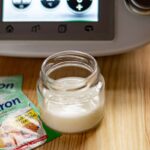
Ingredients 0 / 3 ✓
- 30 g oil
- 10 g washing-up liquid
- 60 g bicarbonate of soda
Instructions 0 / 2
-
1
Mix the ingredients.
Add the oil, washing-up liquid and bicarbonate of soda to the mixing bowl and mix for 10 sec / speed 6.
-
2
Fill into a jar. Transfer to a screw-top jar and shake well before each use.
Tip: Apply the label remover with a cloth or brush directly onto the label or sticky residue and leave to work for a few minutes. Then rinse off with warm water.
Why three ingredients instead of one
Label adhesives are either water-soluble, fat-soluble, or solvent-soluble (smarticular 2021). That is why single-ingredient solutions often fall short: oil alone cannot tackle water-soluble adhesives, and washing-up liquid alone cannot handle tough fat-based ones.
Our paste combines all three mechanisms:
- Bicarbonate of soda acts alkalinely and neutralises water-soluble adhesives. It also provides gentle abrasion without scratching (kurzcnc-fertigung.de March 2026).
- Oil dissolves fat-based adhesive residues. Leave to work for 15 to 60 minutes depending on how stubborn the label is (etiketten-drucken.de July 2025).
- Washing-up liquid emulsifies both phases and makes the paste spreadable. The surfactants also boost its cleaning power.
The ratio of 60 g bicarbonate of soda, 30 g oil, and 10 g washing-up liquid is deliberately heavy on bicarbonate of soda. Most preserving jar labels use water-soluble or mildly fat-based adhesives. For very stubborn cases, you can increase the oil to 40 g.
Bicarbonate of soda settles: shake before every use
Bicarbonate of soda is denser than oil and settles at the bottom of the screw-top jar. After a few days the mixture can separate into layers: oil on top, white bicarbonate of soda mass at the bottom. That is not spoilage, it is simply physics.
Before each use, shake the jar vigorously until the paste looks homogeneous again. If you forget this step, you end up applying either pure oil or pure bicarbonate of soda, and the triple-action effect is lost.
We ignored the separation issue in the first few months and could not work out why the remover worked sometimes and not others. Since then we shake the jar for at least 10 seconds before every use.
How to apply the paste correctly
A brush works better than a cloth because you can apply the paste precisely onto the label without wasting too much. We use an old basting brush with silicone bristles. A cotton bud also works well for smaller labels.
Apply the paste in a thin, even layer. Piling it on thick does not improve the result, it just means more waste. Leave to work for 10 to 15 minutes (myHOMEBOOK Feb 2025). For stubborn cases, after 15 minutes you can work the residue again with the brush and wait a further 5 minutes.
After the working time, rinse off with warm water. The label usually comes away on its own or can be wiped off with a finger. If any adhesive residue remains, do not scrub. Instead, apply more paste and leave for another 5 minutes.
Leaving it on overnight does not help. The chemical reaction is complete within 15 minutes. Longer only means the paste dries out and you have extra cleaning to do.
Warm works better than cold
If you soak the jar in warm water for 10 minutes beforehand, the paste works faster (beegut.de Feb 2022). The warmth softens the adhesive, and the chemical reactions run noticeably more effectively at 40 to 50 degrees Celsius than at room temperature.
We give jars a quick soak, lift them out while still warm, dry them off roughly, and then apply the paste. The combination of warmth and chemistry often saves 5 minutes of working time.
Warning: do not use boiling water. It can cause jars with stress cracks to shatter. Warm tap water (40 to 50 degrees) is more than sufficient.
Adhesive types where the paste falls short
Very old, baked-on labels from jars that have sat in the sun for years sometimes cannot be removed at all. The adhesive bonds so firmly to the glass that only mechanical scraping with a ceramic-hob scraper helps.
Hot-melt adhesive, used on some product labels, barely reacts to the paste. A hairdryer works better here: direct heat onto the label for 2 minutes, then peel off with a fingernail.
Water-resistant adhesives, which many manufacturers now use (VOL.AT Aug 2025), often need a significantly longer working time. If nothing has happened after 15 minutes, repeat the application and wait another 15 minutes. By the second round, most of the residue should come away.
On plastic jars or painted surfaces, test the paste on a hidden spot first. Oil can attack certain plastics or leave lacquered surfaces looking dull.
Shelf life and storage
The paste keeps for 3 to 6 months in a sealed screw-top jar. The oil does not go rancid because the quantity is small and we use a neutral oil such as sunflower or rapeseed oil. Bicarbonate of soda keeps indefinitely anyway.
If the paste discolours or smells off after a few months, water most likely got into the jar. Discard it and make a fresh batch. That normally does not happen as long as you reseal the jar immediately after use.
Shake before every use. That is the single most important point. Without shaking you separate only one of the three phases and lose the triple-action effect.
If you regularly reuse preserving jars, it is worth making a larger batch. We double the recipe to 120 g bicarbonate of soda, 60 g oil, and 20 g washing-up liquid, which gives us enough to last the whole preserving season.
Similar household helpers made in the Thermomix®: Magic Spray All-Purpose Cleaner for everyday cleaning around the home.