Flammkuchen with the Thermomix® means: 2 minutes on kneading mode for the dough, 250 °C oven, 5 to 10 minutes baking time. The basic recipe with four topping variations has worked reliably for years.
We show you the dough, the classic Alsatian version with bacon and shallots, and three further toppings: salmon with dill, vegetarian with red cabbage and goat’s cheese, and sweet with apple and pear.
Vegetarian Flammkuchen, Thermomix® (Topping for 4 pieces)

Ingredients 0 / 8 ✓
- 100 g Emmentaler
- 1/2 leek
- 50 g red cabbage
- 100 g soured cream
- 100 g fresh goat's cheese
- 2 Msp. nutmeg
- 1/4 tsp salt
- 2 pinches pepper
Instructions 0 / 6
-
1
Grate the cheese.
Place the Emmentaler in pieces into the mixing bowl, chop for 5 sec / speed 8, then set aside.
-
2
Prepare the topping.
Wash and trim the leek and red cabbage, place in pieces into the mixing bowl, chop for 3 sec / speed 5 and set aside.
-
3
Preheat the oven.
Preheat the oven to 250°C (top and bottom heat).
-
4
Spread the topping.
Place the soured cream, goat's cheese, nutmeg, salt and pepper into the mixing bowl, mix for 15 sec / speed 4 and spread over the dough.
-
5
Scatter the toppings.
Spread the vegetables over the dough and scatter the Emmentaler on top.
-
6
Bake.
Bake for 5 to 10 min on the middle shelf, keeping a close eye on it.
Video
Nutrition per serving
Why exactly 2 minutes on kneading mode
The dough needs exactly 2 minutes on kneading mode. Less time and the gluten does not develop fully, causing the dough to tear when rolling. Longer and the dough becomes tough and can no longer be rolled paper-thin. The kneading mode works slowly and thoroughly without overheating. That is the difference from speed 6, which would be too fast.
The combination of 150 g wheat flour type 550 and 100 g spelt flour type 630 gives the dough stability and a slightly nutty flavour. Pure type 405 would be too soft, pure spelt too crumbly. The ratio of 150:100 is the result of many tests and is the compromise that rolls out best.
1 hour proving time is the minimum
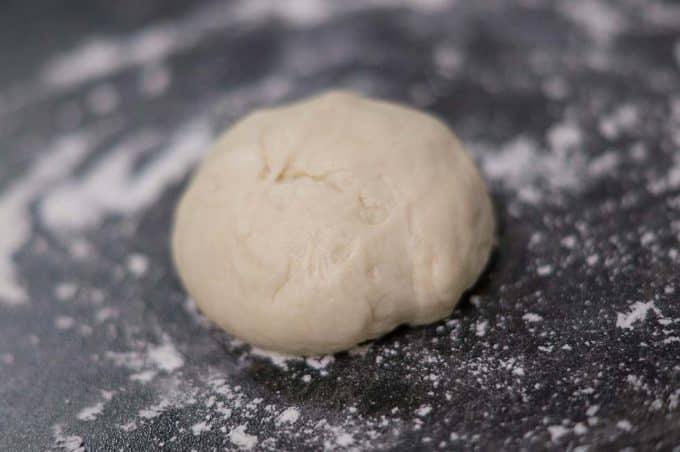
The dough must prove for at least 1 hour in a warm place. Less time and it is harder to work with, as it lacks elasticity. We cover the bowl with a damp cloth to prevent the surface from drying out. At room temperature (around 22 °C), 1 hour is sufficient. In winter, near a radiator it goes faster, so check after 40 minutes.
After proving, divide the dough into four equal portions. Roll each portion out on baking paper as thinly as possible. Paper-thin really means thin, about 2 to 3 mm. Thicker and the Flammkuchen will not be crispy but more like a pizza.
250 °C top and bottom heat, no compromise
Flammkuchen needs 250 °C top and bottom heat. At 200 °C the topping dries out before the base becomes crispy. At 250 °C the dough turns crisp in 5 to 10 minutes and the topping stays moist. Fan-assisted heat distributes too evenly and the base does not crisp up enough.
Preheat the oven until it has genuinely reached 250 °C. This often takes longer than the display suggests. We place the Flammkuchen on the middle shelf and keep watch. After 5 minutes a light golden colour is usually already visible, and after 7 to 8 minutes it is done. Only go beyond 10 minutes if you prefer it very crispy.
Alsatian bacon and shallots as the base
The classic version: crème fraîche as the base, bacon lardons and shallots on top. We chop the shallots for 3 seconds at speed 5 in the Thermomix®, which gives even pieces. The crème fraîche is mixed with oil, salt, pepper and cumin for 15 seconds at speed 3. Cumin is the secret, it gives the Flammkuchen its characteristic depth of flavour.
Scatter the chives only after baking. In the oven they burn, losing their colour and flavour.

Salmon with honey and lemon instead of classic crème fraîche
The salmon version gets a sweet-and-sour crème fraîche base with lemon juice and honey. 2 tsp honey per 200 g crème fraîche, plus 2 tbsp lemon juice. This balances the smoky stremel salmon. Cut cherry tomatoes into quarters, break salmon into pieces. Add dill only after baking, otherwise it turns bitter.
Vegetarian with fresh goat’s cheese and red cabbage
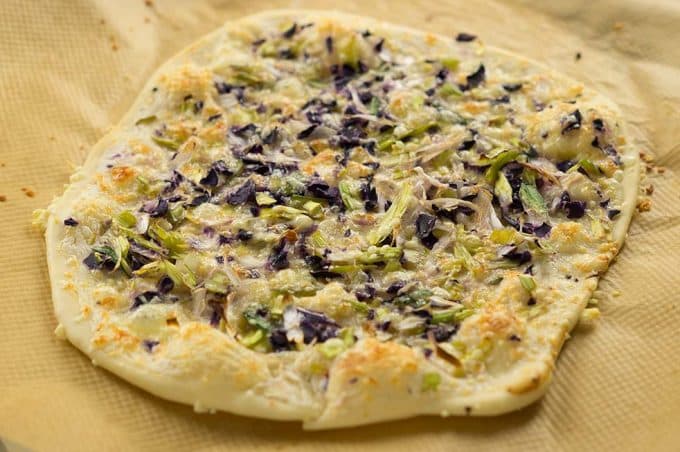
The vegetarian version replaces crème fraîche with a mixture of soured cream and fresh goat’s cheese. This gives more depth than plain crème fraîche. Leek and red cabbage are chopped for 3 seconds at speed 5, then spread over the dough. We scatter Emmentaler on top, even though that is not traditional. Without cheese, though, the salty contrast to the tangy red cabbage is missing.
Sweet Flammkuchen with apple and pear
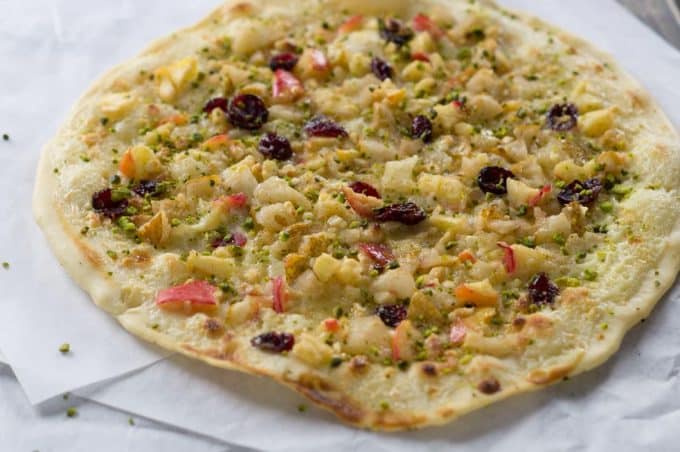
The sweet version gets a crème fraîche and sugar base, with apple and pear and cinnamon on top. Important: chop the apple and pear only roughly, 5 seconds at speed 4. Too fine and they go mushy during baking. The white chocolate is scattered over the finished Flammkuchen, melts slightly and adds sweet accents. Cranberries provide a tart contrast.
Looking for more dough recipes? Take a look at our Thermomix® pizza dough.