Apricot jam with the Thermomix® comes together in a single batch and yields around 10 jars of 200 ml from 1.6 kg of apricots. The short version: chop 1600 g stoned apricots for 10 seconds at speed 5, mix with 750 g 2:1 jam sugar, 50 g Amaretto, 2 tbsp lemon juice and 1/2 tsp vanilla extract, leave to rest for 3 hours, then cook for 16 minutes at 95°C on speed 2. Set test, fill the jars, done.
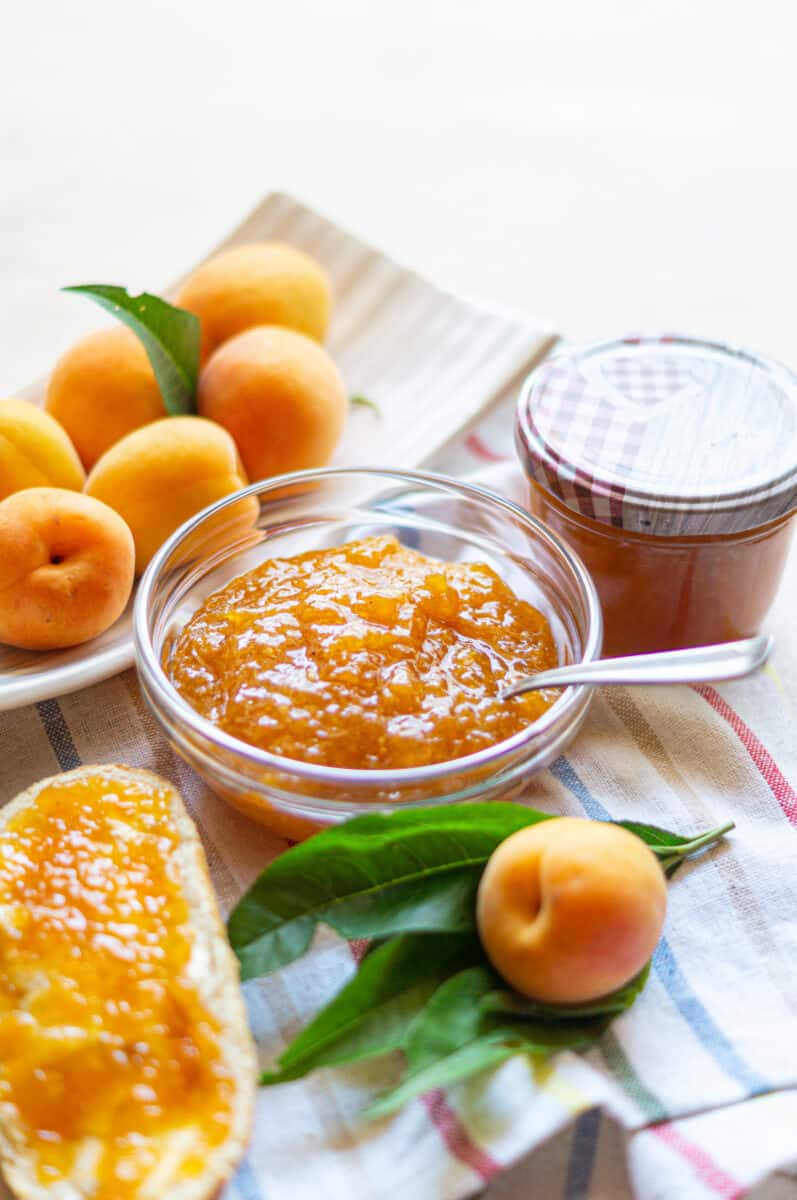
Most Thermomix® recipes online cook only 500 g of apricots into two jars. We go straight for a larger batch, because the apricot season in July and August is short. Making a big batch then means you have summer on toast all year long. It goes beautifully with our Thermomix® pancakes, crêpes and Thermomix® buttermilk pancakes.
Apricot Jam with the Thermomix®

Ingredients 0 / 5 ✓
- 1600 g apricots
- 50 g Amaretto
- 2 tbsp lemon juice
- 1/2 tsp vanilla extract
- 750 g 2:1 jam sugar
Instructions 0 / 4
-
1
Prepare the apricots.
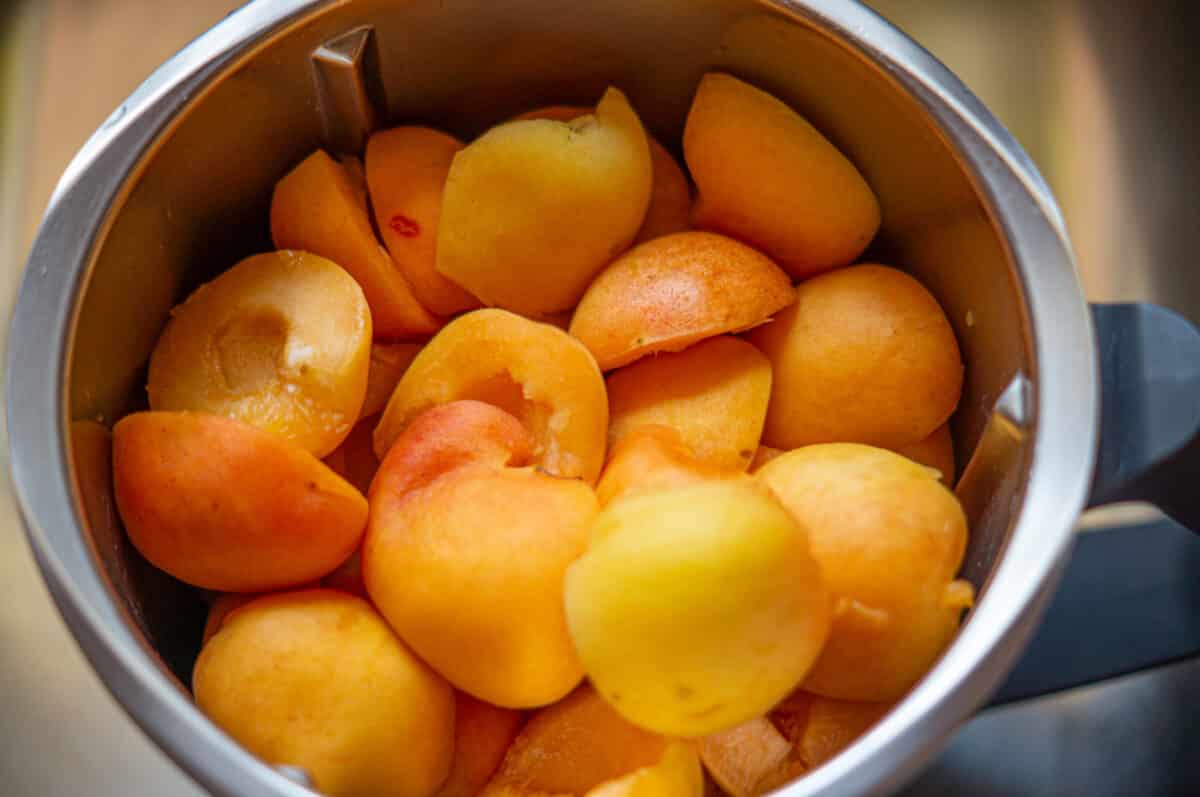
Wash the apricots, remove the stones, cut out any dark spots, place in the mixing bowl and chop for 10 sec / speed 5. The prepared apricots in the mixing bowl should weigh about 1450 g.
-
2
Mix the ingredients and leave to rest.
Add the Amaretto, lemon juice, vanilla extract and jam sugar to the mixing bowl, mix for 10 sec / speed 4 and leave to rest for 3 hours.
-
3
Sterilise the jars.
In the meantime, sterilise the preserving jars with boiling water.
-
4
Cook the jam and fill the jars.
Cook the jam for 16 min / 95°C / speed 2. Carry out a set test. If the jam is still too runny, cook for a further 2 to 3 min / 95°C / speed 2. Keep an eye on it in the final minutes as the jam should not foam up too much. Fill into the prepared jars, seal and leave to cool upside down.
Tip: If you do not have Amaretto to hand or prefer not to use it, simply add the same amount of a fruit liqueur or water instead.
Nutrition per serving
How to make the jam in the Thermomix® step by step
The Thermomix® does three things in one bowl that would otherwise need a blender, a scale and a saucepan all at once. First it chops the apricots in 10 seconds at speed 5 into a chunky pulp. From 1600 g of raw fruit, you are left with about 1450 g after stoning and preparing. It then stirs the jam sugar, Amaretto, lemon juice and vanilla through evenly in 10 seconds at speed 4. Finally it cooks the mixture at a controlled 95°C on speed 2, with no scorching on the bottom.
Scorching is exactly the problem with an ordinary saucepan: sugar burns at too high a heat, and if you are not stirring constantly you end up with caramel notes in the jam. At 95°C on speed 2 the Thermomix® stirs continuously and holds the temperature steady. The 16 minutes of cooking time is a guideline for 2:1 jam sugar. If the set test fails after that time, cook in further 2 to 3 minute intervals at 95°C on speed 2.
Why ripe apricots and Amaretto make the difference
We only use apricots that give slightly when pressed with a thumb. Unripe fruit stays sour and flat, while overripe fruit breaks down during cooking and turns mushy. With this sweet base, 2:1 jam sugar is enough to preserve the fruit flavour without drowning it in sweetness. For 1450 g of prepared apricots, 750 g of 2:1 jam sugar is exactly right. Using 1:1 jam sugar would produce a noticeably sweeter, firmer result where the apricot flavour gets lost.
The real trick, though, is the 50 g of Amaretto. Apricots belong to the stone fruit family and carry the same marzipan-almond note in their kernels as almonds do. Amaretto is an almond liqueur and draws out precisely that character. A simple jam becomes something closer to a rounded Wachau apricot preserve, as you find in Austria. The 2 tbsp of lemon juice provide a fresh counterpoint to the sweetness and support the setting, because the acidity activates the pectin. The 1/2 tsp of vanilla extract rounds everything off without pushing itself forward.
Three common pitfalls that can spoil the jam
The jam does not set
This happens when the set test is skipped or the apricots were too watery. 2:1 jam sugar needs a minimum cooking time, otherwise the pectin does not activate fully.
Our solution: Before filling, drop a small blob onto a cold plate (chill the plate in the freezer beforehand). If the drop does not run after 30 seconds and wrinkles when you tilt the plate, the jam is ready. If not, cook for a further 2 to 3 minutes at 95°C on speed 2 and test again.
The mixture foams up heavily
When cooking with jam sugar, foam forms and leaves small air pockets in the jam that can shorten its shelf life. In the final minutes the mixture should not bubble too vigorously.
Our solution: Cook with the measuring cup resting loosely on top rather than with the mixing bowl lid fully closed, so we can keep an eye on the foam. Stirring in a small knob of butter (about 5 g) at the end of the cooking time causes the foam to collapse. At 95°C rather than 100°C the mixture simmers more calmly than in an open saucepan anyway.
The jars do not keep
If the jars are not sterile or are not filled while the jam is still hot, mould quickly develops. This is the most common reason why home-made jam spoils.
Our solution: During the 3 hours of resting time, rinse the preserving jars with boiling water or sterilise them in the oven for 10 minutes at 120°C. Fill the jars to the brim with the hot jam, seal immediately and leave to cool upside down. As the jam cools, a vacuum forms that pulls the lid down.
Five variations on the apricot jam
Peach and apricot mix: Replace half the apricots with ripe peaches (800 g apricots, 800 g peaches). The result is slightly milder and more floral.
Almond crunch: Stir in 50 g of flaked almonds in the last 2 minutes. This intensifies the marzipan note of the Amaretto and adds a pleasant bite.
Rosemary apricot: Cook a sprig of rosemary with the jam and remove before filling. This gives a Mediterranean, lightly resinous note that goes well with cheese.
Alcohol-free: Replace the Amaretto with the same amount of water or fruit juice and add 1 tsp of bitter almond flavouring. The almond note stays, without the alcohol.
Pure vanilla: Instead of 1/2 tsp of vanilla extract, use the seeds of half a vanilla pod. More intense, with visible vanilla specks in the jar.
How we use the apricot jam
On toast at breakfast it is the classic choice, but it can do much more. With a strong cheese such as goat’s cheese or Brie, it provides a sweet, fruity contrast. In Linzer biscuits or as a thin layer in a Sacher torte it works as a baking ingredient. A spoonful stirred into plain yoghurt or spooned over vanilla ice cream turns either into a quick dessert. And as a glaze on a pork roast for the last 15 minutes of cooking time it gives a glossy, lightly sweet crust.
If you enjoy making preserves, we also have a recipe for strawberry jam with the Thermomix®. The method with jam sugar and the set test is the same, only the fruit and flavourings change.
How long the jam keeps in the store cupboard
Filled into sterilised jars with a good vacuum seal, the apricot jam keeps for around 12 months, stored in a cool, dark cupboard. The Amaretto also acts as a preservative, as alcohol inhibits bacterial growth. Once opened, the jar should go in the fridge and will keep for 4 to 6 weeks.
One important point when opening: always use a clean spoon, never one that has been licked. White or green spots on the surface are mould; if you see them, throw the whole jar away rather than just scooping off the affected area. With clean technique and a proper seal, this should rarely happen.
Goes well with: butter, cream cheese and yoghurt.
You might also like: mulled wine jelly with the Thermomix®.