Sausage goulash comes down to a single sequencing decision: the frankfurters go into the mixing bowl only at the very end. The sausages are already cooked and smoked. If you let them simmer for 20 minutes, they push salt and broth sediment into the sauce and you get fibrous, washed-out pieces of sausage in return. That is the difference between a stew that tastes of sausage and one where the sausage is just along for the ride.
We have had this recipe in our weekly rotation for years. On evenings when we have no desire to sear or braise, it comes together in the Thermomix® from a single tin of tomatoes, one bell pepper, a bag of frozen peas and 200 g of frankfurters. The savoury depth of the sausages takes on the role that hours of braising beef play in a classic goulash. The trick lies in the sequence, not the cooking time.
Quick Sausage Goulash with the Thermomix® (One-Pot)
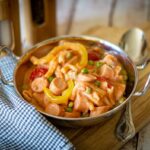
Ingredients 0 / 11 ✓
- 1 onion
- 10 g rapeseed oil
- 400 g tinned chopped tomatoes
- 600 g vegetable stock
- 1 1/2 tsp salt
- 1 tsp pepper
- 1 yellow bell pepper
- 150 g peas frozen
- 200 g frankfurter sausages
- 200 g maccheroncini
- 100 g soured cream
Instructions 0 / 5
-
1
Chop the onion.
Peel the onion, halve it, place in the mixing bowl and chop for 5 sec / speed 5, then scrape down with the spatula.
-
2
Sweat the onion.
Add the oil and sweat for 3 min / Varoma / speed 1.
-
3
Cook the sauce.
Add the tomatoes, vegetable stock, salt and pepper and heat for 5 min / 100°C / speed 1.
-
4
Prepare the pepper and sausages.
Meanwhile, wash the bell pepper, halve it, remove the seeds and stalk, and cut into strips. Cut the frankfurter sausages into slices.
-
5
Cook.
Add the bell pepper, frankfurter sausages, peas, pasta and soured cream to the mixing bowl and cook for 10 min / 90°C / reverse direction / gentle stir setting.
Tip: If you want to use different pasta, make sure it is not too large. Otherwise it will not be cooked through in the stated cooking time.
Prefer something heartier? Try Debrecziner sausages instead of frankfurters.
Nutrition per serving
Why the order makes all the difference
Frankfurters are not braising meat. In the smoking vat they were already brought to core temperature and smoked over beechwood. If we cook them together with the tomatoes and stock for 20 minutes, three things happen: the smoky aroma migrates into the broth (the sauce turns murky and salty), the salt from the sausage meat leaches out (the frankfurters become bland), and the casing splits open and goes spongy (it breaks apart during stirring). That is exactly what we want to avoid.
The mixing bowl reverse direction is essential as soon as the pasta goes in. Maccheroncini are short and sturdy, but on normal direction at speed 1 the blades would cut them apart within 5 minutes. With reverse direction on the gentle stir setting, the blades turn with the blunt side leading. The pasta cooks in the broth without leaving us with broken pasta pieces floating in the sauce.
The tomatoes need their own head start. 5 minutes at 100°C is enough for the acidity from the tin to mellow and the tomato pulp in the juice to dissolve. Anyone who throws in the sausages, pepper and peas at the same time ends up with a tomato stew that tastes sharp and acidic from the start. The two phases are not a convenience, they are about flavour.
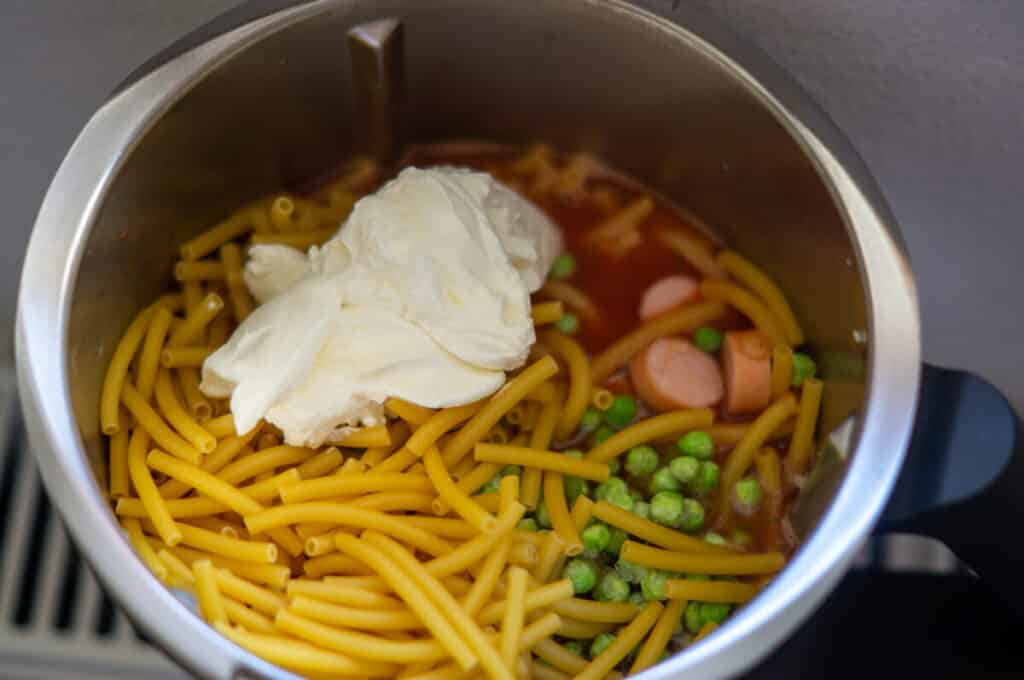
What happens in the mixing bowl in 20 minutes
We chop the onion with 5 seconds at speed 5 to a rough dice. With 10 g of rapeseed oil, 3 minutes at Varoma on speed 1 take away the sharpness and sweat the onion. Then in go the 400 g of tinned chopped tomatoes, 600 g of vegetable stock, 1 1/2 tsp of salt and 1 tsp of pepper, 5 minutes at 100°C on speed 1.
While the sauce is cooking, we slice the bell pepper into strips and the frankfurters into rounds. Both go in together with 150 g of frozen peas, 200 g of maccheroncini and 100 g of soured cream. Now comes the key step: 10 minutes at 90°C on reverse direction and gentle stir setting. The temperature is deliberately kept below 100°C so the soured cream does not split and the sausage casings do not burst. After 10 minutes the pasta has absorbed the broth, the peas are thawed and just heated through, the bell pepper is still slightly firm and the frankfurters are warm without losing their shape.
What often goes wrong on the first attempt
The sausages fall apart and the sauce is milky grey
This is usually a temperature problem. If you cook at 100°C or Varoma instead of 90°C, the thin casing of the frankfurters splits open. The water from inside the sausage then runs into the sauce. Our fix: 90°C is the upper limit. Better to cook a couple of minutes longer at 90°C than shorter at 100°C. The pasta still cooks through in the hot broth at 90°C.
The pasta is mushy or hard
Maccheroncini are roughly 3 cm long and suit the 10-minute cooking time well. Anyone using penne, fusilli or rigatoni will end up with either a hard centre or a mushy exterior. Our fix: For larger pasta shapes, do not extend the cooking time. Instead, soak the pasta for 3 minutes in hot water beforehand, then add it to the mixing bowl along with the sausages. This evens out the size difference without exposing the sausages to extra heat.
The sauce tastes flat despite the salt and pepper
Tinned tomatoes vary a lot in acidity. If the sauce suddenly tastes thin and sharp after cooking, it usually needs some sweetness to balance it out. Our fix: Add 1 tsp of tomato puree together with the tomatoes. This gives more tomato depth and a little natural sweetness. If you have no tomato puree, a pinch of sugar also helps. Season finally at the end, because the frankfurters still release a little salt into the sauce during the 10-minute step.
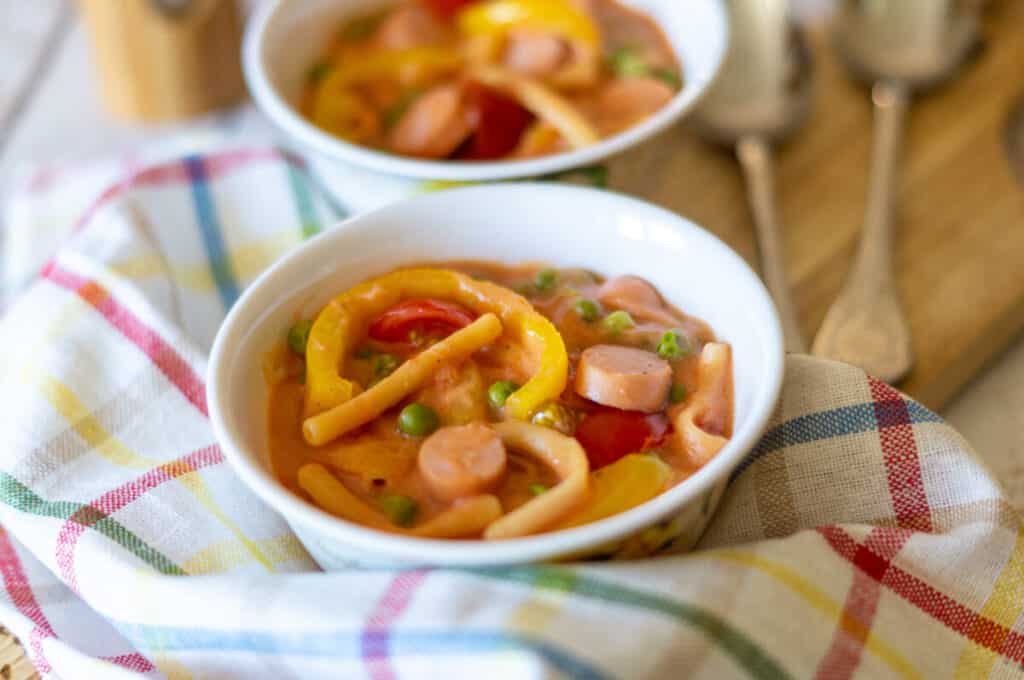
How we vary the recipe day to day
With Debrecziner instead of frankfurters: The Hungarian paprika sausage has a noticeably stronger smoky aroma and brings a spicy kick of its own. We use it when we want the goulash to really taste like goulash. The cooking time stays the same, but we reduce the salt to 1 tsp because Debrecziner is already well seasoned.
With Bockwurst for children: Bockwurst is milder, less smoky and much more popular with children. We leave out the pepper entirely and add half a tsp of sweet paprika at the end so the sauce still looks reddish-brown rather than orange.
Without soured cream, with creme fraiche instead: Creme fraiche has 30% fat and splits more reliably at 90°C than soured cream at 24%. It makes the sauce a little more velvety. We use it when there is already a tub in the fridge.
With sweetcorn instead of peas: A small tin of sweetcorn (140 g drained weight) brings more sweetness and works particularly well with Bockwurst. Peas give the dish its classic stew character, sweetcorn pushes it towards a children’s meal.
With roasted peppers from a jar: If you have no fresh bell pepper at home, use 150 g of roasted peppers from a jar, drained and cut into strips. They give the sauce a slightly smoky note that complements the smoked character of the sausages well.
What we often serve alongside
We usually eat the sausage goulash straight from a soup bowl on its own. On days when someone comes home really hungry, a slice of bread on the side is welcome. Our spelt baguette from the Thermomix® works very well because the crumb is firm enough to soak up sauce without going soggy. For something even simpler, our flatbread, ready in 30 minutes, can be made alongside the goulash at the same time. For children, our crumble cake also makes a calm finish after a hearty dinner.
How leftovers keep the next day
The goulash keeps for two days in the fridge in a sealed container. When reheating, the pasta absorbs more liquid, so we add 50 to 80 ml of water or vegetable stock before warming it through. We heat it in a saucepan over medium heat rather than in the microwave, because the sausages warm unevenly in the microwave.
Freezing works only with reservations. The peas and bell pepper go soft after thawing and the pasta loses its bite. When we cook a batch ahead, we freeze only the tomato and sausage sauce up to the soured cream step and cook fresh pasta when we reheat it. That keeps the texture intact.
How other recipes approach it differently
Goes well with: sourdough bread and Parmesan.
Many sausage goulash recipes for the Thermomix® use frankfurters with bell pepper and tomato puree, but serve it as a plain stew with bread, rice or potatoes on the side. Other popular versions work with two large onions (around 350 g), tinned tomatoes and sweet paprika powder but leave out the pasta entirely. Some recipes use glass-jar sausages with 300 ml of beef stock and treat Bockwurst or Frankfurter as interchangeable. We go one step further and cook the maccheroncini directly in the pot, adding frozen peas and a yellow bell pepper for colour. The result is an all-in-one dish with no second side needed, on the table in 25 minutes with just one load for the dishwasher.
More stews and quick main courses with the Thermomix® are in our stew recipe collection. Further one-pot ideas for busy weeknights are in our main courses collection.