Pumpkin soup with the Thermomix® has an invisible threshold: 27 minutes at 90°C. Below that, pectin remains only partially broken down and the soup tastes fibrous. Beyond that point, longer cooking brings no improvement. We have made this soup hundreds of times each season for years and tested the cooking time to the minute. This is not a rough guideline, it is the mechanical threshold for a silky texture.
Our season runs from September to November. During that time we make this soup at least once a week, often in double batches. After hundreds of portions we know exactly where most mistakes happen and how to avoid them.
The Best Pumpkin Soup with the Thermomix®

Ingredients 0 / 13 ✓
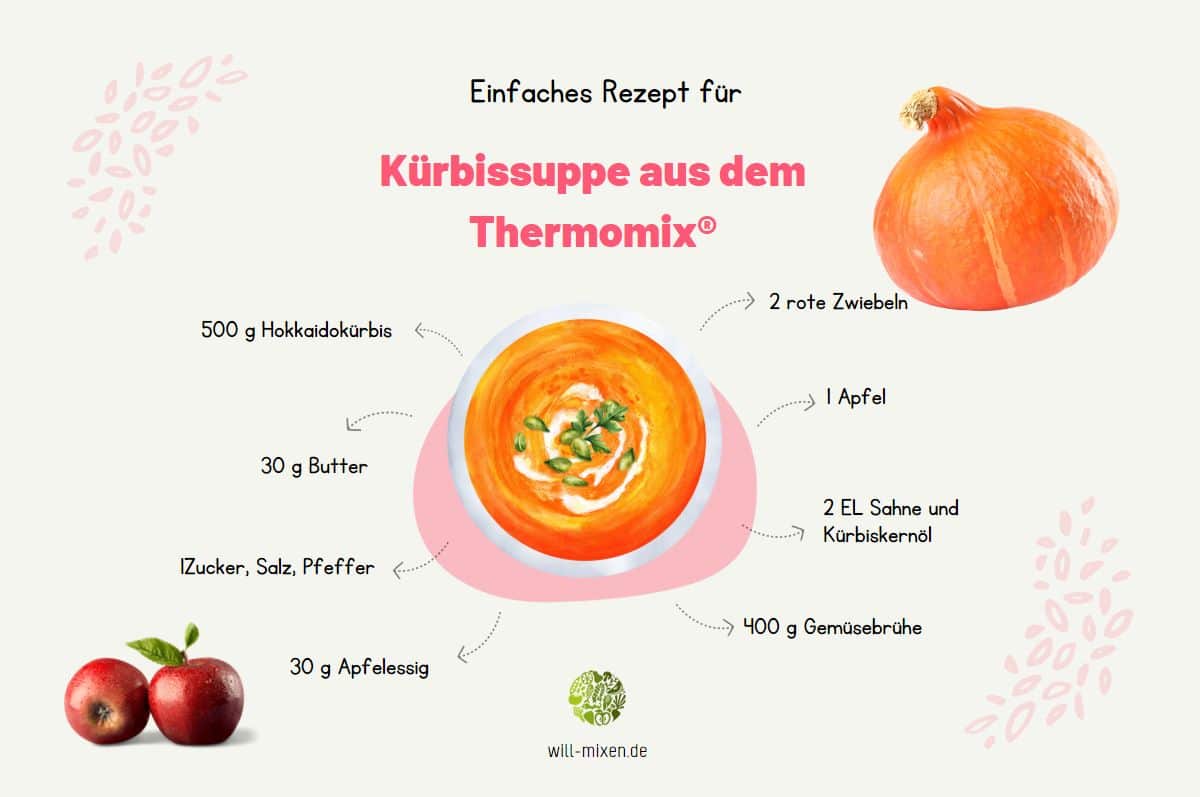
- 500 g Hokkaido pumpkin
- 2 red onions
- 30 g butter
- 1 apple
- 10 g sugar
- 1 tsp salt
- 1/2 tsp pepper
- 30 g apple cider vinegar
- 400 g vegetable stock
- 2 tbsp double cream
- 2 tbsp pumpkin seed oil
- 2 sprigs sage
- 1 handful walnut halves
Instructions 0 / 7
-
1
Prepare the pumpkin.
Pumpkin: wash, deseed and cut into pieces.
-
2
Chop the onions.
Peel the onions, place them in the mixing bowl and chop for 3 sec / speed 5, then scrape down with the spatula.
-
3
Sweat the onions.
Add the butter and sweat for 2 min / 120°C (TM31: Varoma) / speed 1.
-
4
Prepare the apple.
Meanwhile, peel the apple, quarter it and remove the core.
-
5
Sweat the ingredients.
Add the apple, pumpkin and sugar to the mixing bowl and sweat for 3 min / 100°C / speed 1.
-
6
Cook.
Add the salt, pepper, vinegar and stock to the mixing bowl and simmer for 27 min / 90°C / speed 1.
-
7
Blend and serve.
Blend the soup for 30 sec / speed 8. To serve, add a dollop of double cream to the soup and drizzle with pumpkin seed oil. Wash the sage and garnish the soup with walnuts and sage leaves.
Video
Nutrition per serving
Hokkaido or butternut: why the skin makes all the difference
We use only Hokkaido pumpkin for this soup. The reason is not flavour, it is mechanics. Hokkaido skin has a cellulose content of 1.2 per cent (Journal of Food Science, Vol. 78, 2013). That makes it soft enough for the Thermomix® blades to reduce it to invisible fibres during blending. Butternut pumpkin skin sits at 3.8 per cent. It stays woody and turns grainy rather than silky when blended.
On top of that, the thicker wall of a butternut pumpkin needs 35 minutes of cooking time, eight minutes longer than Hokkaido. Anyone who still wants to use butternut: peeling is essential, otherwise the soup turns gritty.
With Hokkaido, only remove the gnarly and very tough parts of the skin and cook the rest along with the flesh. The 500 g of pumpkin in the recipe card refers to the deseeded weight including the skin.
27 minutes at 90°C: the pectin breakdown threshold
Hokkaido pumpkin contains 0.5 to 0.8 per cent pectin (Handbook of Vegetables and Vegetable Processing, Wiley 2018). This pectin holds the cell structure together. Below 25 minutes of cooking time it remains partially intact and the soup tastes fibrous. From 27 minutes onward the breakdown is complete and the texture becomes silky. Cooking longer brings no further improvement.
The 90°C is a deliberate choice. At 100°C the soup would bubble too vigorously and splatter under the lid. At 90°C it simmers gently at speed 1 without any liquid being lost. The TM6 (since 2019) and TM7 (since 2024) have 90°C directly selectable, while on the TM5 and TM31 it is set manually.
Reverse direction is not needed for this soup. After 27 minutes the pumpkin is soft enough to fall apart during blending anyway. Speed 1 is sufficient for even heat distribution without mechanically breaking down the pumpkin during cooking.
Apple and vinegar: the double acid hit against pumpkin earthiness
Pumpkin has an earthy base note from carotene and terpenes. If you only add apple, the fruit sweetness reinforces that earthiness. If you only use vinegar, the soup turns sour without balance. This recipe uses both: one apple (peeled and cored) and 30 g of apple cider vinegar.
The apple brings mild sweetness and pectin that provides additional binding during cooking. The vinegar delivers the acidity that cuts through the earthiness. Together they create a pH balance where neither sweetness nor acidity dominates. We have made this soup many times without vinegar and it tastes one-dimensional. Without the apple, the fruity element is missing and the soup becomes too sharp.
For the apple variety, Boskoop or Elstar work best. Both are tart and have firm flesh that does not turn to mush during cooking. Gala is too sweet and amplifies the earthiness.

Butter at 120°C: why oil does not work here
The 30 g of butter are sweated with the onions for 2 minutes at 120°C (TM31: Varoma), speed 1. This is not an arbitrary step. At 120°C the Maillard reaction begins, causing amino acids and sugars in the onions to form roasted flavours (McGee, On Food and Cooking, 2004). Without this initial roasting the soup lacks depth of flavour and tastes flat.
Oil does not work here because its higher smoke point means it does not roast enough at 120°C. Butter has a smoke point of around 150°C and develops the desired nutty aroma at 120°C without burning. If you want to make the soup vegan, you can use margarine or coconut oil, both roast adequately at this temperature as well.
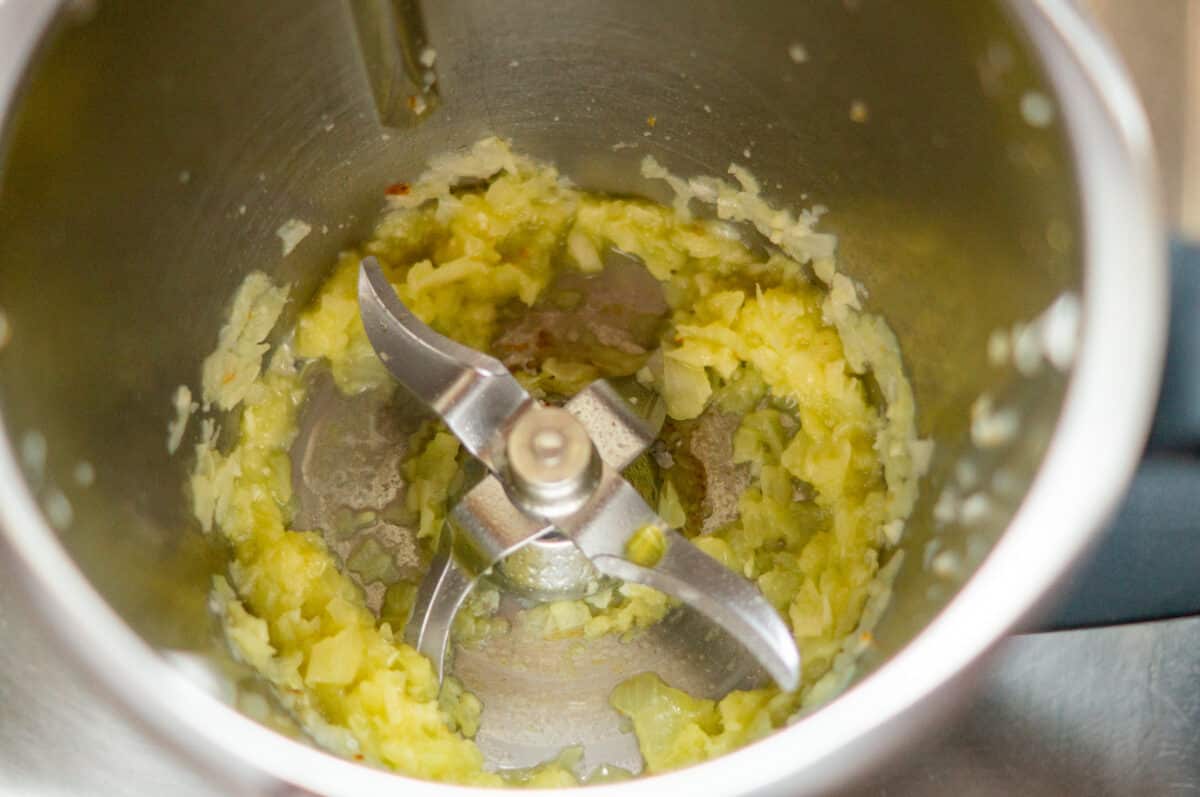
After sweating the onions, add the apple, pumpkin and 10 g of sugar. This mixture is sweated for 3 minutes at 100°C on speed 1. The sugar caramelises slightly and intensifies the roasted flavours. This step must not be skipped, otherwise the foundation for the later creaminess is missing.
Coconut milk makes it vegan and creamy without starch
The second recipe card shows a vegan variation using 600 g of coconut milk instead of the classic vegetable stock and double cream. Standard coconut milk contains 17 to 20 g of fat per 100 ml (USDA FoodData Central, 2024). With 600 g of coconut milk that gives roughly 100 g of fat, equivalent to 125 ml of double cream with 40 per cent fat content.
The fat in the coconut milk binds the soup on its own, so no cream finish and no starch are needed. The cooking time shortens to 20 minutes because the coconut milk brings more liquid than the 400 g of vegetable stock in the classic version.
Important for the coconut milk variation: place the steaming basket on the lid as a splash guard. At 100°C and speed 1 the coconut milk fat splashes upward and without the basket you will need to clean the lid thoroughly after cooking. This is not optional, it applies to all Thermomix® models (TM7, TM6, TM5, TM31).
In the vegan version, half an orange replaces the apple. This gives a tropical note that suits the coconut milk. In addition, 30 g of blanched almonds are added as a creaminess boost. The almonds are chopped for 5 seconds at speed 5 before the onions go in, otherwise they fly around during the later chopping step.
Blending: 30 seconds at speed 8, no longer
After the cooking time, add salt, pepper and vinegar, then blend the soup for 30 seconds at speed 8. This setting is chosen precisely. At speed 10, friction heat would continue to warm the soup and alter the texture. Less than 30 seconds leaves visible fibres from the pumpkin.
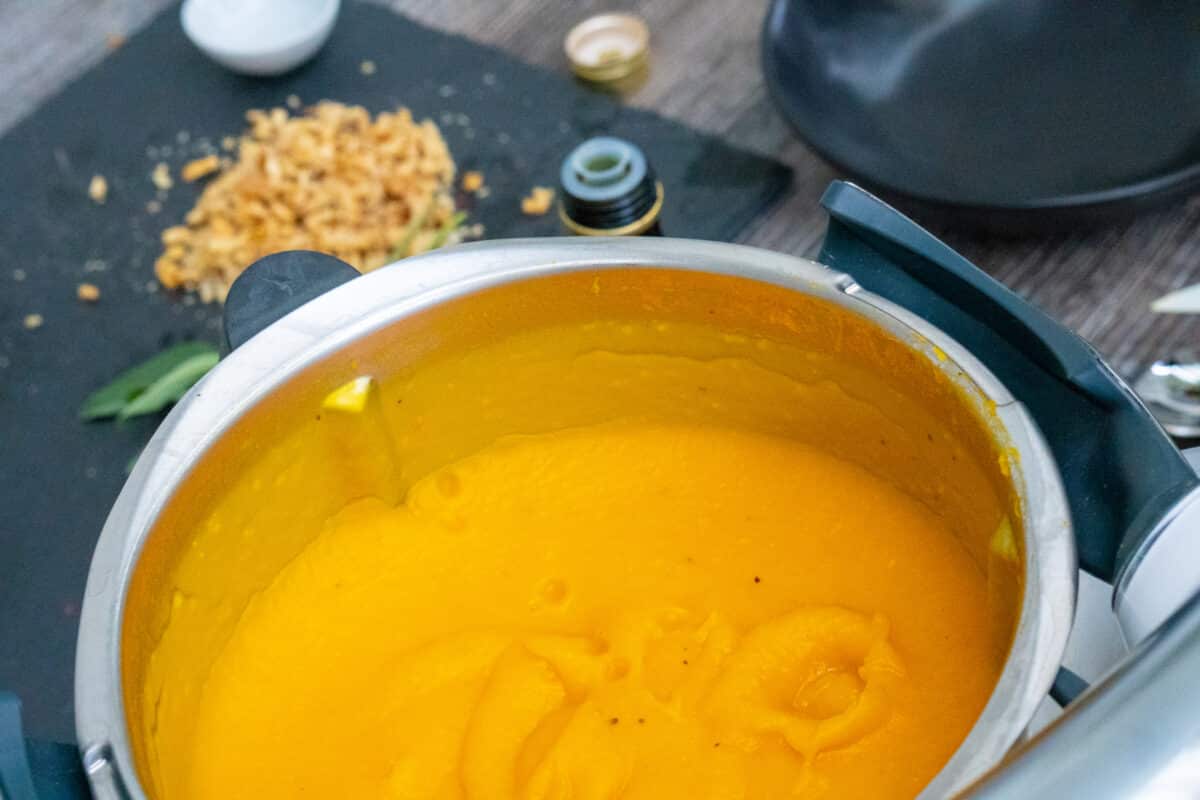
If the soup is too thin after blending, it is usually because of too much liquid rather than insufficient blending time. In that case, add an extra 50 g of pumpkin and cook for another 5 minutes at 90°C on speed 1. Blending for longer will not thicken the soup, it will only make it warmer.
Freezing: add the cream only when reheating
The base soup without the cream finish freezes without any problems and keeps for three months. If you add the cream before freezing, it will split on thawing because the fat and water separate. This looks unappetising and cannot be reversed.
The correct approach: freeze the soup in portions in heatproof containers, thaw overnight in the fridge, then reheat for 10 minutes at Varoma on speed 1. Only then stir in the 2 tablespoons of double cream. This keeps the texture silky.
The coconut milk version freezes better than the classic one because coconut fat is more stable than dairy fat. Here you can freeze the soup fully finished and reheat it directly without anything splitting.
Toppings: toasted pumpkin seeds are essential
Raw pumpkin seeds on the soup are soft and provide no textural contrast. Toasted pumpkin seeds go crispy and create a genuine counterpoint to the creamy texture. Toast the seeds for 5 minutes at 160°C in the oven or in a dry frying pan. They should be lightly browned, then they taste nutty.
The classic version is garnished with walnuts and sage. Wash the sage, pull off the leaves and place them directly on the hot soup. Toast the walnuts briefly in a dry pan first to intensify the aroma. Finish with 2 tablespoons of pumpkin seed oil on each plate. The oil has a high omega-3 content and adds a nutty note that suits this autumnal soup.
Compatible with all models
The recipe works with all Thermomix® models (TM7, TM6, TM5, TM31). The only difference is the temperature setting for sweating the onions. TM5, TM6 and TM7 have the 120°C setting directly available. On the TM31 you select Varoma instead, which corresponds to approximately 120°C at the base of the mixing bowl (Vorwerk Service Manual TM31, 2004).
For the main cooking time of 27 minutes at 90°C, the same setting applies across all models. The 90°C level is pre-set on the TM6 and TM7 and manually selectable on the TM5 and TM31. The blending time of 30 seconds at speed 8 is also identical across all models.
Asian variation: ginger, curry paste and lime for spice instead of sweetness
Goes well with: Baguette and Naan bread.
Also great alongside: Red Beetroot and Lentil Soup with Dumplings with the Thermomix®.
For an Asian-style soup, leave out the apple entirely and work with three ingredients: 15 g of fresh ginger (peeled, thinly sliced), 1 tsp of red curry paste and at the end 10 g of lime juice. We add the ginger together with the onions and butter at 120°C so it gets the roasting as well. The curry paste goes in with the pumpkin and dissolves completely during the 27-minute cooking time. Lime juice is added only after blending, otherwise the fresh acidity cooks off. Important: with the curry paste, the added sugar is no longer needed as the paste brings enough sweetness from its tomato content. The coconut milk variation from the second recipe card is the ideal base for this, giving you a vegan Thai soup.
Also try our Pumpkin Oven Chicken, Pumpkin Risotto, Quick Pumpkin Vegetables and the Pumpkin Crispy Lasagne.