Semolina porridge almost always turns lumpy when the semolina falls too quickly into hot liquid and swells up immediately. The Thermomix® solves this problem through constant stirring on reverse direction: the semolina swells evenly and the texture stays silky. Here is the short version: heat 500 g milk, 200 g double cream, 60 g sugar, 1 vanilla pod, 1 pinch of salt and cinnamon for 8 minutes / 100°C / speed 1. Then add 80 g durum wheat semolina plus 1/4 tsp lemon zest and cook for 15 minutes / 90°C / reverse direction / speed 2. Finally mix in 20 g butter for 10 seconds / reverse direction / speed 3. Ready in 30 minutes, 4 servings.
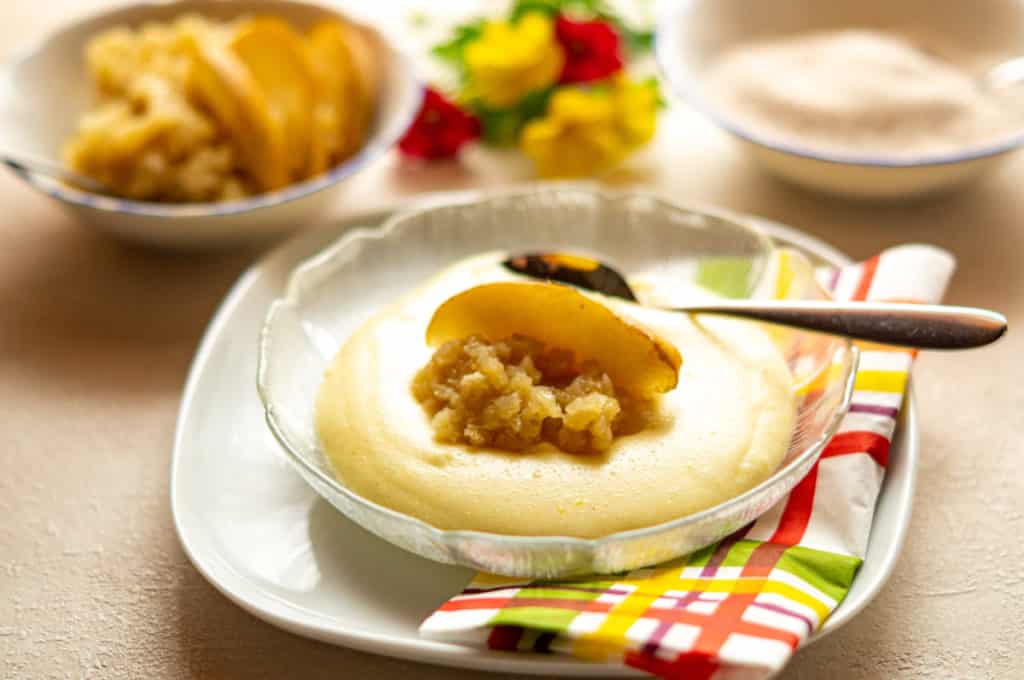
We have been making this semolina porridge for years as a quick lunch or dinner that children eat without complaint. The difference from most recipes: we use 200 g double cream instead of just milk and add a real vanilla pod. The result is creamier and more rounded than the classic version made with 1000 g milk and nothing else. Our Thermomix® rice pudding is just as straightforward if you prefer rice to semolina.
Best Semolina Porridge with the Thermomix®

Ingredients 0 / 9 ✓
- 1 vanilla pod
- 500 g milk
- 200 g double cream
- 1 pinch salt
- 60 g sugar
- 1 pinch ground cinnamon
- 1/4 tsp lemon zest
- 80 g durum wheat semolina
- 20 g butter
Instructions 0 / 3
-
1
Heat the ingredients.
Slit the vanilla pod open and scrape out the seeds. Add the seeds and pod to the mixing bowl together with the milk, double cream, salt, sugar and cinnamon, then heat for 8 minutes / 100°C / speed 1.
-
2
Cook.
Add the lemon zest and semolina to the mixing bowl and cook for 15 minutes / 90°C / reverse direction / speed 2.
-
3
Mix and serve.
Add the butter and mix for 10 seconds / reverse direction / speed 3.
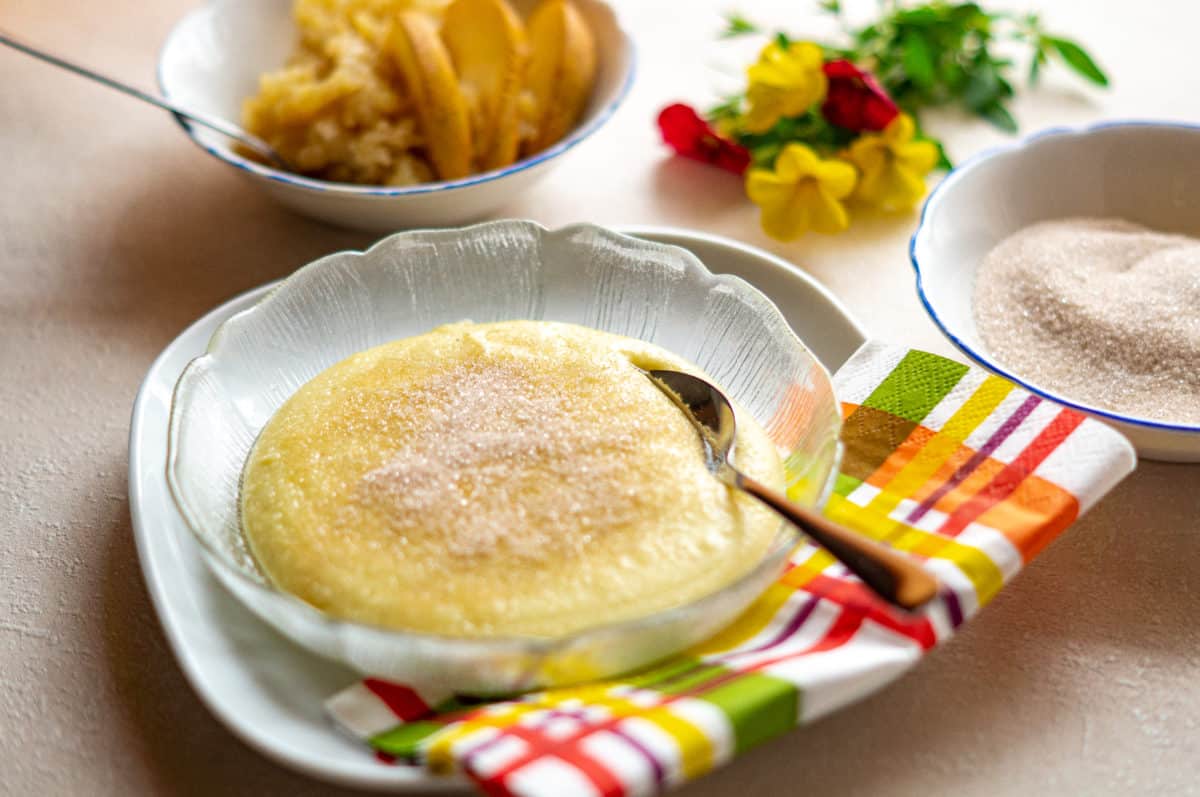
Tip: Serve the semolina porridge with cinnamon sugar or a dollop of compote on the side.
Nutrition per serving
Durum wheat semolina or soft wheat semolina: which one goes in the porridge?
This is the most common question and the point where recipes differ. Many Thermomix® recipes default to soft wheat semolina because it contains more starch and binds faster. We deliberately use 80 g durum wheat semolina because it swells more firmly, keeps a slight bite, and does not collapse into pudding as it cools. Both varieties work in the Thermomix® with the same settings; the difference only shows up on the plate.
Soft wheat semolina turns out more tender and creamy, almost like a light pudding. Durum wheat semolina firms up further as it stands and has a slightly nuttier flavour. If you are cooking the porridge for toddlers or prefer it very soft, you can switch to soft wheat semolina and use only 70 g instead of 80 g, as it binds more strongly. If you want to slice leftovers the next day and fry them in a pan, stick with durum wheat. Both types continue to absorb liquid overnight, so we always pour in a splash of warm milk when serving.
Why reverse direction at speed 2 is the key step
Reverse direction is the reason the porridge turns out lump-free in the Thermomix® without us standing next to it and stirring. On the hob you have to work constantly with a whisk, otherwise the semolina settles on the bottom of the pan and burns. In the Thermomix® the blades spin on reverse direction with the blunt side leading. They stir rather than chop. This keeps the semolina moving, it swells evenly, and no lumps form.
The 90°C in the cooking phase is not a coincidence either. At a full 100°C the porridge would bubble too vigorously during those 15 minutes and spill through the hole in the lid. 90°C keeps it just below boiling point, yet the semolina still swells completely. The double cream has the same practical benefit: the fat stabilises the binding and prevents the porridge from turning grainy as it swells. If you prefer something lighter, replace the 200 g double cream with 200 g milk; the porridge will be thinner and a little less velvety.
The vanilla pod goes in right at the start. We slit it open, scrape out the seeds, and add both to the mixing bowl together with the milk and cream base. The seeds and pod infuse for 8 minutes at 100°C before the semolina goes in, which draws out the full vanilla flavour. We remove the pod just before serving. If you do not have a fresh vanilla pod to hand, home-made vanilla sugar or vanilla extract made in the Thermomix® works as a substitute.
Lumps, too runny, too thick: the typical pitfalls
The porridge has gone lumpy after all
This almost only happens when the semolina drops all at once into liquid that is not moving. In the Thermomix® that is rare, but possible if reverse direction was not set or the speed was too low. Our solution: always pour in the semolina while reverse direction at speed 2 is already running, do not stop the bowl first. If there are still small lumps, 5 seconds at speed 4 in normal direction at the end will smooth out the mixture.
The semolina porridge has stayed far too runny
Semolina reacts differently depending on the grind and variety, and straight after cooking every semolina porridge looks thinner than it will end up. Our solution: leave it to rest with the lid on for 5 minutes, then check. If it is still too runny, cook for a further 3 to 5 minutes / 90°C / reverse direction / speed 2, or trickle in an extra 10 g of semolina. Oat milk and other plant-based milks bind less strongly than cow’s milk, so allow for 10 g more semolina from the start.
The porridge has gone rock hard as it cooled
Durum wheat semolina firms up a lot, especially overnight in the fridge. Our solution: when reheating, add a good splash of milk (50 to 100 g per serving) and warm briefly at speed 1 / 80°C. The creaminess comes back completely. If you want the porridge softer from the start, use 20 g less semolina or 50 g more milk.
A skin is forming on top of the porridge
A skin forms as soon as the hot porridge stands uncovered and the surface dries out. Our solution: the 20 g butter we stir in at the end can also be placed in small flakes on top of the finished porridge. They melt and lay a thin film of fat over the surface, which prevents the skin from forming. Alternatively, press a sheet of cling film directly onto the porridge.
Toppings and flavour: how to keep your semolina porridge interesting
We classically sprinkle cinnamon sugar over the top, and that remains the favourite at the table. If you like fruity flavours, try the semolina porridge with plum jam made in the Thermomix® or apple sauce made in the Thermomix®. Both can be prepared in parallel while the porridge is cooking. A quick berry compote made from 250 g frozen berries, 30 g sugar and a squeeze of lemon works just as well: simmer for 8 minutes / 100°C / speed 1 and it is done.
For more depth of flavour in the porridge itself, we occasionally swap out some components. Instead of cinnamon we add 1/4 tsp ground cardamom, which gives the porridge an Eastern character. If you like a nutty note, stir in 1 tbsp almond butter at the end. For an adult version, replace 50 g of the milk with advocaat or Amaretto, though this is no longer suitable for children. You will find more sweet classics in our Kaiserschmarrn made with the Thermomix®.
Semolina porridge or semolina pudding: what is the difference?
The two are often confused, but they are two different things. Semolina porridge is eaten warm and creamy straight from the pot; it stays spoonable. Semolina pudding is poured into a mould, turned out cold, and is noticeably firmer, almost sliceable. The difference lies in the ratio and the handling: pudding uses less liquid per gram of semolina and sets in a mould. If you are looking for the firm version, our semolina pudding made in the Thermomix® is the right recipe. We have brought together a full overview of creamy desserts in our pudding recipes made with the Thermomix®.
How long the semolina porridge keeps in the fridge
Stored in a sealed container, the semolina porridge keeps for 2 to 3 days in the fridge. It will firm up further during that time, which is normal and no sign that it has gone off. To reheat, add a splash of milk and warm briefly at speed 1 / 80°C, and the creaminess will be back. It also tastes good cold, more like a light pudding at that point.
Freezing works, but it is not our first choice for semolina porridge. After defrosting the texture can feel slightly grainy because the starch changes. If you do freeze it, do so in individual portions and for a maximum of 2 months. Defrost overnight in the fridge, then stir smooth with a little milk at speed 1 / 80°C. Freshly made always remains the best option.