Brussels sprouts have a narrow cooking window within which they work beautifully in a soup. Too short and the soup tastes of raw cabbage. Too long and it tips into a bitter, almost sulphurous flavour that many people remember from childhood and never wanted to eat again.
We have been making this Brussels sprout soup with the Thermomix® for years, always within this exact 18-minute window. 500 g Brussels sprouts, 200 g floury potatoes, 800 g vegetable stock, everything at 100 °C on speed 1. Afterwards it is rounded off with 150 g double cream and a generous pinch of nutmeg, blended smooth and served with strips of smoked salmon. Anyone who has ever tried cooking Brussels sprouts for 30 minutes knows why the 18 minutes are not an arbitrary figure.
Brussels Sprout Soup with the Thermomix®

Ingredients 0 / 10 ✓
- 1 onion
- 2 garlic cloves
- 20 g butter
- 500 g Brussels sprouts
- 200 g potato
- 800 g vegetable stock
- 1 tsp salt
- 1 pinch nutmeg
- 150 g double cream
- 50 g smoked salmon
Instructions 0 / 5
-
1
Chop the onion and garlic.
Peel the onion, halve it, add to the mixing bowl with the peeled garlic cloves and chop for 5 seconds / speed 5.
-
2
Sweat in butter.
Add the butter and cook for 3 minutes / Varoma / speed 1.
-
3
Cook the Brussels sprouts and potato.
Wash the Brussels sprouts, trim the base and remove any wilted leaves. Set a few nice outer leaves aside and slice them into strips. Add the Brussels sprouts to the mixing bowl. Peel the potato, cut into pieces and add with the vegetable stock, salt and nutmeg, then cook for 18 minutes / 100°C / speed 1.
-
4
Blend the soup.
Blend the soup for 10 seconds / speed 8, add the double cream and cook for 3 minutes / 100°C / speed 2.
-
5
Serve.
Cut the salmon into strips, ladle the soup into bowls or plates and serve garnished with the Brussels sprout strips and salmon strips.
Tip: Instead of smoked salmon, you can top the soup with crispy bacon strips or croutons.
Video
Nutrition per serving
The bitterness window and why 18 minutes works
Brussels sprouts contain glucosinolates, which are converted into mustard oil compounds during cooking. In the first 12 to 15 minutes, the concentration is pleasantly sharp, adding depth and the quality that Brussels sprout fans love about the flavour. From minute 20 onwards, the sulphurous note increases noticeably and the flavour flattens out. Our 18 minutes at 100 °C in the mixing bowl hit exactly the point at which the potato breaks down to a creamy texture, the sprouts still carry their bitter note but have not slipped into the sulphurous range.
The Thermomix® has a specific advantage here because it holds the temperature precisely. On the hob, the soup boils more or less vigorously depending on the pot and the ring, and the bitterness window shifts accordingly. With a fixed time and temperature, the result is reproducible. We have now made this soup with three different varieties of Brussels sprouts, from small tight heads to late-autumn sprouts with looser leaves, always 18 minutes, always the same result.

Double cream, nutmeg and a hidden apple as a counterbalance
Three components work against the remaining bitterness. The 150 g of double cream coats the tongue with fat and softens the sharpness of the mustard oils. The pinch of nutmeg brings a warm woodiness that simply works with cabbage soups without becoming overpowering. If you happen to have a particularly bitter batch, add half a sweet apple together with the potatoes in the mixing bowl. The apple disappears into the puree but leaves behind around 8 g of fructose, which rounds off the bitter profile noticeably.
The order of steps matters. First cook everything for 18 minutes until tender, then blend, and only then add the cream and let it cook for a further 3 minutes. Adding the cream from the start risks it splitting at 100 °C, especially if you are using an acidic apple. We therefore add it after blending, at 100 °C on speed 2, so it incorporates evenly without curdling.
Blend after cooking, never before
We often come across the tip of finely chopping the Brussels sprouts beforehand so they cook more quickly. For this soup, that is a mistake. Blending raw Brussels sprouts immediately releases the bitter compounds because the cell walls are broken open. When you then cook the soup, it tastes noticeably more pungent than if the florets are cooked whole and only chopped at the end for 10 seconds on speed 8. This order is the difference between a creamy, mild soup and one that tastes of strong savoy cabbage.
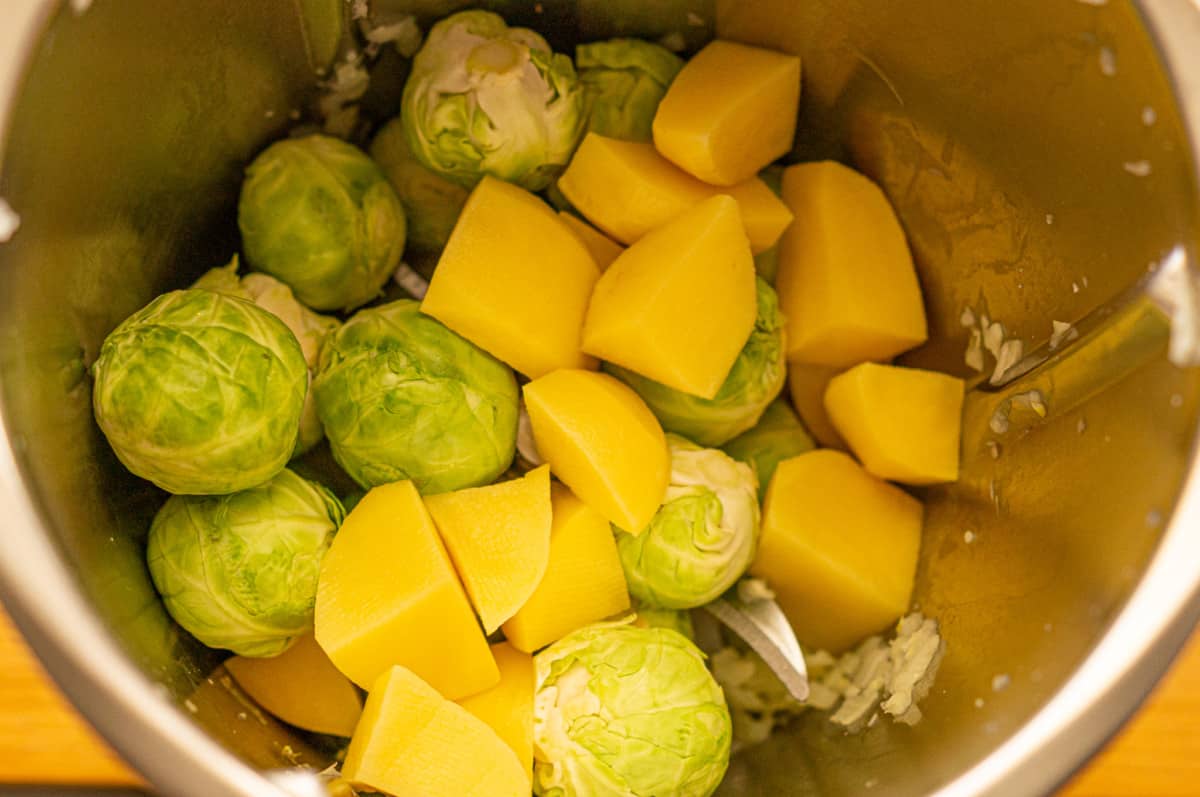
A minute’s preparation on the chopping board before loading the mixing bowl is worthwhile. Trim the base closely, pull off the outer leaves and check them. Yellowed or spotted leaves often carry a concentrated dose of bitterness and can drag the whole soup down. We set aside a few nice outer leaves, cut them into fine strips and use them as a garnish at the end, which adds a fresh cabbage bite against the creamy base.
If the soup still tastes bitter
Some batches are genetically or climatically more bitter, particularly in autumn when the first frost has not yet come. Frost converts some of the bitter compounds into sugar, which is why Brussels sprouts taste milder from mid-November than they do in early October. If you are cooking in October and encounter a bitter batch, you have two effective options: a teaspoon of honey or sugar added with the cream, or a splash of cider vinegar just before serving. Acid does not emphasise bitterness, it masks it, because the taste buds have to process the sour sensation at the same time.
What we do not recommend is blanching the Brussels sprouts in salted water beforehand. It does work against the bitter compounds, but it costs exactly the vitamin C content that makes Brussels sprouts worthwhile in this soup. 119 mg of vitamin C per serving, which is more than double the daily recommended amount, and we do not want to pour that down the drain. In the Thermomix® everything stays in a closed system, which is the whole point of this cooking method.

Smoked salmon as a topping, not a cooking ingredient
The 50 g of smoked salmon goes on the plate at the end, never into the mixing bowl. Smoked salmon is already cooked and seasoned. If you cook it in the soup it falls apart and releases its smoky flavour into the cream, which overpowers the delicate cabbage note. Cut into fine strips and laid on top of the hot soup, it softens slightly, delivers a concentrated saltiness into every spoonful and contrasts the creamy soup with a clean protein note. If you prefer not to use salmon, try 30 g of crisped bacon lardons or homemade croutons from day-old potato bread. We cook both variations regularly.
The soup works just as well as a vegan dish. Replace the 20 g of butter with the same quantity of olive oil and swap the double cream for oat cream or cashew cream. Leave out the salmon and finish with a spoonful of toasted pine nuts or a drizzle of truffle oil when serving. We have tested both variations and the flavour remains remarkably stable, because the bitterness window and the blending timing are the real levers here, not the dairy.
Side dishes and related soups
As a starter, the quantity serves 4. As a main course for 2 with a generous slice of bread alongside. We particularly like our Thermomix® Potato Bread, because the moist crumb absorbs the creamy cabbage soup beautifully, or a crusty mixed grain loaf for dipping. If you want to explore our soup range further, you will find similar 30-minute blended soups in the Thermomix® Potato Soup, the Broccoli Soup and the Courgette Soup. For a hearty version with minced meat, the Cheese and Leek Soup with Mince is a great match.
Reheating and leftovers
Goes well with: farmhouse bread.
The soup keeps in the fridge for two days. When reheating, never let it go above 80 °C or the cream will split. We put the leftovers back into the mixing bowl the next day for 5 minutes at 80 °C on speed 2, which works reliably. Freezing works only without the cream. If you want to cook a larger batch in advance, make the soup up to the blending stage, freeze the base in portions and add the cream fresh when reheating. This keeps the texture stable and gives you a complete meal of 264 kcal per serving in about 8 minutes.