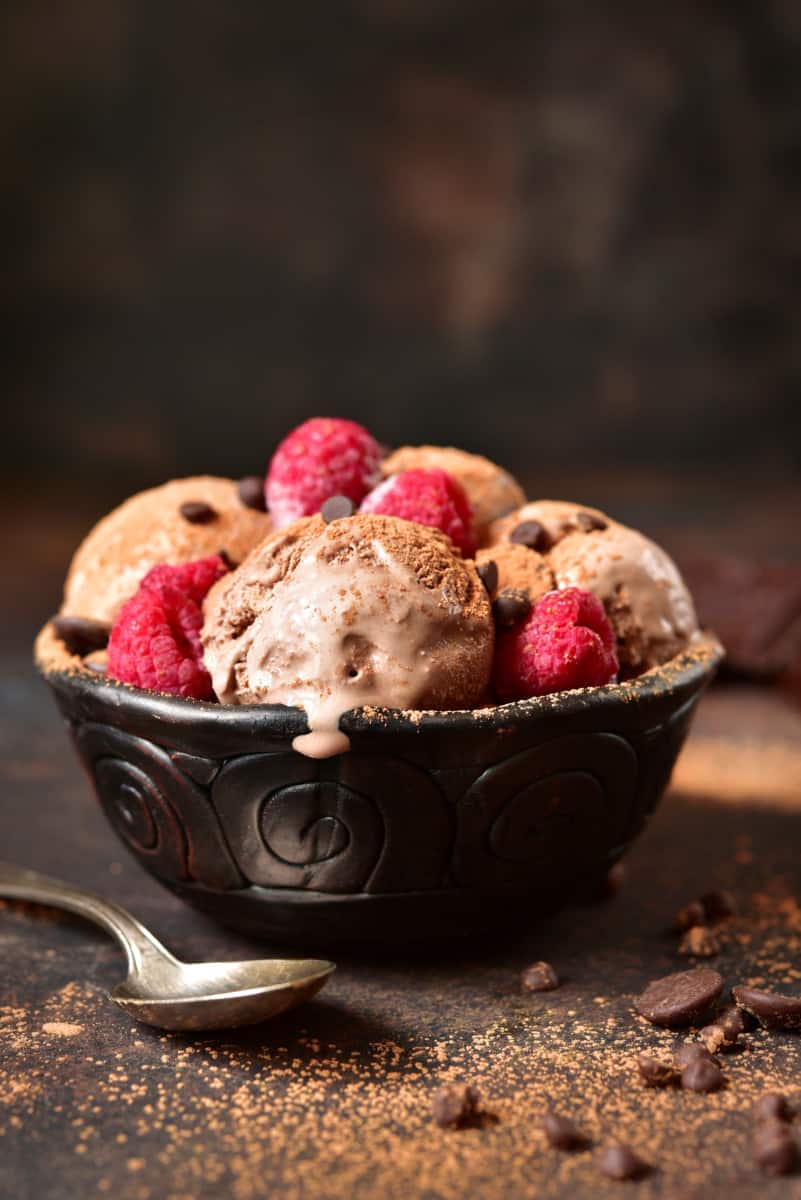
Chocolate ice cream with the Thermomix® needs 10 minutes of active time plus freezing time and makes 8 servings. 200 g milk chocolate couverture, 400 g double cream and 300 g milk is the formula for rich, creamy chocolate ice cream without an ice cream maker. Important: use couverture with at least 30 percent cocoa content.
We make it in summer as a family dessert and in winter as a crowd-pleasing birthday treat. One serving (about 100 g) has 280 kcal. Compared to premium chocolate ice cream from a gelateria (4 to 6 euros per scoop), the homemade version costs around 0.50 euros per serving.
Chocolate Ice Cream with the Thermomix®

Ingredients 0 / 6 ✓
- 100 g sugar
- 1 pinch salt
- 1 vanilla pod
- 200 g milk chocolate couverture
- 400 g double cream
- 300 g milk
Instructions 0 / 4
-
1
Pulverise the sugar.
Place sugar, salt and vanilla pod into the mixing bowl and pulverise for 1 minute / speed 10.
-
2
Chop the couverture.
Break the couverture into pieces, add to the bowl and chop for 5 seconds / speed 8.
-
3
Heat the ice cream mixture.
Add the remaining ingredients, heat for 8 minutes / 70°C / speed 3 and then blend for 10 seconds / speed 10.
-
4
Freeze the chocolate ice cream.
Leave to cool and then churn in an ice cream maker.
Alternatively, pour into a freezer-safe container, seal and place in the freezer. After one hour, stir through with a whisk. Freeze for at least 4 more hours, stirring every hour during this time.
Tip: Serve with fruit, chopped nuts, [eafl id="88771" name="Kokosraspeln Amazon Zutat" text="desiccated coconut"] or [eafl id="88607" name="Superstreusel Amazon in Content" text="sprinkles"].
Video
Nutrition per serving
Couverture vs. baking chocolate vs. cocoa powder: a flavour hierarchy
Milk chocolate couverture (200 g, at least 30 percent cocoa) is the best choice. It has a higher cocoa butter content than regular chocolate and therefore melts more smoothly. Dark couverture (55 to 70 percent) gives a more intense result for chocolate lovers. White couverture produces a sweet, milky, vanilla-flavoured ice cream.
If you do not have couverture, a bar of baking chocolate also works, though it melts slightly less smoothly. Pure cocoa powder produces a different ice cream (creamier, less chocolatey) and requires different quantities (50 g cocoa plus 80 g extra sugar). We recommend couverture.
Cream to milk ratio 4:3 for creaminess
400 g double cream plus 300 g milk (ratio 4:3) gives the optimum creaminess. Pure cream (700 g) would be too rich and heavy; pure milk (700 g) too watery and icy. The 4:3 ratio is the sweet spot between premium ice cream and an everyday version.
Whole milk (3.5 percent fat) is essential. Semi-skimmed milk makes the ice cream hard and icy. For an even richer result: 500 g cream plus 200 g milk. For fewer calories: 300 g cream plus 400 g milk (slightly less creamy).
70°C instead of 55°C: why the gentler temperature
The Vorwerk magazine version heats for only 4 minutes at 55°C. We use 8 minutes at 70°C on speed 3. The reason: at 55°C the couverture does not melt fully and small pieces of chocolate remain. At 70°C everything is perfectly melted and evenly combined.
Above 80°C the chocolate turns bitter as the cocoa butter separates. Exactly 70°C is the optimum temperature. The Thermomix® holds this precisely, which is almost impossible to achieve in a bain-marie on the hob.
With or without an ice cream maker
With an ice cream maker: once cooled, churn straight away for 20 to 30 minutes. This gives the silkiest texture, almost like a gelateria. We recommend models with a freezer bowl or a compressor machine (50 to 400 euros).
Without an ice cream maker: pour into freezer-safe containers and stir through with a whisk every hour for 4 to 5 hours. This breaks up ice crystals and makes the ice cream creamier. If you do not have the patience, the result will be slightly icier but still far better than a hard water ice.
Secret booster: locust bean gum or guar gum
Professional ice cream makers use 2 g of locust bean gum or guar gum as a natural stabiliser. This helps the ice cream turn silky even without a machine and slows melting. Both are plant-based, inexpensive and available from health food shops.
2 g (half a teaspoon) is enough for the whole batch. Add it to the mixing bowl with the sugar before heating. If you do not have any, 1 egg yolk serves a similar purpose (lecithin acts as a binder). With egg the ice cream becomes a classic Italian-style gelato base (a Stracciatella base).
Three variations: dark chocolate, Stracciatella, chocolate sauce topping
Dark chocolate (70 percent): use 200 g dark couverture instead of milk chocolate, plus 30 g extra sugar. More intense, less sweet and better suited to adults.
Stracciatella: prepare the basic recipe, then fold in 100 g of roughly chopped chocolate (milk or dark) after blending. As the ice cream thaws slightly the chocolate softens and adds a pleasant crunch.
Chocolate sauce topping: drizzle with warm chocolate sauce from the Thermomix® just before serving. It turns a simple scoop into a proper dessert.
Chocolate ice cream keeps for 4 weeks in the freezer
Stored in a sealed container in the freezer, it keeps for 4 weeks. Leave it to soften at room temperature for 10 to 15 minutes before serving, otherwise it will be too firm to scoop. Dip your ice cream scoop in warm water before portioning and the scoops will come out cleanly.
With longer storage, ice crystals can form. Blend for 30 seconds on speed 4 with the whisk attachment, then refreeze. Fresh preparation is always better than ice cream that has been stored for a long time.
Goes well with: Waffles and brownies.
You might also like: Nicecream with berries, Thermomix®.