Honey in pizza dough is not there to sweeten it, it is a decision made for the yeast. Sucrose, meaning ordinary granulated sugar, has to be broken down by the yeast before it can be metabolised. Honey, on the other hand, already consists largely of glucose and fructose, exactly the simple sugars that yeast can use directly.
We have been baking our pizza on a pizza stone in the oven on Friday evenings for years. For a long time we made the dough with sugar, then switched to honey and never looked back. The difference is not huge, but it is noticeable. The dough rises more evenly, the base stays a little softer at the edge after baking while still going crispy in the centre. And the dough keeps in the fridge noticeably longer without turning sour.
Honey Pizza Dough with the Thermomix®
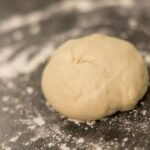
Ingredients 0 / 5 ✓
- 1 cube fresh yeast
- 3 tbsp honey
- 250 g water
- 500 g flour (type 550)
- 1 tsp salt
Instructions 0 / 3
-
1
Place the yeast, honey, and water in the mixing bowl and warm for 3 min / 37°C / speed 2.
-
2
Add the flour and salt to the mixing bowl and knead for 3 min / kneading mode.
-
3
Leave to rise for at least 60 minutes.
Nutrition per serving
Why honey gets the yeast going faster
Yeast lives on sugar, but it cannot process every type of sugar straight away. Sucrose, the white granulated sugar, is a disaccharide. The yeast has to secrete the enzyme invertase first in order to split the sucrose into glucose and fructose. Only then does the actual fermentation begin. That takes time, and you notice it in the first third of the proving period.
Honey is already largely inverted. Bees bring in nectar, their saliva contains exactly this invertase, and in the hive the sucrose portion of the nectar is converted into glucose and fructose. We are giving the yeast a fuel that is ready to use immediately. With the 3 tablespoons of honey in the recipe, that is enough to get the fermentation moving noticeably within the first 15 to 20 minutes. In practice this means: when we check the bowl after an hour, the dough has visibly more volume than a sugar-based dough over the same period.
There is also the water content to consider. Honey naturally brings moisture with it, around 17 to 20 per cent water. With 3 tablespoons that is a few extra grams, which the 500 g of type 550 flour absorbs. The dough feels softer after kneading, almost slightly sticky. That is intentional. When you roll it out it stays elastic, does not tear, and still springs back when pressed even after 24 hours in the fridge.
The mixing bowl makes the difference for the yeast mixture
The first step in the recipe is not the dough itself but the yeast mixture. Fresh yeast, honey, and 250 g of water go into the mixing bowl for 3 minutes at 37°C on speed 2. This is exactly the point at which the Thermomix® has a genuine advantage. Yeast works best between 32 and 38 degrees. Above that the cells die, below that fermentation becomes sluggish. By hand you never get this quite right, the Thermomix® hits 37 degrees precisely.
One important point: we add the honey directly to the water before the yeast goes in. This allows the honey to dissolve completely before the yeast cells make contact. If the honey meets the yeast in too concentrated a form, it can put osmotic stress on the cell walls. In practice, with 3 tablespoons to 250 g of water that is not critical, but we do it this way all the same because the Thermomix® distributes everything evenly regardless.
Then add the flour and salt, and knead for 3 minutes on kneading mode. The salt must only go in after activation, because salt in direct contact with yeast inhibits it. Anyone who throws the cube of yeast in together with the salt and flour will end up with a slower dough. That is one of the most common mistakes we also made for a long time.
60 minutes proving time is enough, but 24 hours is better
The recipe gives 60 minutes proving time, and that is the minimum for a workable pizza dough. On a normal weekend that is perfectly fine. When we make the dough in the morning and bake in the evening, something noteworthy happens: the yeast works at a slow pace the whole time, but the gluten network in the flour continues to develop. The result is a base that not only rises higher but also has a better chew.
Leaving the dough to prove in the fridge gives you even more. At 4 to 6 degrees the yeast works extremely slowly, but it does work. Over those 24 hours the flavours develop that give a pizza dough its slightly malty, almost nutty taste. This is where the second honey advantage shows itself: honey has a mild antibacterial and osmotically preserving effect. A sugar-based dough turns sour in the fridge after two days. The honey dough keeps for three full days without any loss of flavour. After mixing, we often divide the dough into four portions of about 200 g each, pack them individually into oiled screw-top jars, and take out exactly the amount we need for each pizza evening.
Pizza stone at 250°C, otherwise the base will not go crispy
The best dough is no use if the oven does the wrong thing. Pizza needs heat from below, and it needs it immediately. On a normal baking tray the base usually stays pale and floppy, because the tray has to heat up after the pizza is already on it. A pizza stone is the solution: a well-preheated fireclay or cordierite stone stores enough heat to drive moisture out of the dough base within the first few seconds. That is why the base goes crispy and does not go soggy as soon as the tomato sauce is on top.
We preheat the stone at 250°C top and bottom heat on the lowest shelf for at least 45 minutes. With fan-assisted heat we use 230°C instead, because the heat circulates more evenly and otherwise the base burns too quickly before the topping is cooked through. The pizza goes straight from a floured pizza peel onto the hot stone. Baking time is between 6 and 9 minutes depending on the topping and oven. We check from minute 5 onwards every 30 seconds.
A tip from our own experience: the dough should be rolled out thinly, around 3 to 4 millimetres. With honey in the dough it is tempting to leave it thicker because it is so pleasingly elastic. But then the edge turns into a bread roll rather than an airy cornicione. Better to roll it out thin, leave a centimetre of dough at the edge, and it will puff up on its own during baking.
If the dough does not rise or is too sticky
The most common mistake is overheated water. If the water goes above 40 degrees, the yeast cells die. This happens faster than you think, for example if the mixing bowl is still warm from making soup earlier and you then heat it up to 37 degrees. The Thermomix® then measures a temperature that does not reflect the actual wall temperatures. Our solution: rinse the bowl with cold water and dry it before making the yeast mixture.
If the dough sticks badly to your hands after kneading, the flour is the cause. Type 550 is the standard, but if the flour is old or was stored in a damp place it absorbs less water. Our solution: add 1 to 2 tablespoons of flour and run kneading mode for another 30 seconds. No more than that, or the dough will become tough.
If the dough has barely risen after 60 minutes, the yeast was too cold. Fresh yeast straight from the fridge takes longer to get going because it has to come up to operating temperature first. Our solution: take the yeast out 15 minutes before you start, or extend the proving time to 90 minutes.
We often pair this dough with these recipes
We usually make the pizza sauce fresh in the mixing bowl the same evening, before the dough goes into its proving phase. That way the bowl is clean afterwards and the sauce has an hour to develop. A simple salad made in the Thermomix® goes well alongside, as does a creamy dip such as our tomato cream cheese spread, which we like to serve as a starter.
What other recipes do differently
Goes well with: Tomato sauce, Mozzarella, and garlic butter.
In other top recipes for honey pizza dough we often see Tipo 00 instead of type 550 wheat flour, a hydration of 60 to 65 per cent, and a small splash of olive oil for a more supple crumb. With the honey (1 tsp is enough) the yeast starts faster and the honey adds subtle roasted notes to the crust in the oven. Anyone with time to spare can let the dough knead in the Thermomix® for 3 to 4 minutes on kneading mode with reverse direction, then leave it to mature overnight in the fridge. That makes the dough more elastic and easier to digest than the quick version with only one hour of proving time.
Anyone freezing the dough should portion it after the first rise, pack the portions into oiled bags, and press them flat so they are ready to use as soon as they have thawed. We take it out of the freezer in the morning, leave it to thaw in the fridge, and by the evening it is ready to bake. It keeps for three months without any loss of yeast activity.