Red apple sauce from the Thermomix® gets its colour from three natural sources, not from a bottle: red apple skins, sea buckthorn juice and enough citric acid to keep the red stable. In short: add 1000 g red apples with skins on, 100 g sea buckthorn juice, 20 g lemon juice, 1 tbsp vanilla paste and 1 tsp cinnamon to the mixing bowl, chop for 5 sec / speed 5, then cook for 15 min / 98°C / speed 2 and finally blend for 10 sec / speed 10. That gives you 4 jars of 250 g each in about 30 minutes, without any peeling and without artificial food colouring.
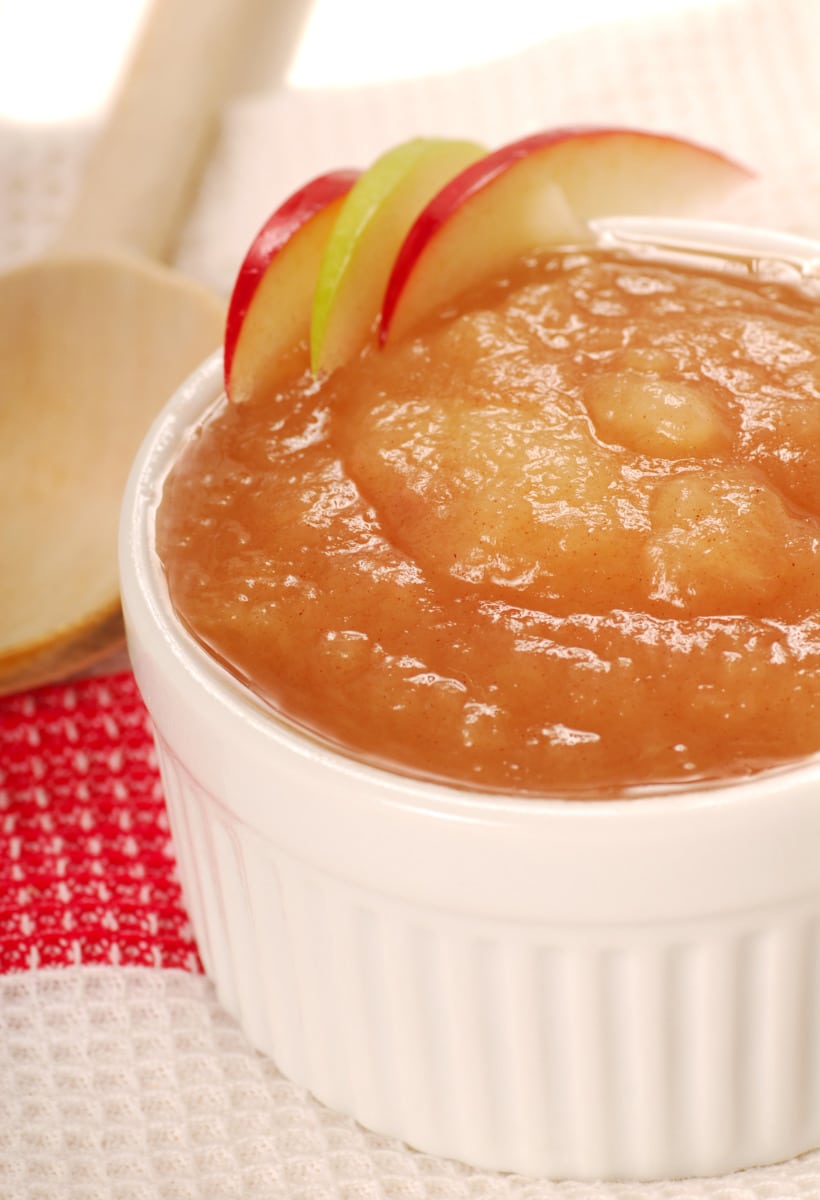
We have been making red apple sauce for years for exactly this reason: our children loved it and we had no interest in artificial food colouring. Over time we calibrated the quantities so that 1000 g apples together with 100 g sea buckthorn juice and 20 g lemon juice produce a rich, clearly red colour that is still there three days after opening the jar. We explain why this ratio works, which apple varieties are best, and what to do if your sauce still looks too pale.
Red Apple Sauce from the Thermomix®
Ingredients 0 / 5 ✓
- 1000 g red apples
- 100 g sea buckthorn juice
- 20 g lemon juice
- 1 tbsp vanilla paste
- 1 tsp cinnamon
Instructions 0 / 2
-
1
Cook the apple sauce.
Wash the apples, quarter them and remove the cores. Add all the ingredients to the mixing bowl, chop for 5 sec / speed 5, then cook for 15 min / 98°C / speed 2.
-
2
Fill the apple sauce into jars.
Blend the apple sauce for 10 sec / speed 10 until smooth, then immediately fill into sterilised jars, screw the lids on tight and leave upside down for 5 minutes.
Tip: Replace some of the apples with ripe, rosy-cheeked pears.
Video
Nutrition per serving
Why the colour holds without food colouring
Red skins provide the anthocyanins. The red pigment in apple skins is called anthocyanin and sits almost entirely in the outermost layer of the skin. Peel the apples and you tip the colour into the compost bin. We leave the skins on, wash the apples thoroughly, quarter them and remove only the cores. In the mixing bowl the Thermomix® breaks down the skins in 5 seconds at speed 5 so finely that no pieces of skin remain to bother anyone. One important point: chop first, then cook. The other way around, the pigments release less effectively.
Sea buckthorn juice boosts both colour and acidity at once. Sea buckthorn provides a second colour source (an orange-red carotenoid) as well as a generous dose of natural acidity. Both work together with the anthocyanins from the apple skins. Anthocyanins are colour-dependent on pH: in an acidic environment they glow red, but in a neutral or slightly alkaline environment they shift to grey-blue. The 100 g of sea buckthorn juice to 1000 g of apples is precisely the quantity needed to lower the pH far enough to keep the red stable, without making the sauce taste sour.
Lemon juice protects against browning. The 20 g of lemon juice is not there for flavour but as a technical ingredient. It inhibits the enzyme polyphenol oxidase, which turns freshly cut apple flesh brown within minutes. In the Thermomix® that browning would otherwise happen in exactly the seconds between quartering and adding to the mixing bowl. Anyone who makes the sauce without lemon juice often sees a reddish-brown tinge in the finished jar. With lemon juice the red stays clear.
The apple varieties that give the deepest red
Not every red apple is pigmented enough on the outside to give a clear signal to the sauce. We tested several varieties across multiple seasons and settled on three favourites:
- Red Boskoop: The classic for apple sauce. Tart, breaks down quickly, and the skin is deep red to burgundy. Best choice for our recipe.
- Red Berlepsch: Slightly sweeter than Boskoop and very aromatic. Matt-red skin with high anthocyanin content.
- Cox Orange (red variety): Works well, but tends to give a warm red-orange rather than a deep red.
What we do not recommend: Elstar or Golden Delicious. The skins are too lightly pigmented and the sauce will turn out pink at best. Red eating apples like Pink Lady look great on the outside but are so sweet inside that the acid balance tips. You end up with a sweet, pale sauce that oxidises quickly. If you have the choice, pick an apple that tastes tart both inside and out: that tartness is exactly what keeps the anthocyanins red.
How to cook the red apple sauce step by step
The process is straightforward and takes about 30 minutes in total. Wash the apples, quarter them and remove the cores, keeping the skins on. Then add all the ingredients together to the mixing bowl: 1000 g red apples, 100 g sea buckthorn juice, 20 g lemon juice, 1 tbsp vanilla paste and 1 tsp cinnamon.
5 seconds at speed 5 is enough to coarsely chop the apple quarters. Then cook for 15 minutes at 98°C at speed 2. The low speed matters because high speeds would shred the apples rather than cooking them gently, and it is that gentle cooking that releases the colour pigments most effectively. Finally blend for 10 seconds at speed 10 and the sauce will be smooth and silky. If you prefer a chunkier texture, blend for only 5 seconds at speed 6.
This is exactly where the Thermomix® comes into its own: chopping, gentle cooking at precisely 98°C and fine blending all happen one after another in the same bowl. No extra blender, no passing through a sieve, no temperature we cannot control on the hob. The 98°C keeps the sauce just below a rolling boil, which protects both the colour and the vitamin C from the sea buckthorn and apple skins.
Fill into sterilised twist-off jars while still hot, screw on the lids and stand the jars upside down for 5 minutes. This creates a slight vacuum inside the jar and extends the shelf life to several months. If you are not planning to store the sauce long-term, you can also fill it into ordinary screw-top jars once it has cooled and keep it in the fridge.
When the sauce stays too pale or turns brownish
The skins were not red enough
Some batches of Boskoop are only partially red with green patches. In that case there is simply not enough pigment. Our solution: cook a tablespoon of rosehip puree or two tablespoons of frozen blueberries along with the apples. Both bring additional anthocyanins without masking the apple flavour.
The apple sauce turns brownish after a day
This is almost always an acidity issue. If the lemon juice was left out or underdosed, the sauce continues to oxidise once the jar is opened. Our solution: stick strictly to the 20 g of lemon juice next time. For extra insurance, add a squeeze of lemon on top right after opening the jar.
Sea buckthorn juice is not available
Sea buckthorn juice has a very distinctive flavour and is not stocked in every supermarket. Our solution: replace it with 80 g red grape juice plus an extra 20 g lemon juice (40 g lemon juice in total). The grape juice provides the colour and the extra lemon keeps the pH low enough for the anthocyanins.
The apple sauce tastes too sweet or too sour
Boskoop is naturally tart and some batches are extremely sharp. Our solution: taste after blending. If it is too sweet, stir in another teaspoon of lemon juice. If it is too sour, stir in 30 g sugar or 40 g apple juice concentrate and mix briefly at speed 2. We deliberately leave sugar out of the basic recipe because the natural sweetness of the apples is usually enough.
Our favourite variations on the red apple sauce
- Mixed with pears: Instead of 1000 g apples we use 700 g red apples and 300 g ripe, rosy-cheeked pears (for example Williams pears with a red blush). The pear makes the sauce softer and sweeter without affecting the colour.
- With cranberries: Add 50 g dried cranberries before cooking. They bring extra acidity and small red flecks to the sauce that look very appealing.
- Without cinnamon for babies: Leave out the cinnamon and reduce the vanilla paste to half a tablespoon. The sauce is then suitable as a first weaning food from seven months onwards.
- With rosehip puree: Use 80 g sea buckthorn juice plus 30 g rosehip puree instead of 100 g sea buckthorn juice alone. This deepens the colour further and adds a slightly bitter undertone.
- With berries for a deeper red: Add a handful of raspberries or blackberries to the mixing bowl. The red becomes richer and the extra acidity balances out the sweetness of ripe apples.
What we serve with the red apple sauce
At breakfast, the sauce is our standard topping on yoghurt or quark, often with a few oats scattered on top. Classically it goes with potato fritters or rosti, where the sweet-sour note harmonises particularly well with the salty fat. If you prefer something sweeter, spoon it over rice pudding or stir it into vanilla custard. It also makes a lovely accompaniment to gingerbread or speculoos biscuits in winter. We also use it regularly as a natural sweetener for home-made yoghurt.
If you are looking for more preserves from the Thermomix®: Our plum sauce from the Thermomix® is the autumnal version with a dark sweetness. If you prefer the classic, we also have the pale apple sauce from the Thermomix®. And if you want to know exactly what the different speeds and temperatures do, our guide What is the Thermomix® has you covered.
What most other red apple sauce recipes leave out
If you search for red apple sauce online, you mostly land on recipes that simply say “apples with red skins” without specifying a variety. That is exactly where the colour fails most often. We deliberately use Red Boskoop or Red Berlepsch because their anthocyanins migrate out effectively at 98°C in the Thermomix®. Many sites also use cinnamon sticks, vanilla pods and star anise, removing the spices after cooking. We use ground cinnamon and vanilla paste instead, leaving them in the sauce. That saves the step of fishing them out and gives more flavour. We leave sugar out of the basic recipe entirely so that the apple flavour leads, and only sweeten to taste if needed.
How long the red apple sauce keeps
Filled hot into sterilised jars and left upside down, the red apple sauce keeps for about 6 months unopened at room temperature in a dark place. Once opened it keeps for about 10 days in the fridge, provided you always use a clean spoon. If you see mould or fermentation bubbles quickly, either the jar was not quite airtight or a spoon with traces of saliva was used.
Freezing works very well. We fill the cooled sauce into 250 ml screw-top jars or labelled freezer bags and freeze in portions. Once thawed it retains its colour and texture because the acidity from the sea buckthorn and lemon protects the anthocyanins even during slow thawing. Thaw overnight in the fridge, give it a quick stir, and it is ready.
Goes well with: pancakes, semolina porridge and yoghurt.
More preserves from our kitchen: plum sauce from the Thermomix® and the classic pale apple sauce from the Thermomix®.