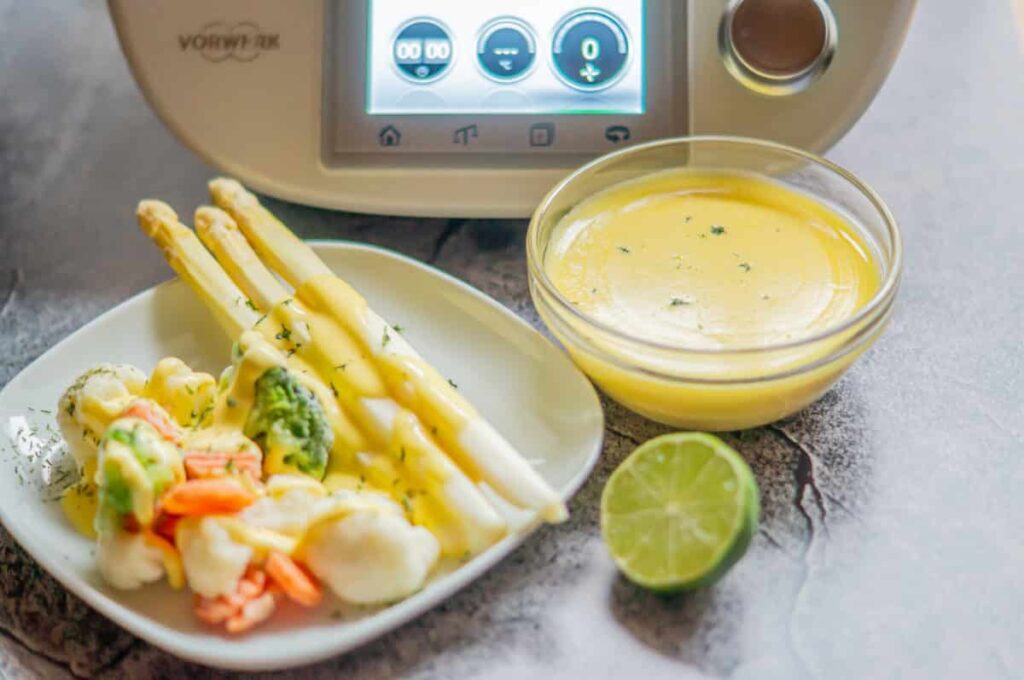
Lime hollandaise is not a gimmick, but an honest solution to a classic hollandaise problem: the sauce is naturally rich and needs acid as a counterbalance. Lime instead of lemon shifts the flavour from sharp-sour to fruity-bitter, and that makes the difference with asparagus or steamed fish.
We have been making this variation for years, whenever the classic hollandaise feels too familiar. The lime zest belongs in the sauce, not just the juice. The essential oils in the zest carry the flavour, the juice only provides the acidity. Without the zest the sauce stays sour and rich, but flat.
Lime Hollandaise with the Thermomix® (Sauce Hollandaise Variation)

Ingredients 0 / 2 ✓
- 1/2 lime unwaxed
- 1 basic Sauce Hollandaise recipe
Instructions 0 / 4
-
1
Zest the lime.
Wash and dry the lime, then zest 2 tsp of the rind.
-
2
Juice the lime.
Juice the lime.
-
3
Prepare the hollandaise.
Prepare the Sauce Hollandaise following the basic recipe, replacing the lemon juice with lime juice.
-
4
Serve.
Add the lime zest to the mixing bowl, mix for 10 sec / speed 3 and serve.
Tip: Goes well with asparagus, fish dishes and fresh vegetables.
Video
Nutrition per serving
Lime zest is the key difference
The zest of an unwaxed lime contains far more flavour than the juice. We zest 2 tsp of rind and add it only at the end, into the finished hollandaise. If the zest were cooked with the sauce, the heat would drive off the volatile oils. 10 sec at speed 3 after whisking is enough to distribute the zest evenly without breaking the emulsion.
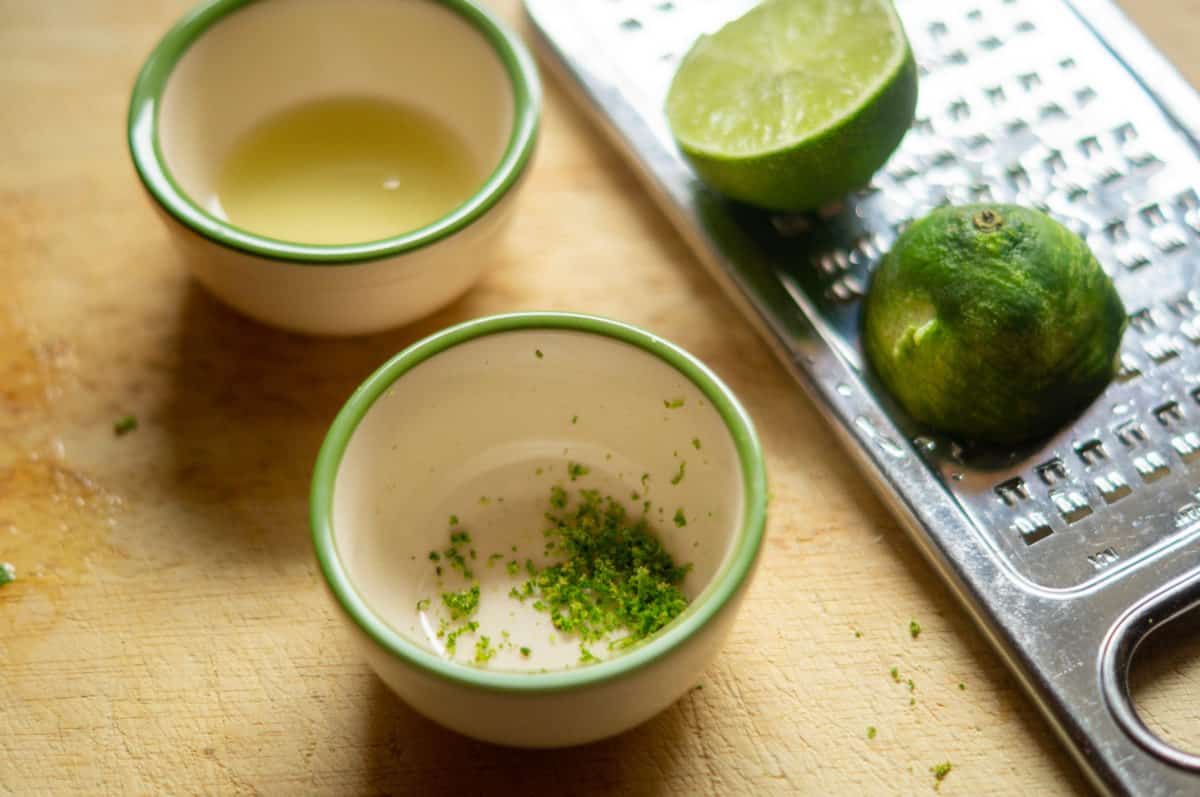
The juice replaces the lemon juice in the basic recipe one to one. The quantity stays the same, only the aroma shifts. Lime has less aggressive acidity than lemon, but a slightly bitter undertone that works surprisingly well with butter and egg yolk.
The emulsion stays stable with the right order
The hollandaise is whisked following the basic recipe, with lime juice in place of lemon juice. The zest goes in only afterwards, into the mixing bowl. This matters because the zest has texture and would disrupt the emulsion during whisking. The sauce would turn grainy instead of smooth.
After whisking, the emulsion is stable enough that 10 seconds at speed 3 will not split it again. The zest is distributed evenly, the flavour infuses into the sauce, and the texture stays creamy.
What the sauce actually goes with
Lime hollandaise works wherever classic hollandaise feels too heavy. With white asparagus it is a genuine alternative, because the fruitiness does not smother the earthy note of the asparagus. With steamed fish, especially cod or pike-perch, the lime lifts the natural flavours rather than overwriting them.
The sauce also works with green vegetables such as broccoli or pak choi, because the bitter note of the lime harmonises with the slightly bitter vegetables. We would not use it with fried meat, as the contrast is missing.
What does not work
Hollandaise is an emulsion that is only stable when freshly whisked. Once it has cooled, the butter separates from the egg yolk. Reheating in the microwave usually results in a curdled mass. The sauce must be served straight away, ideally in a warmed sauce boat. Leftovers cannot be rescued.
Goes well with: Asparagus, Salmon and Avocado.
If you want to get ahead, you can zest the lime and squeeze the juice in advance. Both keep in the fridge for a few hours. We always whisk the hollandaise itself shortly before serving.
More hollandaise variations and sauces: Sauce Hollandaise basic recipe, Sauce Béarnaise, Herb Hollandaise.