Cauliflower rice stands or falls by a single number: 4 seconds at speed 5. A little longer or one speed higher and the cauliflower turns to mush instead of rice. We have been making this recipe regularly as a side dish for years and have learned that grain size is everything, not the seasoning and not the cooking time.
Cauliflower rice ends up on our plates when we are having a curry, a chicken dish, or a stir-fried vegetable in the evening and do not want to feel heavy the next morning. 700 g of cauliflower is enough for four side-dish portions and provides around 90 kcal per serving with 11 g of carbohydrates. A portion of basmati rice of the same size has about 28 g per 100 g, so roughly four to five times the carbs. The difference in taste is there, but it almost disappears behind a curry sauce, a yoghurt dressing, or a well-seasoned broth.
Low Carb Cauliflower Rice with the Thermomix®

Ingredients 0 / 4 ✓
- 700 g cauliflower florets
- 2 tbsp double cream or milk
- 1/2 tsp salt
- 1/4 tsp freshly ground pepper
Instructions 0 / 3
-
1
Remove the stalk from the cauliflower and divide into florets, wash, place half in the Thermomix®, chop for 5 seconds / speed 5 and set aside. Repeat with the second half of the cauliflower.
-
2
Add the double cream, season with salt and pepper and cook for 10 minutes / 100°C / reverse direction / speed 1 without the measuring cup in place.
-
3
Adjust seasoning if needed and serve as a side dish in place of rice.
Tip: Season the rice with curry powder.
You can also enjoy the rice uncooked and raw as a salad. Simply add a dressing of your choice.
Video
Nutrition per serving
Why 4 seconds at speed 5 is the magic limit
Cauliflower is fibrous and has a firm stalk portion. When we put it in the mixing bowl, the Thermomix® wants to process it into a fine puree within seconds. That is exactly what we do not want. Rice-grain size means pieces between 2 and 4 mm, loose, individual, not clumping.
- Speed 5, 4 seconds: Rice-grain size, loose, individual. Exactly what we want.
- Speed 5, 8 seconds: Half is already couscous-fine, the rest still coarse. Uneven.
- Speed 6 or 7: Mush. During cooking, water is released and the mush becomes a puree.
That is why we work in two batches, 350 g each. Anyone who puts 700 g in the mixing bowl at once will get mush at the bottom and coarse chunks at the top. Take half out, set it aside, add the second half, same setting. It takes 30 seconds longer and is the difference between a rice appearance and a mush appearance.
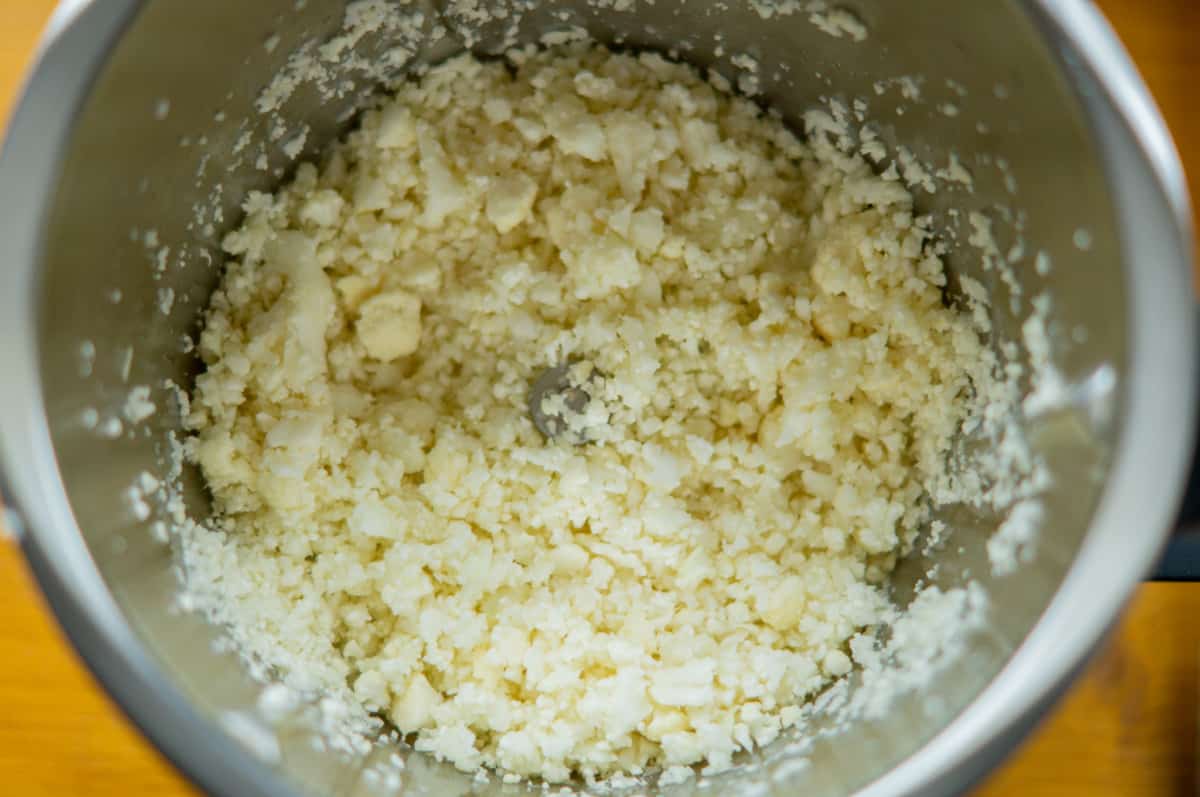
Reverse direction and no measuring cup: two details many people overlook
During cooking, 2 tbsp of double cream, 1/2 tsp of salt, and 1/4 tsp of freshly ground pepper are added, then 10 minutes / 100°C / reverse direction / speed 1 without the measuring cup. Each of these points has a reason:
- Reverse direction: The gentle stir setting turns the blades backwards and stirs rather than cutting. The rice stays grainy. In normal direction it turns to mush within two minutes.
- Speed 1: The lowest speed is perfectly sufficient, because at 100°C the starch in the cauliflower provides binding. Higher speeds blend it again.
- No measuring cup: The steam must escape. Otherwise condensation collects in the bowl and the rice becomes wet and mushy. Place the steamer basket on top instead and nothing will splatter.
- Double cream instead of just water: 2 tbsp of double cream is enough to round off the cauliflower flavour. Those who prefer it lighter can use milk. Without any fat at all, the rice turns dry and tastes noticeably of cabbage.
Where cauliflower rice goes mushy or turns to mush instead of rice
The rice tastes too strongly of cauliflower
This is usually because the vegetable was cooked for too long or the seasoning is lacking. At 12 or 15 minutes the sulphurous flavour intensifies, which is barely noticeable at 10 minutes. Our solution: Stop at exactly 10 minutes, add a pinch of nutmeg, and use half a teaspoon of granulated stock instead of just salt. That reliably covers the cabbage note.
The rice is as mushy as a puree
Three causes, all three worth checking at once: too high a speed when chopping, no reverse direction during cooking, measuring cup left on. Our solution: Next time follow the instructions strictly and place the steamer basket instead of the measuring cup. If the rice still turns out too soft, cook for just 8 minutes next time and taste at the end.
Water collects at the edge of the plate
Cauliflower releases water during cooking. When the rice comes straight from the mixing bowl onto the plate, the water runs out and makes the main dish watery. Our solution: Briefly tip the finished rice into a sieve and leave to drain for 30 seconds before plating. With the pepper variation (recipe below) this is not necessary, because the peppers absorb the water.
Variations we actually make
- Curry variation: Add 1 tsp of mild curry powder with the double cream. It turns the rice golden yellow and goes with any Indian or Asian-inspired dish.
- With pepper and spring onion: The second recipe card below shows our favourite variation with sweated spring onion, curry oil, and yellow pepper strips. The plain side dish becomes a dish in its own right.
- With garlic and parsley: Chop 1 garlic clove and a small bunch of parsley together for 5 seconds at speed 5, then add to the cauliflower. It tastes Mediterranean and goes with chicken or lamb.
- Raw as a salad: Do not cook the chopped cauliflower at all, but dress it straight away with yoghurt, lemon juice, olive oil, and herbs. This turns it into a tabbouleh substitute, also low carb.
Curry, chilli, or as a bowl base
We most enjoy serving the cauliflower rice alongside our spring chicken with yoghurt sauce, because the acidity of the yoghurt takes away the cabbage flavour completely. It also works well with a fruity vegetable curry or a coconut milk and halloumi curry, because the sauce surrounds the cauliflower and it absorbs the flavours. For anyone who wants to see a different approach: our recipe for whole steamed cauliflower from the Varoma uses the same vegetable but a completely different method.
3 days in the fridge, frozen for 2 months
In the fridge, the finished cauliflower rice keeps for 2 days in a sealed container. It continues to release water as it sits, so warm it up the next day in a frying pan with a little butter or oil rather than in the microwave. Freezing does not work well. Once thawed, the rice becomes mushy and loses its grain appearance entirely. Anyone who wants to keep a supply is better off freezing raw, already chopped cauliflower in individual portions and cooking it fresh from frozen. That way the grain size is preserved.
Goes well with: Meatballs and schnitzel.
Also good: White cabbage with the Thermomix® Varoma.
Comparing the carb figures: 100 g of cooked rice has around 28 g of carbohydrates, while our portion of cauliflower rice comes to 11 g for the full side-dish amount. That is a reduction of around 85 to 90 per cent, without any real loss on the flavour side. The rice is gluten-free as a matter of course, and with 140 mg of vitamin C per serving it also happens to provide more than an adult’s daily requirement.
Anyone who wants to develop the low carb approach further will also find a halloumi curry with coconut milk and whole Varoma cauliflower on our site. Both take less than 30 minutes and fit the same menu logic as the cauliflower rice.