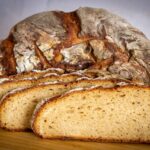
A cooked potato in bread dough is not a filler, it is a moisture reservoir. The potato starch binds water that does not evaporate during baking but stays in the crumb. That is exactly why our potato bread with the Thermomix® is still not dry on the board on the third day.
The recipe is one that Tobias’ grandmother baked for decades, always with the leftover potatoes from the Sunday roast. We adapted it for the Thermomix® and fine-tuned it over the years until the crumb, crust, and keeping quality were just right. Today it is the bread that goes into the oven on Thursdays and carries us through the weekend without any fuss. 300 g of cooked potatoes to 520 g of flour sounds like a lot, but it is exactly the ratio that keeps the crumb light while adding that slightly sweet, almost malty note that shop-bought bread simply does not have.
Potato Bread with the Thermomix®
Ingredients 0 / 8 ✓
- 300 g potatoes
- 800 g water
- 200 g buttermilk
- 1/2 cube fresh yeast
- 350 g spelt flour, type 630
- 170 g rye flour, type 1050
- 1 1/2 tsp salt
- 1 tsp bread spice mix optional
Instructions 0 / 5
-
1
Cook the potatoes.
Wash potatoes (medium size) and arrange in the Varoma. Add water to the mixing bowl, place the Varoma on top and cook for 30 min / Varoma / speed 1, then leave to cool. Rinse the mixing bowl.
-
2
Chop the potatoes.
Peel potatoes, cut into pieces and place in the mixing bowl, chop for 5 sec / speed 4 and set aside.
-
3
Dough.
Add buttermilk and yeast to the mixing bowl and warm for 5 min / 37°C / speed 1. Add potatoes and remaining ingredients, knead for 4 min / kneading mode until a smooth dough forms, transfer to a bowl and leave to rise, covered, for 1 hour.
-
4
Shape the loaf.
Line a baking tray with baking paper, shape the dough into a loaf and leave to rise, covered, for 30 minutes.
-
5
Bake.
Preheat the oven to 220°C fan. Score the bread with a sharp knife, brush with a little water and bake for 15 minutes. Reduce the temperature to 180°C and finish baking for 20 to 25 minutes.
Tip: You can also cook the potatoes the day before, or use leftover potatoes for this delicious bread.
Video
Nutrition per serving
Why the potato in the dough makes all the difference
With a standard bread dough, the baking process draws some of the water out of the crumb. The bread is wonderful on the day it is baked and hard two days later. With potato bread the physics work differently: the cooked potato has gelatinised starch that binds water at a molecular level. That bond holds for days. We tested the bread deliberately over several days and it is still soft enough for buttered slices on the fourth day, without needing to freeze it or wrap it in cling film.
The second effect: the starch makes the crumb fine-pored and elastic. Anyone who has tried to slice a pure rye bread thinly knows the crumbling. With potato bread you can cut a slice down to just under half a centimetre without the crumb tearing. That is why this bread works so well for open sandwiches at lunch or for a breakfast spread.
Which potatoes belong in the dough
For this bread we need floury potatoes. Waxy varieties have a lower starch content and give the dough moisture but not the structural potato starch that keeps the bread moist. Varieties that are too waxy do not work here. Better choices are floury varieties such as King Edward, Maris Piper, or a floury farmhouse potato from a local supplier.
The 300 g is the weight of the peeled, cooked potato, weighed after cooking. With medium potatoes (around 150 g each) that means two potatoes. If there are leftover boiled potatoes from the day before, that is the quickest option: simply peel, weigh, and put straight into the mixing bowl. The Varoma step can then be skipped.
Why 60 minutes of proving time is essential
The yeast needs longer to work with a potato dough than with a pure wheat dough. The starch from the potato is already gelatinised, which makes the yeast productive, but the dough is also heavier and wetter. Anyone who moves on after 30 minutes will end up with a dense loaf with a flawed crumb. We leave the dough for the full 60 minutes in a warm spot until it has visibly doubled in size.
Important: cover the bowl with a damp cloth or a plate, never stretch cling film tightly over it. Otherwise the dough draws condensation that sits on top and makes the surface greasy. After shaping there is a further 30 minutes of final proving on the baking tray. Both proving times together are not a luxury but the reason why this bread develops a crumb that does not collapse.
The flour blend: spelt and rye
350 g of spelt flour type 630 and 170 g of rye flour type 1050 give a total of 520 g of flour to 300 g of potatoes and 200 g of buttermilk. The ratio matters: spelt alone would be too mild, pure rye flour would make the crumb too dense and sour. The blend gives the bread a gentle savouriness without tipping it into wholemeal territory.
If you have rye flour type 997 instead of 1050 at home, you can swap it without any problem. With type 1150 the bread will be more robust and slightly darker. Plain wheat flour instead of spelt also works, but the flavour shifts towards mild and the crumb turns paler. What does not work: swapping in wholemeal flour at a 1:1 ratio. Wholemeal needs more liquid, otherwise the bread will be dry despite the potato.
Bread spice mix: yes or no
The recipe lists one teaspoon of bread spice mix as optional. We usually bake it with, because the blend of fennel, coriander, caraway, and anise supports the rye flour and gives the bread that typical farmhouse character. Anyone who dislikes caraway can simply leave it out. A good bread spice mix is available from health food shops or whole-food stores, often as an own-brand product. Mixing your own works too: equal parts fennel, coriander, and caraway, plus a pinch of anise, crushed together in a pestle and mortar.
Baking without a tin: why the free-formed loaf
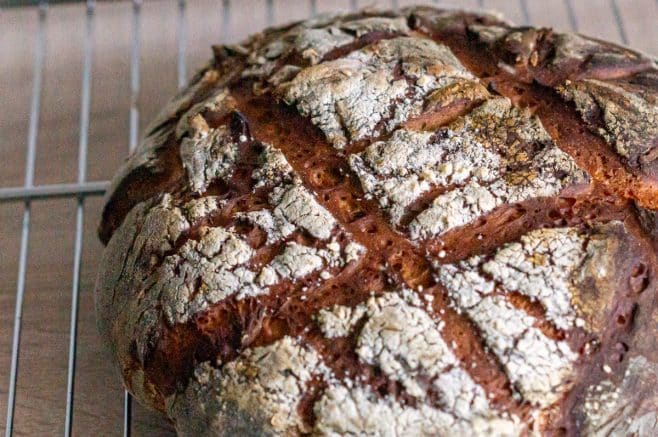
We bake the bread deliberately without a loaf tin, simply as a free-formed loaf on the baking tray. The dough has enough structure from the potatoes that it does not spread. The free-formed loaf develops crust on all sides, which increases the surface area and creates more flavour. Before baking we score the loaf with a sharp knife (or a lame). Three diagonal cuts across the top are enough. They give the dough room to expand during the initial bake without the crust splitting in uncontrolled places.
Brushing with water just before loading into the oven is not an optional step. It creates the glossy crust and keeps the surface elastic during the first 15 minutes at 220°C so the bread can rise fully. Only then do we reduce the temperature to 180°C and finish baking for a further 20 to 25 minutes. Tap test on the underside: a hollow sound means done, a dull sound means five more minutes.
What we eat with this bread
Fresh from the oven with a little butter and coarse salt it is already a pleasure. It goes well with our creamy potato soup. The double potato combination sounds like too much, but it works because the bread adds savouriness while the soup provides creaminess. On evenings with a cold buffet we often make our mixed loaf alongside it, then there are two breads to choose from, one with a potato character, one classic. Anyone looking for a completely different style of bread will find the moist vegetable version in our spelt and carrot bread.
4 days moist in a cloth bag, frozen up to 3 months
Leave the finished bread to cool completely on a wire rack, at least two hours. Wrapping it while warm traps condensation and softens the crust. We store it in a cloth bag or a bread crock, never in a plastic bag and not in the fridge (the fridge dries bread out through its low humidity). That way it stays moist and firm enough to slice for four days.
Goes well with: butter, cheese and soup.
Anyone who wants to bake ahead: once the bread has cooled completely it can be sliced and frozen without any trouble. Place individual slices in freezer bags or layer them with baking paper in a container. To defrost, pop the slices in the toaster and the crust will be crisp again. Freezing the whole loaf also works, but it takes several hours to defrost at room temperature.
More bread and baking recipes from our kitchen:
- Mixed loaf
- Spelt and carrot bread
- Quick wholemeal bread
- Yoghurt crust bread
- Toast bread
- French baguette
- French white bread
- Eat-your-fill bread
- Pizza dough