A one pot stew in the Thermomix® is essentially a braise in the mixing bowl. Meat, root vegetables and stock go into the same pot one after another, and at the end everything cooks together for 5 minutes at 100°C. For this to work, one technical requirement must be met, otherwise the blades will turn the kassler into a mince.
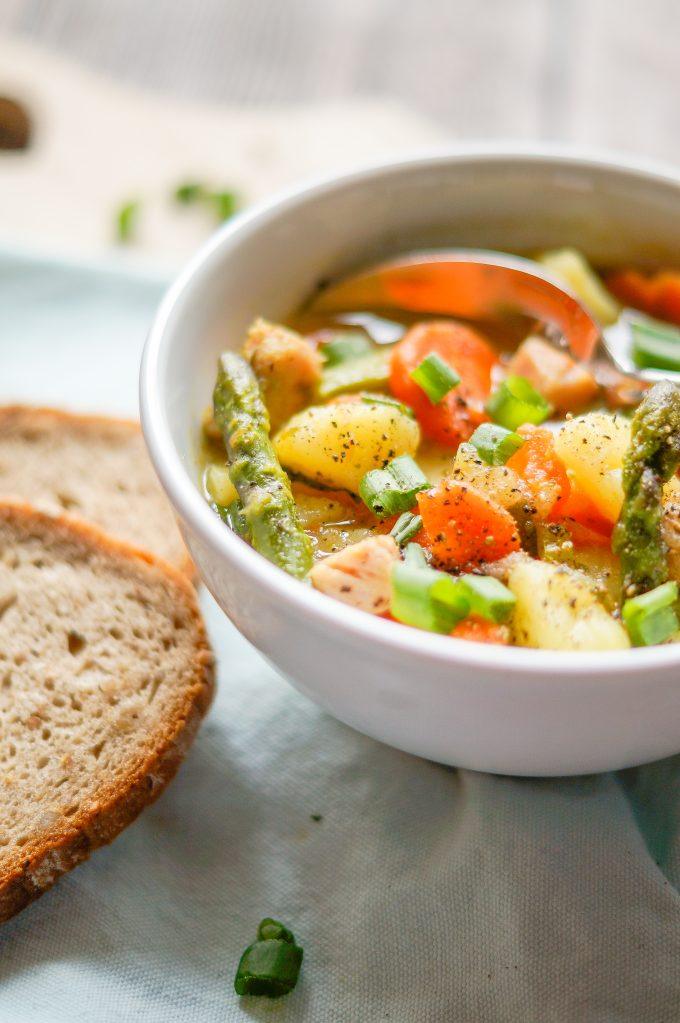
We have been making this stew every asparagus season from April to June for years. It is our go-to for evenings when we need something filling after 6 pm but have no desire to fry anything in a pan or deal with a stack of drained dishes. 15 minutes of chopping, 25 minutes in the mixing bowl, done.
One Pot Stew with the Thermomix®

Ingredients 0 / 14 ✓
- 1 garlic clove
- 2 onions
- 20 g rapeseed oil
- 300 g kassler (smoked cured pork loin)
- 500 g new potatoes
- 300 g carrots
- 600 g vegetable stock
- 300 g green asparagus
- 3 spring onions
- 1 1/2 tsp salt
- 2 tsp dried oregano
- 2 tsp dried thyme
- 2 tsp dried lovage
- 1 tsp pepper
Instructions 0 / 6
-
1
Chop the garlic.
Peel the garlic, place in the mixing bowl and chop for 3 sec / speed 8, then push down with the spatula.
-
2
Chop and sweat the onions.
Peel the onions, halve them, place in the mixing bowl and chop for 3 sec / speed 5. Cut the kassler into cubes, add to the mixing bowl with the oil and cook for 7 min / 120°C (TM31: Varoma) / reverse direction / speed 1.
-
3
Cut the potatoes and carrots.
Meanwhile, peel the potatoes and carrots, cut the potatoes into cubes and the carrots into slices, add to the mixing bowl with the stock and cook for 15 min / 98°C / reverse direction / speed 1.
-
4
Prepare the asparagus and spring onions.
Meanwhile, wash the asparagus and spring onions. For thick asparagus spears, peel the lower half, cut off the woody end and cut into 2 cm pieces. Cut the spring onions into rings.
-
5
Finish cooking.
Add the asparagus and spring onions (reserving a few for garnish) to the mixing bowl with the salt, oregano, thyme and lovage and finish cooking for 5 min / 100°C / reverse direction.
-
6
Serve.
Serve scattered with spring onion rings and pepper.
Tip: If you like, you can enrich the stew with 100 g of single cream or double cream at the end.
Nutrition per serving
Reverse direction is not optional here, it is essential
Three of the five cooking steps run in reverse direction at speed 1. That is the heart of this recipe. In normal direction the blades would cut the kassler into a mince during the first 7 minutes of sweating. The 500 g new potato cubes would lose their shape, and the green asparagus would come out as a puree. Reverse direction means the blunt side of the blade stirs the ingredients rather than cutting them.
The second technical point: starch from the new potatoes thickens the 600 g of vegetable stock into a lightly velvety broth. We need no cream, no roux, no sauce thickener. New potatoes contain less starch than older stored potatoes, so the consistency stays pleasantly liquid with a gentle body rather than turning gluey. Anyone who wants a creamier stew can stir in 100 g of single cream or double cream at the end, without reheating.
120°C to sweat, then 100°C for the rest
In the second step we add the diced onions to the mixing bowl with the kassler and 20 g of rapeseed oil and set the temperature to 120°C for 7 minutes. That is the only point where we really bring heat into the pot. 120°C is not enough for true Maillard browning as you would get in a frying pan, but it renders the fat from the kassler and brings the onions to a soft, glassy state. The TM31 does not reach 120°C, so simply choose the Varoma setting there and the result is virtually identical.
After that we drop to 98°C once the potatoes and carrots are in the pot. 15 minutes is enough for new potato cubes because they have thinner cell walls than older potatoes. For stored winter potatoes from November to March, allow 18 minutes instead. Asparagus and spring onions go in for the final 5 minutes, which matches the cooking time of thin green asparagus. If you are using thick spears, peel the lower half thoroughly, otherwise woody fibres will get stuck between your teeth.
What can go wrong if you ignore the order of steps
Anyone who adds the asparagus at the same time as the potatoes will end up with 20 minutes of cooked asparagus, which is a mush. Asparagus needs 5 to 6 minutes of cooking time in total, no more. The layering is not arbitrary but follows the different cooking times of each ingredient. First chop the garlic and onion, then sweat the kassler, then add the long-cooking vegetables, and finally the short-cooking ones.
A second common mistake is with seasoning. Kassler already contributes 1700 mg of sodium per serving. Adding the full amount of salt from the recipe on top of that gives a stew that tastes like a salty broth. We start with 1 tsp of salt instead of 1 1/2 tsp and taste at the end. With kassler from an organic butcher, which is sometimes less heavily cured, the full amount works fine. With standard supermarket kassler, a level teaspoon is enough.
Thirdly, the lovage. 2 tsp of dried lovage is not a small amount. Lovage has a very dominant flavour reminiscent of Maggi seasoning. Anyone who finds that too much can halve the quantity or replace it with flat-leaf parsley. Oregano and thyme are less critical because they balance each other out.
Swap out the asparagus for other vegetables
Autumn version: Replace the asparagus and spring onions with 300 g of savoy cabbage cut into strips and one leek cut into rings. Extend the final cooking time to 8 minutes because savoy cabbage takes longer. It tastes like a classic home-style stew.
Vegetarian: Replace the kassler with 200 g of smoked tofu cut into cubes. Smoked tofu brings the smoky flavour that would otherwise come from the kassler. Reduce the sweating time from 7 to 4 minutes, otherwise the tofu will turn dry. Use a robust mushroom stock instead of vegetable stock for extra depth.
With braising beef: Use 400 g of stewing beef (short rib or chuck) instead of kassler. You will then need to pre-cook the beef for an additional 25 minutes before adding the potatoes and carrots, otherwise the meat will stay tough. With kassler the recipe takes 40 minutes, with raw stewing beef it takes 65 minutes.
Creamier version: Stir in 100 g of single cream or double cream at the end, mix once with the spatula and do not bring back to the boil. This turns the stew into a saucy dish that also works well with bread or as a starter before a main course.
More recipes for the mixing bowl
If you enjoy one pot recipes, we have more classics to explore. Our kohlrabi and broccoli soup with avocado uses a similar technique but is fully vegetarian and creamy from the avocado. For winter we love the classic stew recipes from our stew category, including lentil stew and potato soup in all its variations. A great partner for this stew is our Mediterranean bread rolls, which we often bake in the oven at the same time as the stew cooks in the mixing bowl.
One pot means one less pan and no colander
The classic way to make stew on the hob uses two vessels: fry the onion and kassler in a frying pan while the stock comes to the boil in a separate pot, then combine everything and simmer for 25 minutes. Three pots, a colander for the potatoes, three things to wash up at the end. In the Thermomix® exactly the same sequence runs in a single vessel, because 120°C for sweating, 98°C for cooking and reverse direction for gentle stirring flow seamlessly into one another. We do not decant anything, we do not drain anything, we start once and at the end we lift a finished meal out of the pot. That is the difference from recipes that cook everything together for 20 minutes at once: here every ingredient gets the right cooking time without needing a second vessel.
Leftovers: even better the next day
Kept in a sealed container in the fridge, the stew lasts 3 days. On the second day it tastes better than freshly cooked because the flavours from the kassler, lovage and spring onions have had time to develop. When reheating, add 200 ml of water, otherwise it will become too thick as it heats.
Goes well with: farmhouse bread and wholemeal bread.
Freezing works, but with one caveat: the potatoes turn slightly floury and break apart when thawed. For a creamy version that is no problem, but for the classic version with distinct cubes it is better to eat within 3 days. Frozen in 500 ml portions the stew keeps for 3 months. Thaw overnight in the fridge, then reheat for 6 minutes at 100°C in reverse direction at speed 1.
More recipes for a stew evening: soup recipes with the Thermomix®, stew recipes with the Thermomix® and Mediterranean bread rolls as a side.