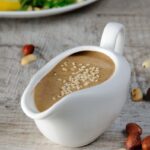
Peanut sauce with the Thermomix® takes 5 minutes and makes 4 servings (about 320 g, 250 kcal per serving). 100 g peanut butter, 150 g coconut milk, 30 g soy sauce, 20 g sesame oil, 20 g rice vinegar and 20 g soft brown sugar. The order does not matter: add all ingredients to the mixing bowl, blend for 5 seconds, heat for 4 minutes. Done.
We serve this sauce with satay skewers (classic Indonesian style), as a dip for summer rolls, alongside wok vegetables, over Asian noodles or as a salad dressing for coleslaw. Compared to ready-made satay sauce from a jar (Asian supermarket, 3 to 4 euros per 200 ml), the homemade version costs about 1.50 euros for the same quantity.
Peanut Sauce with the Thermomix®
Ingredients 0 / 6 ✓
- 100 g peanut butter
- 150 g coconut milk
- 30 g soy sauce
- 20 g sesame oil
- 20 g rice vinegar
- 20 g soft brown sugar
Instructions 0 / 3
-
1
Blend all ingredients.
Add all ingredients to the mixing bowl and blend for 5 seconds / speed 8.
-
2
Heat the peanut sauce.
Heat the sauce for 4 minutes / 90°C / speed 3.
-
3
Serve.
Serve the peanut sauce straight away or store in a screw-top jar in the fridge.
Tip: You can easily double the quantities if you need more sauce. Simply heat the sauce for 2 minutes longer.
Video
Nutrition per serving
Smooth or crunchy peanut butter
Peanut butter is the main ingredient. The choice makes a real difference:
Smooth peanut butter (standard): produces a uniform, silky sauce. Ideal as a dip or dressing. Around 2 to 3 euros per 350 g jar at the supermarket.
Crunchy peanut butter: brings small pieces of peanut into the sauce. Great for satay skewers, as it adds texture and bite. Warning: do not blend for too long or the Thermomix® will chop up all the pieces.
Homemade peanut butter: blend 200 g roasted, unsalted peanuts for 1 minute at speed 8 in the Thermomix®. More flavour, no added sugar, no preservatives. That said, it takes 30 minutes and costs about 4 euros per 200 g.
Important: avoid peanut butter with added palm oil and choose an unsweetened variety (otherwise the sauce will be too sweet).
Coconut milk: why 150 g and which brand
Coconut milk makes the sauce creamy and slightly sweet, and softens the saltiness of the soy sauce. 150 g (about 7 tbsp) is the sweet spot for 100 g of peanut butter. Less and the sauce becomes too thick, more and it turns too thin.
Full-fat coconut milk (17 to 22 percent fat, brands such as Aroy-D, Real Thai or organic varieties) is essential. Light coconut milk (5 to 10 percent fat) makes the sauce watery. From an Asian supermarket it is considerably cheaper (1 to 1.50 euros per 400 ml tin) than from standard supermarkets (2 to 3 euros).
A tip: give the tin a shake before opening. Otherwise the solid coconut cream separates from the coconut liquid below.
Soy sauce, sesame oil, rice vinegar: the Asian flavour base
Soy sauce (30 g): brings umami and salt. Light soy sauce (classic Japanese or Chinese) for a milder note. Dark soy sauce for a more intense character. Tamari (gluten-free) works just as well.
Sesame oil (20 g): very intense. Never use it as a cooking oil, only as a seasoning oil. 20 g is the upper limit, as more will overpower everything else.
Rice vinegar (20 g): milder than regular vinegar, with a slight sweetness. Apple cider vinegar or lime juice (50 g) can work in a pinch. Never use balsamic (too intense).
Soft brown sugar (20 g): for the characteristic sweetness of South-East Asian cooking. Raw cane sugar, palm sugar or coconut blossom sugar all work too.
4 minutes at 90°C: why not boil
90°C rather than 100°C matters here: peanut butter and coconut milk are both fat-based. At 100°C the fat often separates and floats to the top, which looks unappetising. At 90°C the sauce stays nicely emulsified.
Speed 3 is gentle but enough to prevent the sauce from catching. 4 minutes is sufficient for all the flavours to come together and for the sauce to reach serving temperature. Heating for longer does no harm, but adds nothing either.
Variations: ginger, garlic, chilli, lime
Ginger and garlic variation (authentically Asian): add 1 cm of fresh ginger and 1 garlic clove to the ingredients. Chop for 3 seconds at speed 7 before adding the other ingredients.
Chilli variation (spicy): add 1/2 tsp of sambal oelek or 1 fresh chilli, deseeded. This turns the sauce into a Thai-style version.
Lime variation (fresh): stir in 1 tbsp of fresh lime juice at the end, after cooking. Do not cook it in, or the acidity will lose its freshness.
Curry variation (Indonesian): add 1 tsp of red curry paste and 1/2 tsp of curry powder. This turns it into an Indonesian satay sauce.
Tahini variation (Middle Eastern twist): replace 50 g of the peanut butter with 50 g of tahini (sesame paste). Especially good as a salad dressing.
What to serve with peanut sauce
Satay skewers: chicken, pork or tofu marinated on wooden skewers, grilled or pan-fried. The classic use.
Asian salad: glass noodle salad, coleslaw or a mixed salad with the sauce as a dressing. Thin it down with a little lime juice to reach the right consistency.
Wok vegetables: pour over the stir-fried vegetables just before serving. Pak choi, broccoli, peppers and carrots work especially well.
Summer rolls / spring rolls: serve as a dip in a small bowl. Classic with rice paper summer rolls in the Vietnamese style.
Asian noodles: pour over freshly cooked rice noodles and top with sesame seeds and spring onions.
Burgers and sandwiches: use with chicken and coleslaw instead of mayonnaise. An unexpected twist.
Peanut sauce keeps for 1 week in the fridge
Stored in a screw-top jar in the fridge, the sauce keeps for 7 to 10 days. It will firm up when chilled, as coconut milk and peanut butter are both fat-based. Before serving, either warm it briefly in a microwave-safe jar for 20 seconds, or stir in 2 tbsp of warm water to bring it back to the original consistency.
Freezing is not ideal: the emulsion breaks when thawed. Better to make small fresh batches as needed (5 minutes of effort) rather than freeze.