With potato goulash, a single setting makes the difference between chunks and mush on the plate. We cook this recipe in the mixing bowl consistently in reverse direction so the blades stir the potatoes rather than cutting through them.
We have been making potato goulash with the Thermomix® for years, sometimes with beef goulash, sometimes without any meat at all. The recipe has its roots in Hungarian stew cooking and relies on two things: a good amount of paprika and potatoes that hold their shape. It is exactly that second point where many Thermomix® versions fall short, because the default programme runs in normal direction. 500 g of diced potatoes do not survive that.
Potato Goulash with the Thermomix®

Ingredients 0 / 15 ✓
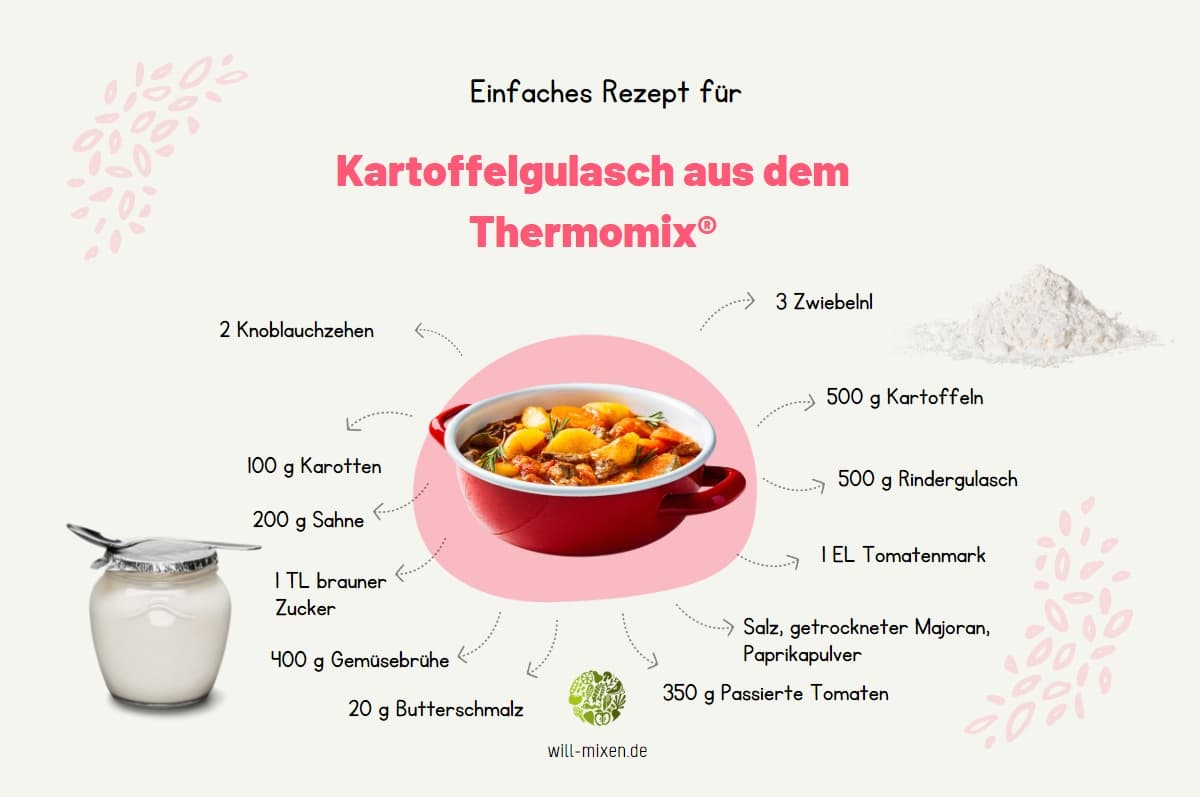
- 2 garlic cloves
- 3 onions
- 100 g carrot
- 500 g potatoes
- 1 tsp brown sugar
- 1 tbsp tomato paste
- 30 g olive oil
- 1 tsp salt
- 1 tsp dried marjoram
- 1 tsp paprika
- 350 g passata
- 400 g vegetable stock
- 20 g clarified butter
- 500 g beef goulash
- 200 g double cream
Instructions 0 / 6
-
1
Chop the vegetables.
Peel the garlic, peel and halve the onions, wash the carrots and cut into pieces. Add the garlic, onions and carrots to the mixing bowl and chop for 5 sec / speed 5.
-
2
Add the potatoes.
Wash, peel and dice the potatoes into 2 cm cubes. Add to the mixing bowl with the sugar, tomato paste and olive oil and cook for 4 min / 100°C / reverse direction / speed 1.
-
3
Cook.
Add the salt, marjoram, paprika, passata and vegetable stock and cook for 15 min / 100°C / reverse direction / speed 1.
-
4
Sear the beef.
Meanwhile, heat the clarified butter in a frying pan and sear the beef goulash over a high heat.
-
5
Cook the beef.
Add the beef goulash to the mixing bowl and cook for 10 min / 100°C / reverse direction / speed 1.
-
6
Heat and serve.
Add the double cream and heat for 2 min / 90°C / reverse direction / speed 1. Serve.
Tip:
If you would like to make the potato goulash without meat, replace the 500 g of beef goulash with the same quantity of potatoes.
The goulash freezes well in individual portions, or keeps in the fridge and can be reheated the following day.
Video
Nutrition per serving
Why reverse direction makes all the difference here
In normal operation, the blades in the mixing bowl are aligned sharp-edge-forward in the direction of rotation. That is intentional, as they are meant to chop and blend. In reverse direction the motor turns the other way and the blunt back edge of the blades guides the food. The potato cubes are moved, not cut. That is exactly why every cooking step after the potatoes are added has REVERSE DIRECTION written in our recipe.
Specifically, this applies to three steps: sweating the potatoes for 4 min / 100°C / reverse direction / speed 1, the main cook with stock and passata for 15 min / 100°C / reverse direction / speed 1, and the final heating with cream for 2 min / 90°C / reverse direction / speed 1. Anyone who accidentally uses normal direction or selects a higher speed will end up with potato soup rather than goulash.
The right variety of potato makes the second difference
Reverse direction alone is not enough. Floury potatoes break down even in the gentlest reverse direction because their starch swells. For the 500 g in this recipe we use only waxy varieties such as Charlotte, Nicola, or Anya. They hold their bite and still release enough starch to give the sauce a lightly thickened consistency.
The size of the dice also matters. 2 cm cubes are the sweet spot. Any larger and they will still be firm in the middle after a total cooking time of 19 minutes, any smaller and they will break apart despite reverse direction. We always cut the potatoes by hand, as the mixing bowl cannot produce evenly sized cubes at this size.
Paprika: sweet and a pinch of hot
The original recipe calls for 1 tsp of paprika, which we always increase in practice. Our standard is 2 tsp of sweet paprika plus half a knife-tip of hot paprika. That gives the goulash the typical Hungarian depth without a burning heat. The 1 tsp of dried marjoram and the 1 tsp of brown sugar are both in the recipe as written, and they are not optional extras but carry the flavour.
The brown sugar caramelises during the sweating step together with the tomato paste in the 30 g of olive oil, building the flavour base that defines any Hungarian goulash. Anyone who leaves out the sugar because it sounds unusual in a stew will notice afterwards that a layer of depth is missing.
Sear the meat separately, never in the mixing bowl
For the version with 500 g of beef goulash, we always sear the meat in a frying pan with 20 g of clarified butter over a high heat, never in the mixing bowl. The mixing bowl does reach 120°C in Varoma mode, but it cannot move the meat without cutting it. A proper sear crust, which later adds flavour to the sauce, is only possible in the pan. Only then does the seared beef go into the mixing bowl with the cooked potatoes, where it cooks on for 10 minutes in reverse direction.
For the meat-free version, simply replace the 500 g of beef goulash with a further 500 g of potatoes and skip the searing step. All the potatoes then go into the mixing bowl at once. The cooking time stays the same, as it is calculated for the volume of potatoes, and the sauce gains more body.
Three common mistakes we have learned to avoid
Forgetting to switch to reverse direction
The mixing bowl does not remember the last setting. Anyone who chops the vegetables in step 1 with 5 sec / speed 5 and then moves straight to sweating without actively switching to reverse direction will have mashed potato after 4 minutes. Our solution: Always pause before sweating the potatoes, press the reverse direction symbol, then set the time and temperature. Reverse direction is shown on the display as an arrow pointing to the left.
Choosing the wrong potato variety
Floury potatoes break apart despite reverse direction. Mainly waxy varieties are borderline, they roughly keep their shape but the sauce turns cloudy. Our solution: Look deliberately for waxy potatoes when shopping. It is usually shown on the packaging, or look for varieties by name such as Charlotte, Nicola, Anya, or Estima.
Adding the cream too early
The 200 g of double cream only goes in right at the end, not during the main cook. At 100°C over 15 minutes it will curdle, especially in combination with the acidic tomato paste and passata. Our solution: Add the cream strictly after the beef step and heat for just 2 min / 90°C / reverse direction / speed 1. That is enough to incorporate it and gentle enough to keep it creamy.
Three variations we cook regularly
Vegetarian with smoked tofu: Instead of beef goulash, we use 250 g of smoked tofu cut into 1.5 cm cubes, briefly seared in the pan and added for the last 5 minutes in reverse direction. It brings in the smoky note that usually comes from the meat.
With sausages instead of goulash: For a quicker option, replace the beef goulash with 4 thick bratwurst or frankfurters, sliced. They do not need to be seared and go straight in for the final 2 minutes to heat through. A weeknight dinner in under 30 minutes.
With pepper and pointed cabbage: We often add one red pepper cut into strips and 100 g of pointed cabbage in strips during the passata cook. It adds more vegetable depth and turns the stew into a complete meal without a side dish.
What to serve alongside
On its own, the potato goulash works as a main course because the potatoes and sauce already make a complete meal. We often serve a piece of spelt baguette made with the Thermomix® on the side to mop up the sauce. A spoonful of soured cream on each plate adds extra creaminess. Anyone wanting more of a classic goulash feel can cook beef goulash with the Thermomix® as the main and serve this potato goulash as a filling side.
Anyone looking for other Hungarian-inspired stews can browse our stew collection. Our potato soup with the Thermomix® uses the same reverse direction principle, though with a blended rather than chunky texture.
3 days in the fridge, up to 3 months frozen
Kept covered in the fridge, the goulash lasts 3 days. The flavour actually improves on the second day as the paprika and marjoram soak deeper into the potato. To reheat, warm in a saucepan over a medium heat and add 50 ml of water or stock to stop the sauce catching.
It freezes well in individual portions for up to 3 months. Important: either leave out the cream before freezing or be prepared for it to split slightly after defrosting. We usually freeze the goulash without the cream and stir it in fresh when reheating. That way the creamy texture is preserved.
How our recipe differs from the Cookidoo version
Goes well with: Farmhouse bread and crispbread.
The official Vorwerk version and most similar recipes cook the potatoes in 400 g of water with passata and specify neither a potato variety nor a paprika differentiation. We use 500 ml of a full-flavoured stock as the flavour base instead, specifically call for waxy varieties such as Charlotte or Nicola, and work with 2 tsp of sweet paprika plus half a knife-tip of hot paprika. Those three adjustments lift the goulash from a thin stew to a proper deep-flavoured dish. Anyone using frankfurters instead of beef goulash should add them only in the last 2 minutes as described in the recipe, so the skins do not split.
More stews and hearty main courses can be found in our main course collection and under comfort food. Potato lovers will find more ideas in the potato recipes section, from mash to chips made in the Varoma.