When we realise at half past six in the evening that pizza is on the menu, we do not start by wondering whether the dough has had 24 hours to rest. We know it has not, and that is exactly what this recipe is for: pizza dough in the Thermomix® in 30 minutes from yeast to pizza stone. The short version: heat 240 g water and 1 cube of fresh yeast for 3 minutes / 37°C / speed 1, then add 500 g strong white bread flour, 1 tsp salt, and 60 g olive oil, knead for 3 minutes / kneading mode, leave to prove in a warm place for 40 minutes, roll out, add toppings, and bake at 250°C. That is enough for four thin pizzas.
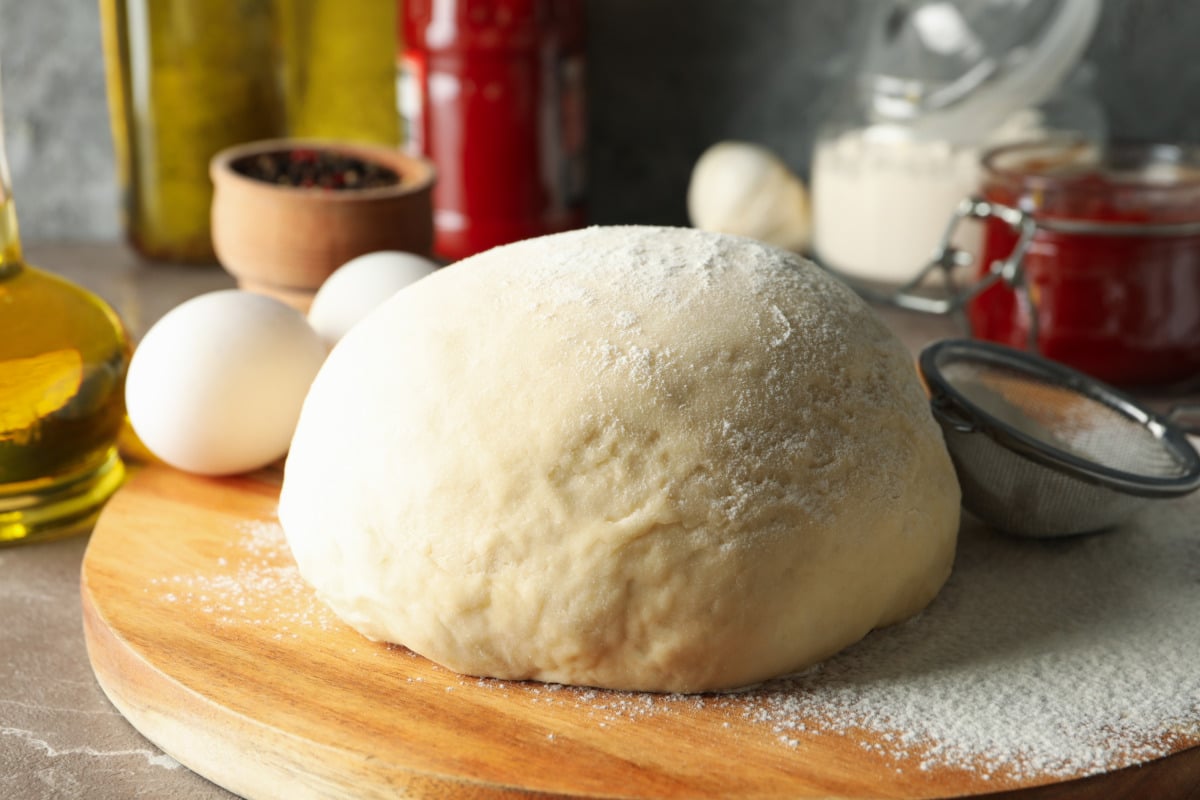
We have made this recipe so many times now that we know the order off by heart. Three steps in the Thermomix®, 40 minutes proving time in a warm bowl, then into the preheated oven. One honest caveat upfront: the truly quick route only works if the oven with a pizza stone is waiting at 250°C fan. Without a stone, the base will not go crispy, and we explain more about that below.
The Quickest Pizza Dough with the Thermomix®

Ingredients 0 / 5 ✓
- 240 g water
- 1 cube fresh yeast
- 500 g flour, type 550 (strong white bread flour)
- 1 tsp salt
- 60 g olive oil
Instructions 0 / 4
-
1
Dissolve the yeast.
Water and fresh yeast into the mixing bowl and heat for 3 minutes / 37°C / speed 1.
-
2
Knead the dough.
Add the remaining ingredients to the mixing bowl and knead for 3 minutes / kneading mode. Cover the dough and leave to prove in a warm place for 40 minutes.
-
3
Preheat the oven.
Preheat the oven to 250°C.
-
4
Roll out the dough and bake.
Roll out the dough as desired, add your toppings, and bake on the middle shelf until the crust is crispy.
Tip: You can also shape this quick pizza dough into several small pizzas, add your toppings, and freeze them. That way, after a stressful day, you just need to slide them into the oven.
Video
Nutrition per serving
Why 30 minutes works instead of 24 hours
A long prove is not wrong, it is simply not essential. What a long dough achieves is flavour through acidity and a finer crumb structure. What it does not achieve is more volume or better baking performance. When we are baking for the family on a Wednesday evening, we rebalance speed and flavour. With fresh yeast, warm water, and olive oil in the dough, we draw out enough flavour to make the difference from a long-proved pizza acceptable. And 25 minutes later the first slices are on the table.
The mechanics behind it are straightforward. Yeast needs warmth, moisture, sugar (present in the flour), and time to activate. We give it everything at once: the water is at 37°C, the mixing bowl stays warm, and the yeast meets the starch in the flour immediately. Instead of 12 hours in the fridge, the dough gets 40 concentrated minutes in the warmth. The volume is enough for four thin pizzas. The crumb will not be as airy as a 24-hour version, but it is stable enough for classic toppings.
The 48 per cent hydration makes the dough beginner-friendly
240 g water to 500 g flour gives roughly 48 per cent hydration. That is a deliberate choice on the low side. Neapolitan professional doughs sit at 65 to 70 per cent, stick heavily, and take practice to shape. Our quick dough at 48 per cent is firmer, barely sticks to your fingers, and can be rolled out thin even without experience. That is exactly what you want when speed matters and there is no time for wet dough handling.
The Thermomix® brings a key advantage here: it weighs every ingredient in the same bowl to the gram and kneads the dough evenly in 3 minutes. By hand, you would need 8 to 10 minutes of vigorous kneading to develop the same gluten structure. If you want a softer bite, you can increase the water to 250 g. The dough will be a little softer and the crumb airier, but it will also stick more. We would not go above 260 g with this short prove, otherwise the dough becomes difficult to lift off the stone.
Type 550 flour is non-negotiable
We use wheat flour type 550, not type 405. The difference is the higher mineral and gluten protein content. Type 550 absorbs more water and produces a more elastic dough that can be rolled out thin even without a long prove, without tearing. With type 405, the base becomes brittle quickly on a 30-minute prove. If you want a classic Italian pizza result, you can use type 00 flour, which works similarly to type 550 and is a clean alternative.
For extra crispiness on the base, we sometimes swap 50 g of the flour for fine semolina (semola). That gives a slightly rougher underside that browns faster on the hot stone and turns out crunchier. The olive oil in the dough is not optional. 60 g to 500 g flour gives roughly 12 per cent fat content, which softens the crumb and slows down drying during the short bake time. Pizza Napoletana uses no oil in the dough, but then the prove takes two days. In the quick version, the oil helps give the dough in 40 minutes of proving the flavour that a long-proved pizza develops over hours.
The pizza stone decides between crispy and soft
We want to be honest here: anyone who wants a truly crispy pizza cannot get around a pizza stone. Baking paper on a standard baking tray is not enough. The reason lies in heat storage capacity. A sheet metal baking tray cools the moment the soft dough lands on it. The water in the dough base evaporates slowly, the base cooks through but does not crisp up, it turns leathery instead.
A pizza stone is heated in the oven for 30 to 45 minutes at 250°C and stores the heat in its mass. When the dough hits the stone, the base temperature shoots up to well over 200°C, the water in the dough evaporates rapidly, the base becomes crispy and develops those characteristic slightly charred spots. Anyone who wants to make homemade pizza regularly should invest in a stone. Cordierite stones are affordable, last for years, and fit in any domestic oven. A pizza steel also works and heats up even faster, but it costs more.
If you do not have a pizza stone and do not want to buy one, you can turn a baking tray upside down, preheat it empty at 250°C, and slide the pizza onto it from a pizza peel or chopping board using baking paper. That is significantly better than placing the pizza on a cold tray in the normal way, but it does not fully replace the stone.
Step by step through the 65 minutes total time
So it is clear what happens when, here is the sequence with time windows. 5 minutes of active work at the Thermomix®, 40 minutes proving time, 15 minutes baking time. We use the proving time to prepare the toppings and preheat the oven. That is the real Thermomix® advantage with this recipe: while the dough is proving in the warm mixing bowl, we can make the pizza sauce in the same machine without dirtying a second pot.
- Minutes 0 to 1: 240 g water and 1 cube of fresh yeast into the mixing bowl, heat for 3 minutes / 37°C / speed 1.
- Minutes 3 to 6: Add the remaining ingredients, knead for 3 minutes / kneading mode.
- Minutes 6 to 46: Cover the dough in the warm mixing bowl and leave to prove. Meanwhile make the sauce, grate the cheese, slice the toppings, and preheat the oven with the pizza stone to 250°C fan.
- Minutes 46 to 60: Divide the dough into four, roll each piece out thin, add toppings, and slide each pizza onto the stone one at a time. Bake for 8 to 12 minutes each until the crust is golden and the cheese is bubbling.
The 65 minutes in the recipe card include preparing the toppings and preheating. If you work in pairs and already have the oven running, you can get from craving pizza to first pizza on the table in 45 minutes. When rolling out, do not press the dough flat with a rolling pin. Instead, gently stretch it from the centre outwards. That keeps the small air pockets intact so the crust still puffs up in the oven.
Where quick pizza dough can go wrong
Yeast gets too hot and dies
The most common mistake with a short prove. 37°C is the comfort temperature for yeast. If you accidentally turn the setting to 50°C or 60°C, the yeast dies within seconds. The dough will not rise, no matter how long you leave it. Our fix: Double-check the temperature during heating and do not go above 37°C. If the yeast still shows visible cube remnants after 3 minutes, the temperature was too low rather than too high, so just run it for another 30 seconds.
Dough does not prove in a cold mixing bowl
The mixing bowl warms up during kneading, but it does not hold the heat for 40 minutes. In a cold kitchen it cools down and the proving time is not enough. Our fix: Place the bowl with the lid somewhere warm, next to the preheating oven or on a radiator. Alternatively, run the mixing bowl for 30 seconds at 37°C before kneading to warm up the walls, then start the yeast and water mixture.
Base turns soggy instead of crispy
A classic sign of too many toppings, too little heat, or no pizza stone. If you pile on heavy toppings, you add too much moisture to the thin dough, which soaks down and becomes waterlogged. Our fix: Spread the tomato sauce sparingly, use Mozzarella in balls or sliced thin, and briefly saute or squeeze out any fresh vegetables beforehand. Mushrooms and courgettes in particular release a lot of water. And above all: use a pizza stone, then the base has a chance.
Dough tears when rolling out
This happens when the dough is too cold or was not kneaded enough. Gluten strands need time to relax, otherwise the dough keeps springing back when you roll it or develops holes. Our fix: Let the freshly kneaded dough rest for 5 minutes before rolling out, then the gluten will give way. Always work on a lightly floured surface so the soft dough does not stick and tear when you lift it.
Topping ideas that work with this dough
The dough is neutral and takes any classic topping. We switch between four standards depending on what is in the fridge and what we feel like.
- Pure Margherita: Tomato sauce, Mozzarella, fresh basil added after baking. The classic for the first pizza, because you can taste from the dough itself whether it has turned out well.
- Salami and mushrooms: Pizza salami, Mozzarella, mushrooms sliced thin. Saute the mushrooms for 2 minutes in a pan first, otherwise the base turns soggy.
- Ham and cream: Instead of tomato, use a mix of 100 g double cream, a little salt, and nutmeg as the sauce, then add cooked ham and grated Gouda on top. Works especially well for children.
- Tuna and onion: Tomato sauce, Mozzarella, drained tuna, thin red onion rings, and a few drops of olive oil before serving. A classic from the pizzeria.
Sauce, toppings, and recipes to go with it
A homemade pizza stands or falls on three things: dough, sauce, and toppings. We have the dough covered here. We make the sauce from sieved tomatoes, olive oil, salt, oregano, and a garlic clove. You will find the matching recipe in our pizza sauce with the Thermomix®. If you prefer the classic with a long prove, our original pizza dough recipe with 12 to 24 hours of maturing time is also here. And if you want to use the dough in a completely different way, say as a filled pizza wreath for a birthday party, take a look at our pizza wreath with the Thermomix®.
If you regularly make bread or yeast dough in the Thermomix®, you will find more recipes and our methods in our bread baking overview. It also covers how to swap flour types, what distinguishes type 550 from type 405, and which amount of yeast we recommend for what purpose.
Making dough in advance: how we freeze it
We often make double the quantity and freeze half in individual portions. After proving, divide the dough into four, wrap each portion separately in cling film, and put in the freezer. It keeps for 3 months. To use, transfer to the fridge overnight, then leave to come to room temperature for 30 minutes, roll out, add toppings, and bake as if fresh. It is slightly faster than starting from scratch because the thawing happens passively.
Fully topped pizzas can also be frozen. Roll out the dough thin, add toppings, and pre-freeze each pizza individually on a board for 1 hour, then wrap in film and stack in the freezer. Straight from the freezer onto the hot pizza stone, 12 to 15 minutes at 250°C, done. That is our standard supply for evenings when there is simply no time to cook.
Keeping fresh dough in the fridge works too. Transfer it straight to the fridge after kneading, before the first prove. That slows the yeast activity and the dough matures for 8 to 24 hours in the fridge, actually gaining in flavour. That turns the 30-minute dough into a long-proved dough, which is handy if we know in the morning that pizza is on the cards for the evening.
What others do differently
Most Thermomix® quick pizza dough recipes differ from ours on three points. First, the yeast: many use just 2 g of fresh yeast with a cold bulk ferment for 6 to 24 hours in the fridge. We stick with a whole cube and 40 minutes of proving because our promise is speed, not a long cold prove. Second, the flour: others swear by type 00 or type 405, but we stay with type 550 because the dough is more stable and can be rolled out thin even without a resting period. Third, the olive oil: classic Neapolitan doughs leave it out entirely, but we deliberately add 60 g for a softer bite and faster browning at 250°C.
Frequently asked questions about quick pizza dough
Goes well with: Tomato sauce, Mozzarella, and pesto.
More yeast dough recipes and our pizza classics can be found in the bread baking overview, in the original pizza dough with a long prove, and in the matching pizza sauce with the Thermomix®.