150 g feta, 200 g cream cheese, 40 g ajvar, garlic and parsley. 10 minutes in the Thermomix® and you have a creamy dip that disappears from every spread. The Turkish feta dip is the feta-based cousin of the Bavarian Obatzda, spicier and with more heat.
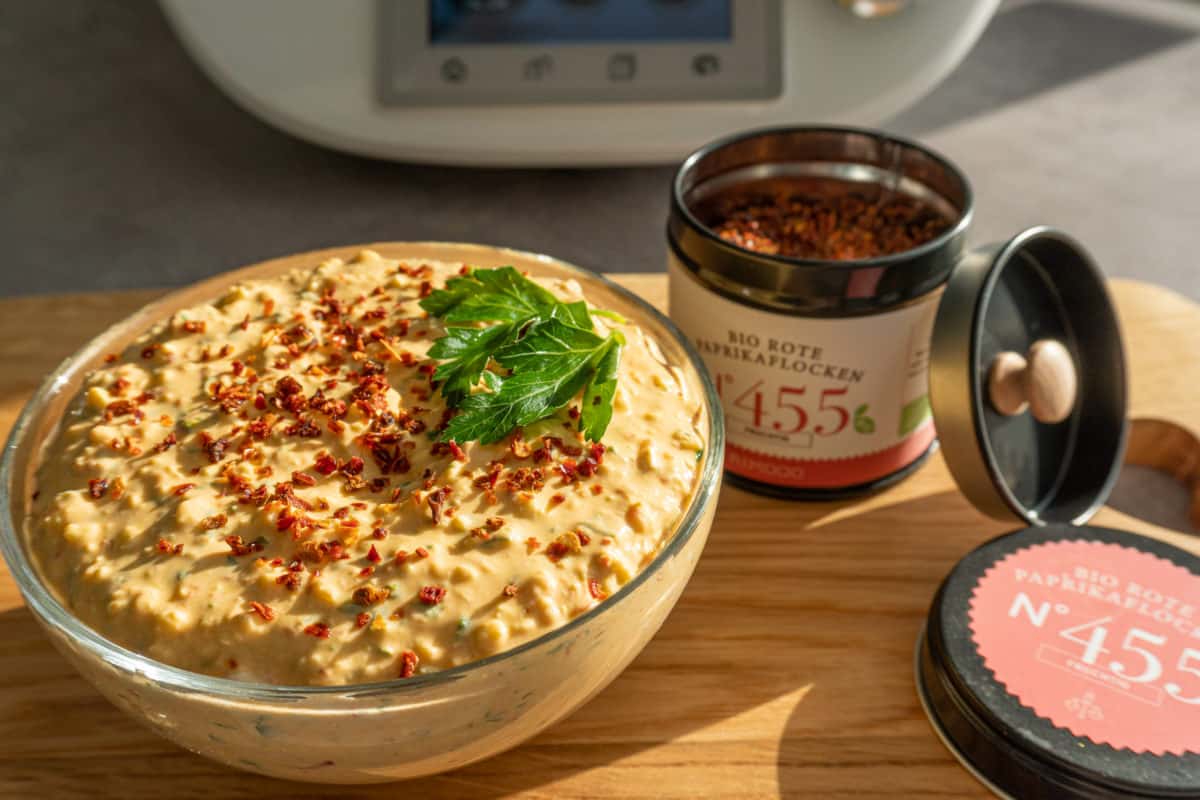
Here is how we make the Turkish feta dip in the Thermomix®: chop 2 garlic cloves and half a bunch of parsley for 3 seconds at speed 8, then add 150 g feta cut into pieces with 200 g cream cheese, 40 g ajvar, 1 tsp chilli flakes, 1/4 tsp cumin and 1 tsp paprika flakes and mix for 8 seconds at speed 4. Season with 1/2 tsp salt. This makes 4 servings with around 273 kcal each. Below we explain how to get the texture just right, what usually goes wrong with this dip and how to vary it.
Turkish Feta Dip with the Thermomix®

Ingredients 0 / 9 ✓
- 2 garlic cloves
- ½ bunch flat-leaf parsley
- 150 g feta
- 40 g ajvar
- 1/2 tsp salt
- 1/4 tsp cumin (ground cumin)
- 1 tsp chilli flakes
- 200 g full-fat cream cheese
- 1 tsp paprika flakes + a little extra for sprinkling
Instructions 0 / 2
-
1
Chop the garlic and parsley.
Peel the garlic and place in the mixing bowl. Wash the parsley, shake dry, add the leaves to the mixing bowl and chop for 3 seconds / speed 8.
-
2
Mix in the remaining ingredients.
Cut the feta into pieces, add with the remaining ingredients and mix for 8 seconds / speed 4.
Video
Nutrition per serving
Bavarian or Turkish: the difference is the feta
The Bavarian Obatzda is based on Camembert and cream cheese. The Turkish version replaces the Camembert with 150 g feta and adds 40 g ajvar. The result is a saltier, more pungent spread with a mild paprika heat. Both come together in the Thermomix® in just a few minutes, but they taste quite different.
Feta already brings plenty of salt on its own. That is why we use only 1/2 tsp of salt, no more. Better to taste after mixing and add more if needed. Using feta made from pure sheep’s milk gives the boldest flavour. Cow’s milk feta or halloumi-style block cheese is milder and suits anyone who finds pure sheep’s cheese too intense.
Why two separate blending steps work better than one
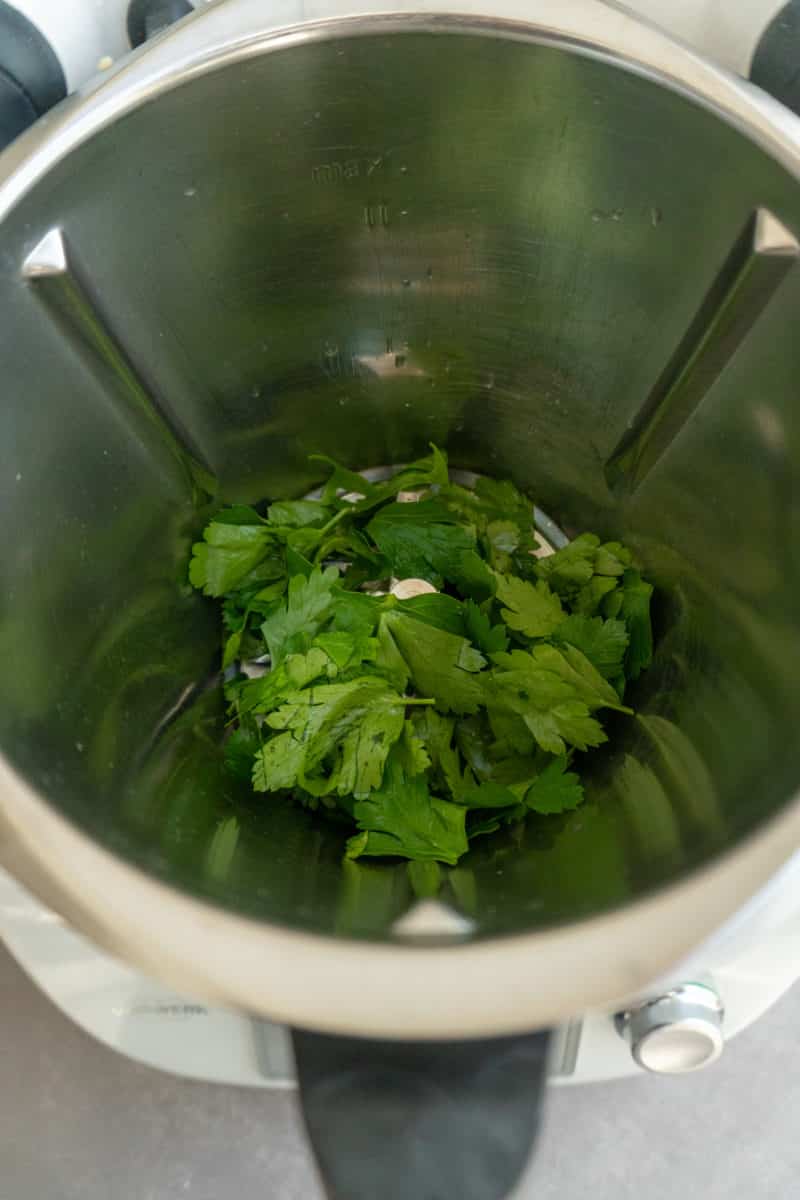
The 2 garlic cloves and half a bunch of parsley go into the mixing bowl first: chop for 3 seconds at speed 8. This step matters because the garlic and parsley need to be finer than everything else. If we blended everything together at once, there would be rough chunks of garlic in the finished dip. At speed 8 the Thermomix® breaks down the parsley in seconds to an even, fine consistency, which takes longer by hand and is never as uniform.
Only then do the feta and cream cheese go in, but now at speed 4 only. These two different speeds are exactly why the Thermomix® works better than a stick blender here: pulverise the garlic at high speed, then gently combine the cheese, all in one bowl without transferring.
8 seconds at speed 4: why the dip should not be smooth
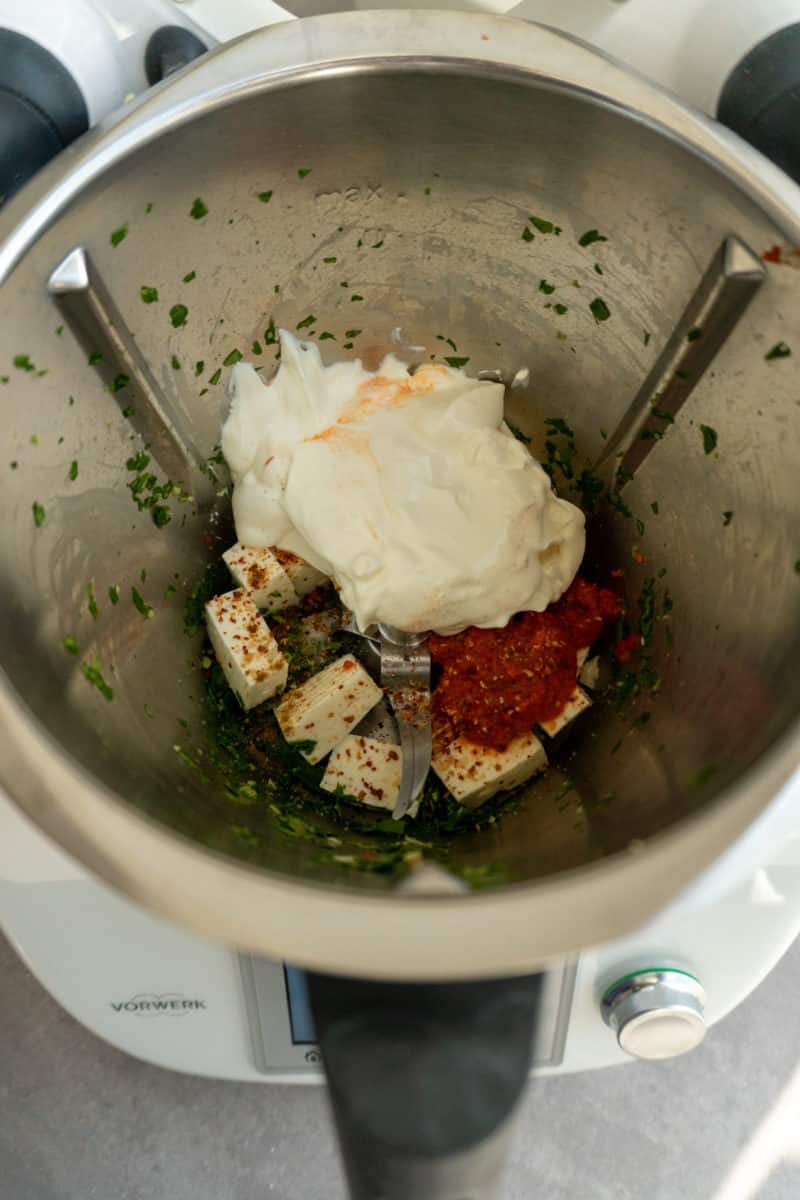
Add the 150 g feta in pieces with the 200 g cream cheese, 40 g ajvar, 1 tsp chilli flakes, 1/4 tsp cumin and paprika flakes: 8 seconds at speed 4. The short time at the low speed is deliberate. The dip should still have a little texture, not be as smooth as cream cheese from a tube. That texture is what sets a good Turkish feta dip apart from a bland cheese cream.
Cumin is not a minor detail here, it is the flavour anchor. 1/4 tsp of ground cumin gives the typical Middle Eastern note that distinguishes this dip from the Bavarian original. The chilli flakes bring the heat. If you prefer it milder, halve the amount to 1/2 tsp. If you want more fire, go up to 2 tsp.
If you pop the feta in the freezer for 15 minutes beforehand, you get an even better texture. The lightly frozen feta breaks down more evenly and the spread turns out creamier. Do not freeze it solid, just lightly firm it up.
Three pitfalls that ruin the dip
The dip turns out smooth and pasty instead of textured
If you blend for longer or at a higher speed out of habit, the feta gets completely puréed. The dip then loses its structure and tastes only of seasoned cream cheese. Our fix: Stick to exactly 8 seconds at speed 4, then stop and check. Better to blend twice briefly than once for too long. If there are still large lumps, add 2 to 3 seconds, no more.
The dip turns out too salty
Both feta and ajvar bring salt. Adding a full teaspoon of salt on top of that oversalts the dip. Our fix: Start with 1/2 tsp salt, taste after mixing and only add more then. If it is still too salty, stir in 1 to 2 tbsp of cream cheese or a spoonful of yoghurt to round it out.
Rough chunks of garlic taste raw and sharp
If you blend the garlic together with the cheese only at speed 4, you end up with hard garlic pieces that taste raw and sharp. Our fix: Always chop the garlic and parsley in the first step alone at speed 8. Only that way does the garlic get distributed finely enough and the dip tastes rounded rather than pungently sharp in spots.
Four variations from mild goat’s cheese to mezze platter
With goat’s cheese instead of feta: 150 g goat’s cheese in place of feta gives a milder, slightly lemony dip. Quantities and times stay the same, the flavour becomes softer.
As a looser dipping consistency: If you want the spread thinner for dipping, stir in 1 to 2 tbsp of yoghurt or milk after blending. This makes it spoonable for breadsticks, crackers or vegetable sticks.
Extra smoky: Use smoked paprika flakes instead of regular paprika (pul biber is often sold lightly toasted). This gives a deeper, almost grilled note that goes well with barbecued meat.
As part of a mezze platter: Serve the dip alongside olives, pickled vegetables and warm flatbread. A drizzle of good olive oil and a few fresh parsley leaves on top turn the dip into a small starter.
Resting time makes it better
The dip tastes good straight after blending, but noticeably better after 2 hours in the fridge. The spices, especially cumin and chilli flakes, need time to develop their full flavour. Leaving it to rest overnight is ideal if time allows.
In the fridge, the dip keeps for 3 days in an airtight container. If the texture is too firm after chilling, simply stir in a spoonful of yoghurt or milk. We advise against freezing: cream cheese and feta separate on thawing and the dip becomes watery and grainy.
With pitta bread, crudités or on a buffet
The Turkish feta dip works as a bread spread, as a dip for crudités (cucumber, carrots, radishes) or as part of a cold buffet. It goes especially well with our Pitta Bread with the Thermomix®. Sprinkle with paprika flakes before serving.
More dips and spreads: Date Dip, Guacamole, Aioli without Egg or our full Thermomix® Dips Collection.
Key questions about the Turkish feta dip
Can I freeze the feta beforehand?
Yes, 15 minutes in the freezer is enough. The lightly frozen feta breaks down more evenly at speed 4 and the finished dip turns out creamier. Do not freeze it solid, just lightly firm it up.
Does this work with goat’s cheese instead of feta?
Yes. 150 g goat’s cheese instead of feta gives a milder, slightly lemony dip. Quantities and times stay the same. The flavour changes noticeably, but both versions work well.
Do I need ajvar for the Turkish feta dip?
The 40 g of ajvar gives colour and a sweet, paprika depth. Without it the dip is paler and less flavoursome. In a pinch, use 2 tbsp of passata plus 1/2 tsp paprika powder, though the flavour will be flatter. If you like, make the Ajvar with the Thermomix® yourself.
How many calories are in one serving?
One serving (out of four) has around 273 kcal, approximately 8 g protein, 25 g fat and 4 g carbohydrates. To cut calories, use a lower-fat cream cheese, though the dip will be a little less creamy.
Which Thermomix® models work?
All of them. TM31, TM5, TM6 and TM7 give the same result. There is no heating involved, only chopping and mixing: 3 seconds at speed 8 for the garlic and parsley, 8 seconds at speed 4 for the rest. No difference between models.
How far in advance can I make it?
Goes well with: Flatbread.
Up to 3 days ahead. Flavour-wise it is actually at its best after 2 hours to overnight in the fridge, because cumin and chilli flakes have time to infuse. For a buffet, blend it the day before and keep it covered in the fridge.