Wholemeal flour in the Thermomix® takes just 45 seconds and yields 200 g from 200 g of whole grains. Keep to a maximum of 250 g per milling run, otherwise the motor gets too hot and heat-sensitive nutrients (vitamin E, B vitamins) are lost. Freshly milled flour has one key advantage: all the components of the whole grain are present and have not yet oxidised.
We have been milling our own wholemeal flour for years and only buy it as a backup. Compared with ready-made wholemeal flour (around 1.50 to 2 euros per kg in the supermarket), whole grains cost roughly 1 to 1.50 euros per kg (organic: 2 to 3 euros). Plus the decisive advantage: the flour is 100 per cent fresh, not 6 months old from an industrial mill.
Wholemeal Flour with the Thermomix®
Ingredients 0 / 1 ✓
- 200 g whole grains e.g. spelt, wheat, rye
Instructions 0 / 2
-
1
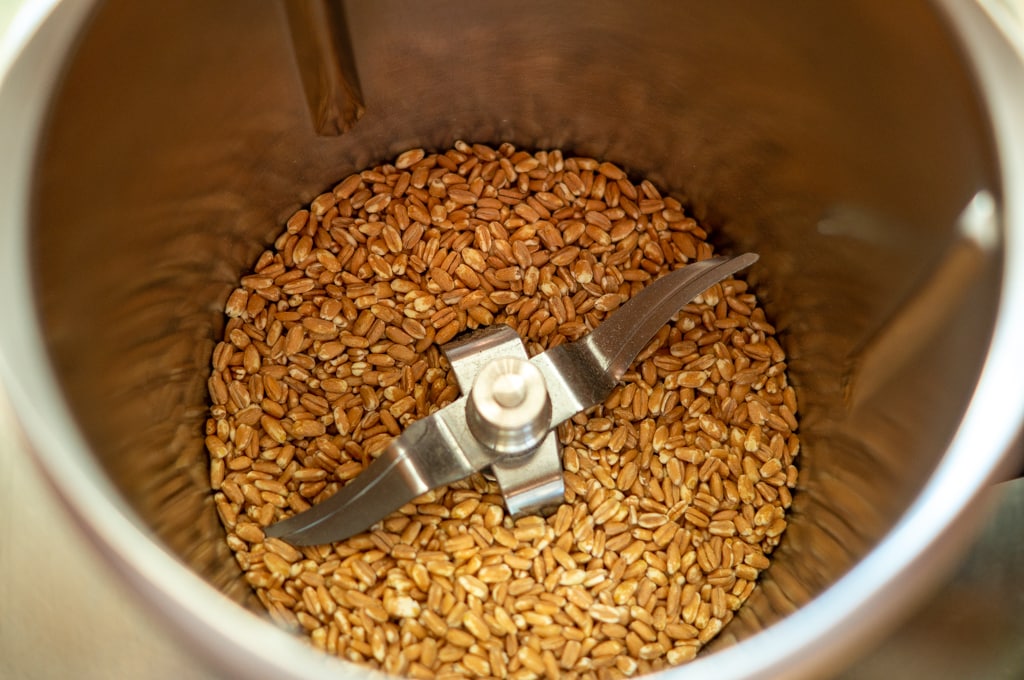
Add whole grains to the mixing bowl and mill for 45 sec / speed 10.
-
2
Use the finished wholemeal flour as required by your recipe.
Tip: Regardless of which grain you use, do not exceed 200 to 250 grams per milling run.
If the flour is still too coarse, simply extend the milling time as needed.
Video
Nutrition per serving
Why a maximum of 250 g per milling run
The Thermomix® blade spins at up to 10,700 revolutions per minute. With more than 250 g of grain, frictional heat quickly rises to 80 to 90 °C inside the mixing bowl. That is a problem: vitamin E in the grain is heat-sensitive and begins to oxidise at 60 °C. B vitamins are equally vulnerable.
With 200 g of grain the temperature stays below 50 °C. Before every second milling run, check the base of the mixing bowl with your hand: if it feels warm, wait 5 minutes. If you need 1 kg of flour, mill it in 4 batches with a 5-minute break between each.
45 seconds at speed 10 for fine flour
45 seconds produces fine flour comparable to shop-bought wholemeal flour. If you need it even finer (for cakes): 60 seconds. If you want a coarse meal (for rustic bread): only 15 to 20 seconds. That is the advantage over industrial flour: you control the fineness yourself.
Speed 10 is the maximum setting. Lower speeds are not sufficient for whole grains and the flour comes out uneven. Important: add the grains first, then put the lid on, then ramp up to speed 10 (not the other way round). Otherwise grains will jump against the lid and the blade.
Which grain to use: wheat, spelt, rye, emmer
Wheat: the standard choice, mild, with plenty of gluten for light loaves. Allergen risk (wheat intolerance). Available at health food shops or organic supermarkets for 2 to 3 euros per kg.
Spelt: an ancient grain, similar to wheat but easier to digest (different gluten profile). Nutty flavour. Slightly more expensive (3 to 4 euros per kg organic).
Rye: robust and earthy, dark. Essential for farmhouse bread and pumpernickel. Rye flour needs sourdough (not ordinary baking powder) because rye has little gluten.
Emmer: a rediscovered ancient grain with a high iron and protein content. Slightly earthy and nutty. A premium option at 5 to 6 euros per kg.
Einkorn: the oldest cultivated grain, yellowish and mild. Very expensive (6 to 8 euros per kg), suited to specialist breads.
Kamut (Khorasan wheat): mildly sweet, easy to digest. 4 to 5 euros per kg, can be used in a similar way to wheat.
Pseudo-cereals: buckwheat, quinoa, amaranth
These are not botanically cereals, but they mill just as well. Advantage: they are gluten-free, making them suitable for people with coeliac disease.
Buckwheat: nutty and earthy, classic for Russian blini and French galettes. 4 to 5 euros per kg.
Quinoa: slightly bitter in taste, so rinse for 1 minute in hot water first (this removes saponins). High in protein.
Amaranth: very fine, mildly sweet. High in protein and minerals. Use a maximum of 30 per cent in flour blends, otherwise the result will be too dense.
Important when using pseudo-cereals: on their own they do not bind (no gluten), so mix with regular flour or add a binding agent (psyllium husk, xanthan gum).
Wholemeal vs. Type 405/550/1050
Industrial flour is classified by ash content: Type 405 (very fine, low in minerals, for cakes), Type 550 (all-purpose, for pizza and bread), Type 1050 (robust bread flour), Type 1700 (almost wholemeal). The type number equals milligrams of minerals per 100 g of flour.
In the Thermomix® we always mill wholemeal flour from the whole grain. If you want something closer to Type 405 or 550: sieve the milled flour through a fine sieve. The coarser bran stays behind and the finer flour passes through. Expect around 5 to 10 minutes of sieving for 250 g.
Wholemeal flour stays fresh for only 4 to 6 weeks
This is the main reason to mill your own: compared with Type 405 flour, wholemeal flour contains a much higher proportion of the germ, which is rich in oil and fatty acids. These oxidise on contact with air. After 4 to 6 weeks of storage the flour turns rancid (sour smell, bitter taste).
Whole grains, by contrast, keep for 2 to 3 years because the outer husk protects them. So the approach is: stock up on whole grains, then mill only the quantity you will use within 2 weeks. That way you always have maximum nutrients (vitamin E, B1, B2, B3, B6, folate, iron, zinc, magnesium).
Baking ideas with home-milled wholemeal flour
Use it in our spelt wholemeal sticks, wholemeal nut bread, or wholemeal pizza dough. You can also mix it 50:50 with plain flour in pancakes for extra nutrition without any loss of flavour.
Important when baking: wholemeal flour absorbs more liquid than Type 405. Add 10 to 20 per cent extra water or milk to the dough, otherwise it will be too dry and the finished product will be dense.
Wholemeal flour keeps for 4 to 6 weeks in a screw-top jar
Stored in a clean screw-top jar in a cool cupboard it will keep for 4 to 6 weeks (rye flour a little less, around 3 to 4 weeks). Keep it in a dark, cool spot: light and warmth speed up oxidation. In the fridge: up to 3 months. Frozen: 6 months.
Whole grains, on the other hand, keep for 2 to 3 years in a dry pantry. So our practice is: keep a stock of 5 to 10 kg of grain, always have only 200 to 500 g of milled flour on hand, and mill the rest fresh as needed.