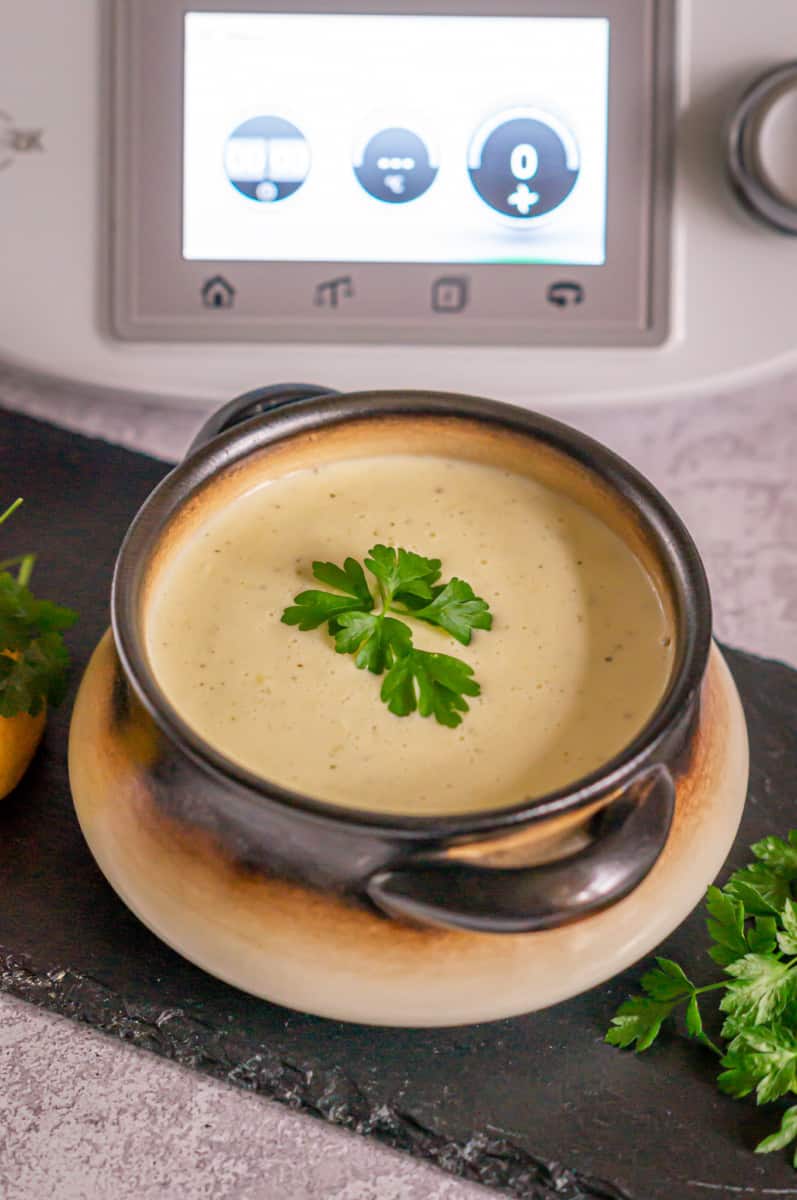
This cream sauce with the Thermomix® takes 20 minutes and makes 4 servings. The base is a roux of onion, butter and flour, followed by 200 g double cream, 200 g vegetable stock and 200 g cream cheese. The cream cheese is what sets this apart from most Vorwerk cream sauce recipes that use only cream: the result is creamier, denser and restaurant-worthy.
We use it regularly as a go-to sauce with Spaetzle, pasta, schnitzel, vegetables or potatoes. One serving (roughly 150 g of sauce) has about 260 kcal. That is plenty of sauce for a 250 g portion of pasta plus a side. Cooking for a family: double the quantity and you are done in 25 minutes.
Cream Sauce with the Thermomix®

Ingredients 0 / 11 ✓
- 1 onion
- 2 tbsp sunflower oil
- 20 g butter
- 20 g flour
- 200 g vegetable stock
- 200 g double cream
- 200 g full-fat cream cheese
- 1/2 tsp salt
- 1 pinch nutmeg
- 1/2 tsp black pepper
- 2 tsp lemon juice
Instructions 0 / 3
-
1
Chop the onion.
Peel the onion, halve it and place in the mixing bowl. Chop for 5 seconds / speed 5, then scrape down with the spatula.
-
2
Sweat.
Add the oil and butter and cook for 3 minutes / Varoma / speed 1 without the measuring cup in place.
-
3
Cook.
Heat for 2 minutes / 100°C / speed 2 and slowly add the flour. Add the remaining ingredients, mix for 10 seconds / speed 7 and then cook for 9 minutes / 100°C / speed 2.
Blend by gradually increasing to speed 8 and serve immediately.
Tip: You can add extra flavour to your sauce with dill or other fresh or frozen herbs.
Video
Nutrition per serving
Cream cheese instead of just cream: the secret
Most Vorwerk community cream sauce recipes work with cream alone (200 to 400 g). We use 200 g double cream plus 200 g full-fat cream cheese. The cream cheese brings three advantages: a velvety mouthfeel, a thicker consistency (less liquid overall) and a gentle tang that balances the sauce nicely.
No cream cheese to hand: use 400 g double cream on its own. The result will be thinner and milder. For something even richer: 100 g double cream, 100 g creme fraiche and 200 g cream cheese. Restaurant-level richness, but quite calorie-dense.
The roux as a base: why 20 g of flour
The 20 g of flour is cooked with butter and onion before the cream and stock go in. This roux (French for the technique) binds the sauce and gives it body. Without a roux, the sauce stays too thin. With more flour (30 g) it becomes too thick, almost like a pudding. 20 g is the sweet spot.
For a gluten-free version: use 20 g cornflour instead of plain flour. It works in exactly the same way and gives the sauce a slightly glossier finish. Skipping a thickener altogether is not recommended as the sauce will stay thin.
Vegetable stock and cream in a 1:1 ratio
200 g vegetable stock combined with 200 g double cream is the standard blend. Pure cream would be too rich; pure stock too thin. The 1:1 ratio gives a well-balanced sauce. For a richer result: 300 g cream and 100 g stock. For a lighter result: 100 g cream and 300 g stock, plus 1 tbsp extra cornflour.
Stock rather than plain broth gives a better flavour. Home-made vegetable stock from the Thermomix® is the premium option. Stock powder dissolved in 200 g of hot water works as a quick alternative, though it tends to be saltier and more processed in taste.

Three variations: ham, mushroom and ham with mushroom
Ham cream sauce: Stir in 100 g diced cooked ham at the end (do not blend). A classic family favourite, great with tagliatelle carbonara-style.
Mushroom cream sauce: Sweat 200 g sliced mushrooms with the onion for 5 minutes. Dust with the flour, then continue as per the main recipe. A vegetarian variation with real depth of flavour.
Ham and mushroom variation: 100 g mushrooms and 100 g ham. The full combination, perfect with tagliatelle or Spaetzle. A classic German home-cooked dish.
Lemon juice at the end: 2 tsp bring balance
2 tsp of lemon juice added at the end of cooking makes the difference between a heavy cream sauce and a well-balanced one. The acidity lifts the sweetness of the cream and makes the sauce easier to eat over a longer meal. Without lemon: 1 tbsp white wine works as an alternative.
With the ham variation: the amount of acid may need adjusting depending on how salty the ham is. With the mushroom variation: 2 tbsp white wine instead of lemon juice gives an Italian note. Acidity is always part of the sauce, only the source varies.
What to serve with cream sauce
Classic pairings: Spaetzle, tagliatelle, penne, rigatoni. Also great with schnitzel (hunter-style or creamy schnitzel), pork fillet, steamed vegetables (broccoli, cauliflower), sauteed potatoes. Use it as a lasagne layer instead of bechamel. Or as a soup base (add 200 g more stock).
For a vegetarian main: cream sauce over penne with mushrooms and Parmesan is a classic pasta bianca. Looking for more sauce ideas: our cheese sauce with the Thermomix® is the cheesy alternative.
Cream sauce keeps for 2 days in the fridge, reheat with a milk trick
Store in a sealed container in the fridge for up to 2 days. When reheating, add a splash of milk (30 to 50 g) because the roux thickens on standing. Warm through over a medium heat, stirring, and do not let it boil again (the cream cheese can split if it does).
Freezing does not work well: the cream cheese component turns grainy on thawing. If you want to make a batch ahead, freeze the sauce without the cream cheese and stir it in freshly when you reheat.
Also pairs well with: Spaghetti and tagliatelle.