Lentil salad made in the Thermomix® falls apart in most kitchens because of salt. Anyone who cooks beluga lentils in salted water or salted stock and then wonders why the skins stay tough and the centres are still slightly floury is making the same mistake. We take a different approach, and that is exactly what this recipe is about.
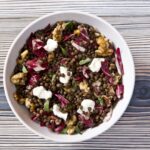
We have been making this lentil salad regularly for years, especially when we need something filling on the table quickly that still tastes like summer. With 200 g of beluga lentils, a splash of apple cider vinegar, rapeseed oil and three shallots, we have a salad ready in 45 minutes that often tastes even better the next day. The finishing touch is fresh goat’s cheese and toasted walnuts, which we add only at the moment of serving.
Lentil Salad with the Thermomix®
Ingredients 0 / 9 ✓
- 200 g beluga lentils
- 700 g vegetable stock
- 3 shallots
- 30 g apple cider vinegar
- 30 g rapeseed oil
- 1/2 tsp salt
- 1 tsp pepper
- 150 g fresh goat's cheese
- 50 g walnuts
Instructions 0 / 5
-
1
Cook the lentils.
Rinse the lentils well under running water and drain. Then add them to the mixing bowl together with the vegetable stock and cook for 40 min / 100°C / reverse direction / speed 1, then transfer to a salad bowl.
-
2
Chop the shallots.
Peel the shallots, halve them, add to the mixing bowl and chop for 5 sec / speed 5.
-
3
Add the dressing.
Add the vinegar, oil, salt and pepper and mix for 8 sec / reverse direction / speed 3.
-
4
Mix in the lentils.
Add the lentils and mix for 8 sec / reverse direction / speed 3, then transfer to the salad bowl.
-
5
Serve.
Serve the lentil salad garnished with fresh goat's cheese and walnuts.
Video
Nutrition per serving
Why beluga lentils and not plate lentils
Beluga lentils are small, glossy black and have an especially firm skin. They hold their shape during cooking and do not turn to mush. That is exactly what we want here. Plate lentils cook through more quickly but fall apart at the slightest touch inside the mixing bowl. Anyone who has ever tried to rescue a salad made with overcooked lentils knows: it cannot be done. The texture turns to sludge, the dressing goes grey and the salad looks like porridge.
With the 200 g of beluga lentils we use here, that does not happen. Even after 40 minutes at 100°C on reverse direction they remain as individual grains. Reverse direction matters here because it turns the lentils gently without the blades cutting through them. On normal direction we would end up with lentil puree.
Salt after cooking, not before
This is the point where most lentil recipes go wrong. Salt hardens the skins of pulses during cooking. In a stew that does not matter because everything keeps simmering for a long time anyway, but in a salad it is a real problem: the lentils then need considerably longer to soften, and the centres can remain floury. We therefore cook the 200 g of beluga lentils only in 700 g of vegetable stock, which we deliberately do not salt further. A standard ready-made vegetable stock already contains some salt, but so little that it does not affect the skins.
The right salt goes into the dressing only once the lentils are fully cooked: 1/2 tsp salt and 1 tsp pepper together with apple cider vinegar and rapeseed oil. And this is where the second trick comes in.
Dressing the lentils while still warm draws the flavour in
We do not pour the dressing over cold lentils but over warm ones. Right after cooking, beluga lentils are porous and absorb liquid like a sponge. Anyone who lets the salad cool first and then folds in the dressing will end up with lentils that remain flavourless and a dressing that pools at the bottom of the bowl. Dressing them while warm means every single lentil absorbs the apple cider vinegar and the rapeseed oil. You can taste the difference after just ten minutes of resting.
In practice: as soon as the lentils have been transferred from the mixing bowl to the salad bowl, we move straight on to the shallots and the dressing in the mixing bowl. This keeps the lentils warm until the dressing is ready, and the absorption works perfectly.
What the walnuts and goat’s cheese do right here
50 g of walnuts sounds like very little, but it is enough because the nuts make themselves known in every bite. We toast the walnuts briefly in a dry pan without any fat before serving, about two to three minutes over a medium heat. This activates the essential oils and turns a flat-tasting walnut into one that actually tastes of walnut. Added raw they are softer and get lost flavour-wise.
We crumble the 150 g of fresh goat’s cheese with our fingers directly over the salad. Do not stir it in the mixing bowl, otherwise the cheese turns into a creamy sauce that smothers everything. We want individual pieces that melt in the mouth, combined with the firm lentil and the crunchy walnut. That is the real trick of this salad: three textures sitting side by side rather than blending together.
Where lentils stay hard or the dressing tastes flat
1. Lentils turn out hard and floury
Classic salt problem. Anyone who adds salt to the cooking water or uses a very heavily salted stock will get tough skins. Our solution: Use a mild vegetable stock and add the salt to the dressing only. If you already have a very salty stock in the jar, simply dilute it with a little water before adding it to the mixing bowl.
2. Salad tastes flat even though all the ingredients are in
This happens almost every time the dressing goes over cold lentils. Our solution: Mix the lentils with the warm dressing straight after cooking. Then leave to rest for at least ten minutes, preferably half an hour. Only then add the walnuts and goat’s cheese.
3. Shallots taste too sharp
Fresh shallots can have an aggressive bite that dominates the salad. Our solution: Briefly steep the chopped shallots in the apple cider vinegar before adding the oil. Ten minutes is enough. The vinegar takes the edge off the shallots and turns the raw sharpness into a rounded, slightly sweet note.
Variations we have actually tried
With red onion and fresh flat-leaf parsley: Instead of shallots, use one small red onion and a good bunch of flat-leaf parsley. This makes the salad more vibrant in colour and gives it a Mediterranean twist. Add the parsley just before serving, otherwise it goes soggy.
With feta instead of goat’s cheese: Cut 150 g of feta into small cubes. This tastes saltier and more robust, so use only a small pinch of salt in the dressing.
Served warm as a side dish with salmon: Do not let the salad cool down; serve it straight from the bowl as a warm accompaniment. It goes particularly well with pan-fried salmon or grilled chicken breast.
With pumpkin seed oil instead of rapeseed oil: 30 g of Styrian pumpkin seed oil adds a nutty note that pairs beautifully with the walnuts. This only works with good-quality pumpkin seed oil; cheap versions taste rancid.
Bread, grilled vegetables or as a side dish with fish
We often serve the lentil salad as a side dish with grilled meat or fish, but sometimes also as a complete main meal with a slice of freshly baked bread. Anyone looking for more Thermomix® salad recipes will find a whole collection on our site. Other vegetarian Thermomix® recipes also go well with this salad as part of a buffet. If you are a fan of pulses, our lentil and bean soups are well worth a look too.
Keeps for 3 days in the fridge, and tastes even better on day 2
The salad keeps in the fridge in an airtight container for three to four days. On the second day it actually tastes better because the lentils have fully absorbed the dressing. Important: add the walnuts and goat’s cheese portion by portion, not into the storage container. Otherwise the walnuts go soft and the goat’s cheese runs. Keep both separately in the fridge and add them to the plate just before serving.
Freezing does not work with this salad. The lentils become watery on defrosting, the dressing separates and the texture is ruined. Anyone who wants to cook ahead should freeze only the fully cooked and cooled lentils without dressing. Defrost overnight in the fridge, then dress freshly.
Preparing ahead is no problem at all: we often make it in the morning and keep it in the fridge until lunchtime. Give it a stir before serving, add the walnuts and goat’s cheese on top, and it is ready.
Mediterranean version with pepper, cucumber, tomato and feta
When we serve the salad as a summer main course or bring it to a barbecue, we turn it into a colourful Mediterranean version. One red pointed pepper, half a cucumber and 200 g of cherry tomatoes are cut into small cubes and folded into the warm lentils only after marinating. Important: tomatoes and cucumber release water into the salad, so salt them briefly first, leave for five minutes and drain off the liquid. Instead of goat’s cheese we use 150 g of feta in cubes and a bunch of parsley. Walnuts still work well, but toasted pine nuts add extra crunch. The dressing stays the same, though we reduce the salt to a pinch because the feta and salted vegetables already bring plenty of seasoning.
Goes well with: Baguette.