Garlic sauce with the Thermomix® is always on our table when we are grilling, doing fondue, or setting up raclette. We have been making it for years following exactly the same method, and we know by now that just one single step decides whether the sauce turns out creamy or splits: drizzling the oil in at speed 4.
At its core, this recipe is an egg and oil emulsion, so technically it is closer to mayonnaise and aioli than to a yoghurt-based garlic sauce. That is exactly what makes it so versatile: thick enough to hold on bread, creamy enough for dipping chips or wedges, and neutral enough to be pulled in any direction with herbs, chilli, or mustard. 250 g of sunflower oil to a single egg forms the base, and 20 g of double cream added right at the end gives the final boost of creaminess.
Garlic Sauce with the Thermomix®
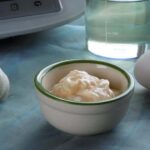
Ingredients 0 / 7 ✓
- 2 garlic cloves
- 1 egg
- 1/2 tsp salt
- 10 g lemon juice or white wine vinegar
- 1 pinch white pepper
- 250 g sunflower oil
- 20 g double cream
Instructions 0 / 3
-
1
Combine the ingredients.
Peel the garlic cloves, place them in the mixing bowl and chop for 3 seconds / speed 8, then scrape down with the spatula. Add the egg, salt, lemon juice, and pepper and combine for 10 seconds / speed 3.
-
2
Emulsify the sauce.
Set the Thermomix® to speed 4 and slowly drizzle the oil through the measuring cup in the mixing bowl lid into the mixing bowl, a little at a time.
-
3
Serve the sauce.
Once all the oil has been incorporated, add the double cream and switch off the Thermomix® after 5 seconds. If needed, scrape everything down with the spatula and mix again for 5 seconds / speed 4.
Video
Nutrition per serving
Why drizzling the oil in at speed 4 makes all the difference
A mayonnaise-style sauce only works when the oil is incorporated into the egg and garlic base in tiny droplets. The lecithin in the egg yolk coats each individual droplet, and it is precisely this microstructure that creates the creaminess we see on the spoon at the end. We set the Thermomix® to speed 4, place the measuring cup on the lid, and pour the oil in through the top. The hole in the measuring cup lets it flow in thinly and evenly into the mixing bowl. That is the trick.
Adding the oil too quickly overloads the emulsion. The egg base can no longer bind the fat, the sauce splits, and you end up with a bowl of yellowish foam sitting on a pool of oil. We have done this ourselves in the past, which is why we now stick strictly to the order: combine the garlic and egg for 10 seconds / speed 3, then switch to speed 4 and let the oil run through without rushing. 250 g of oil takes roughly one minute. If you are done sooner, you went too fast.
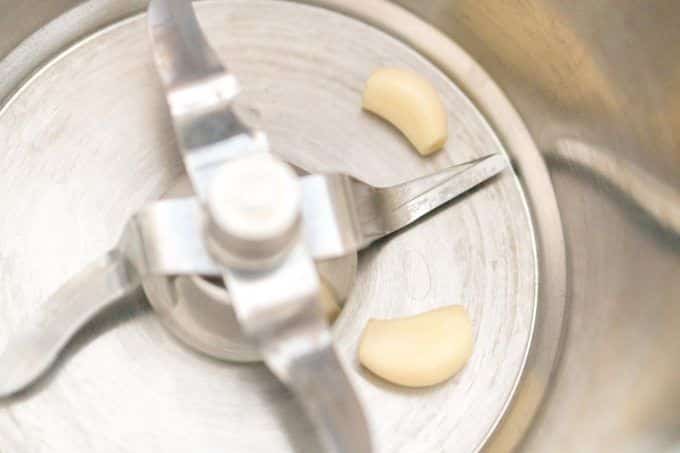
Fresh cloves only, never tube paste
With just two garlic cloves and 250 g of oil, the garlic carries all the flavour of the sauce. Tube paste is a firm no here. It brings a sour, slightly fermented undertone that, combined with neutral sunflower oil, tastes unpleasantly metallic. Fresh cloves, on the other hand, give that typical sharp and mildly sweet garlic note that softens and rounds out after a few hours in the fridge.
In the original recipe we chop the garlic for 3 seconds / speed 8. That is enough to finely chop it without turning it to a paste. Over-blending garlic risks bitterness, because the cell walls are completely destroyed and allicin is released without being able to disperse. Three seconds, a quick scrape down with the spatula, and you are done. For particularly large cloves, we run it for another two seconds.
One hour in the fridge makes all the difference
Straight from the mixing bowl the sauce tastes flat and sharp. The garlic is in the foreground, the egg barely noticeable, and the cream has not yet blended in. We have made a habit of transferring the sauce directly into a screw-top jar after blending and leaving it in the fridge for at least one hour. During that time the garlic infuses into the oil, the acidity from the lemon juice or vinegar settles, and the cream rounds off the sharper garlic edges.
After two hours the sauce tastes different again, more harmonious and less aggressive. If you prepare the sauce the day before, you get the full flavour the next day. That is also our standard approach for barbecue parties: make the sauce in the evening, serve it the following lunchtime.
If the sauce splits: rescued in 30 seconds
It still happens sometimes: the sauce is runny, oil is floating on top, and the whole thing looks like a failure. Do not throw it away. We take a fresh egg yolk into a clean mixing bowl, set the speed to 4 and slowly drizzle the split sauce through the measuring cup just as we did with the plain oil before. The egg yolk restarts the emulsion, and you end up with a creamy sauce again. This rescue method works nine times out of ten.
The cause of splitting is almost always one of three things: the oil was added too quickly, the egg was ice-cold straight from the fridge, or the speed was too low (speed 3 instead of 4). We take the egg out of the fridge half an hour before blending. Room-temperature egg white binds the oil significantly more reliably than cold.
Variations that actually work
With fresh herbs. Add 10 g of parsley or chives together with the garlic in the first step. Warning: do not blend the parsley for longer than 5 seconds or it will turn mushy and release water. We therefore add the parsley after the garlic and run it for 3 seconds / speed 6.
With chilli for a doner-style version. Add half a red chilli or a teaspoon of chilli flakes together with the garlic. This variation comes closest in flavour to the spicy garlic sauce from a kebab shop, even though the kebab-shop version usually uses a yoghurt base. Our mayonnaise-style version has the advantage of not going watery as quickly.
With mustard for extra stability. Add a level teaspoon of medium-hot mustard together with the egg. Mustard is an additional emulsifier and makes the sauce extremely stable. Flavour-wise it adds a gentle heat and makes the sauce more versatile for roast potatoes or grilled dishes.
Lighter with yoghurt. For a lower-fat version, replace 100 g of oil with 100 g of Greek yoghurt (10% fat), which we add at the end instead of the double cream. The result is less mayo-like and closer to a tzatziki-style consistency. This version does not keep quite as long, though.
What we serve the sauce with
The main purpose of this sauce is grilled meat and fondue, but it can do more. On a warm flatbread with grilled vegetables it turns a side dish into a main. With chips and wedges it replaces mayo and aioli at the same time. At raclette we put it next to the cocktail sauce on the table and always notice that the garlic sauce runs out first.
If you are looking for more dips and sauces made with the Thermomix®, we also have tzatziki, aioli, and mayonnaise. Anyone planning a full barbecue party should put the garlic sauce next to a milder yoghurt sauce, because not every guest can handle the full garlic punch.
Keeping it in a screw-top jar
Because the sauce contains a raw egg, it does not keep as long as a shop-bought mayonnaise. In a clean screw-top jar at 4 to 6 °C in the fridge, we count on three to four days. Rinse the jar with boiling water before filling and leave it to dry thoroughly, which pushes spoilage back by another day. Always use a clean spoon to take the sauce out, and never dip a spoon back into the jar.
Freezing does not work. The emulsion breaks on thawing, and the result is a flaky, oily mass that cannot be rescued. It is better to make small portions fresh. The Thermomix® effort is minimal at ten minutes anyway.
Food safety with raw egg
We only use very fresh eggs (no more than one week old) that have been kept chilled. For pregnant women, young children, and people with a weakened immune system we recommend using pasteurised liquid egg instead, or choosing the yoghurt variation. The egg must not be cracked, and the shell should be briefly rinsed under warm water before breaking.
How other recipes approach it differently
Goes well with: flatbread and falafel.
Cookidoo and similar platforms usually use a yoghurt and mayonnaise mix with a raw garlic clove and parsley, blended in under a minute. Food with Love works with yoghurt, soured cream, and mint, much fresher in character but without the emulsion-stable body. The Turkish version (Sarımsak Sos) relies on yoghurt, lemon, olive oil, and a resting time in the fridge, ideal with doner and grilled lamb. Our recipe deliberately takes the mayonnaise route with a fresh egg yolk and oil drizzled in slowly at speed 4. The result is a thick, dense sauce that does not soak through a burger and still holds its shape the next day. If you prefer something lighter, you will find the yoghurt variation further up.
For more inspiration for your next barbecue, have a look at our collection of grill recipes and matching desserts. You can also find everything about the Thermomix® recipe world from Vorwerk.