Baked gyros works as a layered casserole: rice forms the base, gyros with Metaxa sauce goes on top, and feta covers everything as a crust. Three layers, three textures, one trip to the oven. We make this dish regularly for guests because it can be prepared in advance and there is no stress when serving.
At a Greek restaurant, the dish arrives at the table sizzling in a cast-iron pan. At home we have replicated that with a stoneware baking dish. It holds the heat just as long, and 200°C in the oven is enough for a proper cheese crust. Using turkey strips instead of pork makes it lighter without losing any flavour. The spice mix of paprika, oregano, thyme, cumin and coriander carries all the aroma.
Baked Gyros with Metaxa Sauce and Rice, Thermomix®

Ingredients 0 / 22 ✓
- 400 g turkey strips
- 2 tbsp olive oil
- 1 tsp salt
- 1 tsp hot smoked paprika
- 1/2 tsp dried oregano
- 1/2 tsp dried thyme
- 1 tsp cumin
- 1 pinch coriander
- 2 garlic cloves
- 1 tbsp tomato puree
- 1 tsp honey
- 3 red pointed peppers
- 2 onions
- 150 g mild pepperoncini jar
- 200 g vegetable stock
- 200 g chopped tomatoes (tinned)
- 300 g rice
- 100 g double cream
- 100 g soured cream
- 40 g Metaxa
- 200 g feta
- parsley to garnish
Instructions 0 / 11
-
1
Marinate the meat.
Place the turkey strips in a bowl, add the olive oil, salt, paprika, oregano, thyme, cumin and coriander, and mix well.
-
2
Chop the garlic.
Peel the garlic, place in the mixing bowl, chop for 3 sec / speed 3 and push down with the spatula.
-
3
Add the meat, tomato puree and honey to the mixing bowl and cook for 5 min / Varoma / reverse direction / speed 1.
-
4
Meanwhile, wash the pointed peppers, halve them, remove the seeds and stalk, and cut into strips. Peel the onions, halve and cut into half-rings. Drain the pepperoncini, remove the stalks and cut into bite-sized pieces.
-
5
Add the vegetable stock and chopped tomatoes to the mixing bowl and cook for 18 min / 100°C / reverse direction / speed 1.
-
6
Meanwhile, cook the rice in a saucepan according to the packet instructions.
-
7
Preheat the oven to 200°C top and bottom heat.
-
8
Add the double cream, soured cream and Metaxa to the mixing bowl and mix for 2 min / 100°C / reverse direction / speed 1.
-
9
Transfer the meat and vegetables to a baking dish and mix together. Cut the feta into cubes, fold in with the spatula, and bake for 20 minutes on the middle shelf of the oven.
-
10
Wash the parsley and pick the leaves.
-
11
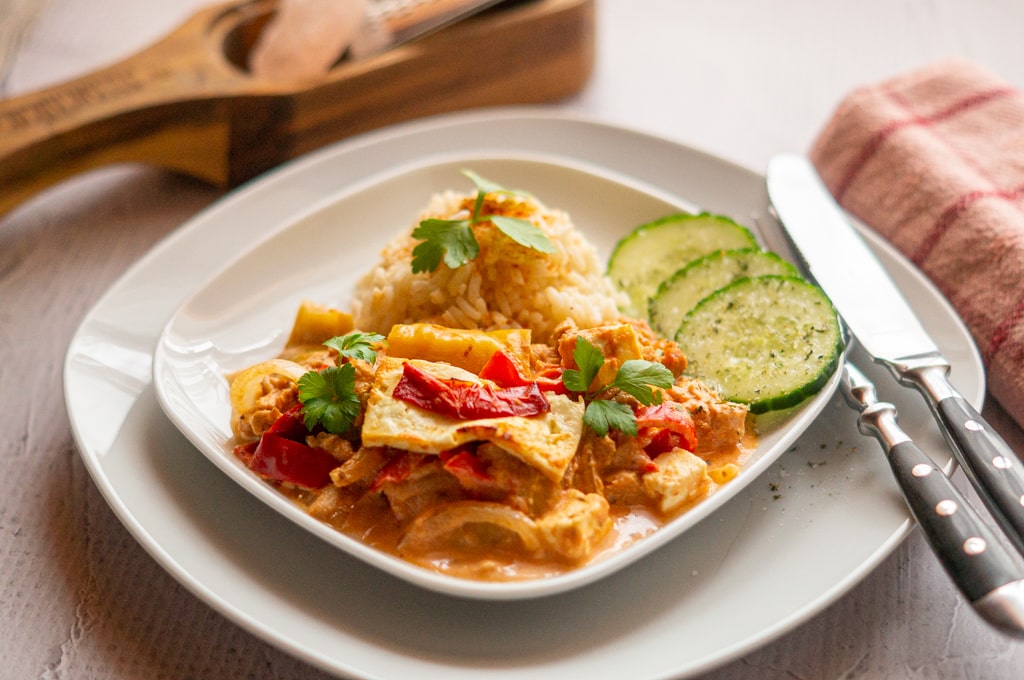
Serve the gyros with rice, garnished with parsley.
Video
Nutrition per serving
Why Metaxa is the key
Metaxa is not a cognac or a brandy in the classic sense, but a Greek grape brandy blended with Muscat wine. In the pot, two things happen with the 40 g of Metaxa: the alcohol evaporates completely at 100°C, leaving behind a caramel, slightly resinous sweetness that gives the sauce its Greek character. Without Metaxa, the sauce tastes like an ordinary tomato and cream sauce. With Metaxa, it tastes like a taverna.
We add the 40 g Metaxa together with 100 g double cream and 100 g soured cream at the very end, for 2 minutes at 100°C in reverse direction at speed 1. Reverse direction matters here because the soured cream will split otherwise. If you do not have Metaxa, a good brandy works as a substitute, though the typical flavour will be missing. Ouzo is not an alternative as it becomes too anise-heavy.
Cut the vegetables by hand, not in the mixing bowl
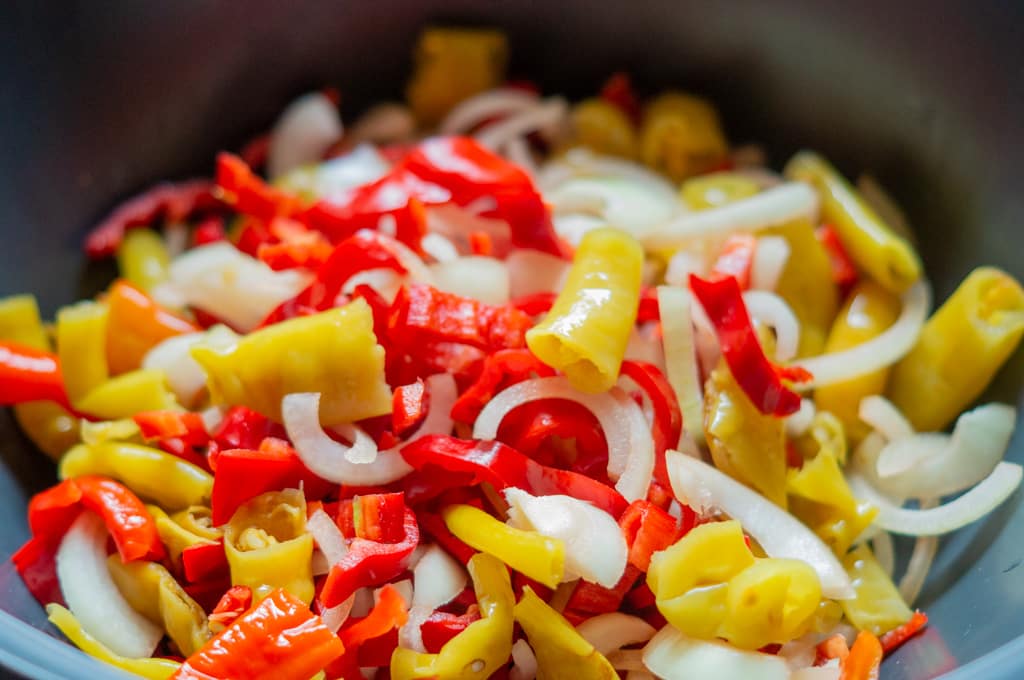
Three red pointed peppers, two onions and 150 g of mild pepperoncini from a jar. We deliberately cut all of these by hand, not in the mixing bowl. Pointed pepper into strips, onions into half-rings, pepperoncini into bite-sized pieces. In the mixing bowl the vegetables would come out too small and turn mushy during cooking. For a layered bake we need some texture, otherwise the structure collapses under the cheese.
Pointed pepper matters more here than ordinary red pepper. The skin is thinner, the sugar content higher, and during the 18 minutes of sauce time it cooks to perfection. Ordinary bell pepper stays too crunchy and that is disruptive in a bake. For the pepperoncini we use the mild ones from a jar, because the hot variety makes the dish too spicy for children. If you want heat, hot smoked paprika in the marinade is enough.
Rice in a saucepan in parallel, not in the steamer basket
Unlike many other dishes, we cook the 300 g of rice here in a separate saucepan according to the packet instructions. The steamer basket would be too tight: while the sauce simmers for 18 minutes at 100°C in reverse direction, most varieties of rice only need 10 to 12 minutes. The steamer basket trick works when everything needs to be ready at the same time. Not here. The rice is layered under the bake and stays warm perfectly in the 200°C oven.
We use long-grain rice or basmati. Risotto rice becomes too sticky in a bake, and wild rice too nutty for the Greek character. If the rice can rest for ten minutes before layering, it is less moist and absorbs the sauce better.
The order of steps in the mixing bowl
To keep 21 ingredients from turning into chaos, we follow a fixed order. First we marinate the 400 g turkey strips in a bowl with olive oil, salt, hot smoked paprika, oregano, thyme, cumin and a pinch of coriander. Leave to marinate for at least 15 minutes, longer if possible. Only then do we start the Thermomix®.
In the mixing bowl, four things happen in sequence. Chop the garlic for 3 seconds at speed 3 and push down with the spatula. Add the marinated meat with tomato puree and honey, and cook for 5 minutes at Varoma in reverse direction at speed 1. Then add vegetable stock and chopped tomatoes and simmer for 18 minutes at 100°C in reverse direction at speed 1. Finally add the double cream, soured cream and Metaxa and stir for 2 minutes at 100°C in reverse direction at speed 1. Reverse direction throughout, because otherwise the meat would be cut up and the soured cream would split.
During the 18 minutes of simmering time, we have exactly the right window to cut the vegetables and cook the rice. This parallel setup is why the recipe is faster in the Thermomix® than on the hob: no frying in a pan, no turning, no sticking to the bottom.
Layering in the baking dish
We do not follow the original instructions here exactly. We place the meat with the sauce into the baking dish and mix the cut vegetables through only when assembling in the dish. In the mixing bowl, the fresh vegetables would lose their colour and turn mushy if cooked along with everything else. This way the pointed pepper stays red, the onion still has some bite and the pepperoncini keeps its shape.
On top goes 200 g of feta cut into rough cubes. Do not grate it, do not crumble it. Larger cubes do not melt into a flat layer but remain as melted islands, which gives the right cheese pull when you dig in with a fork. Twenty minutes on the middle shelf at 200°C top and bottom heat. For a crispier crust, switch to the grill setting for the last 3 minutes, but keep a close eye on it as the feta can burn in 30 seconds.
Where things go wrong when cooking for the first time
Three issues come up repeatedly when someone cooks this recipe for the first time. First: the sauce is too thin. The reason is usually that the soured cream was left out or replaced with yoghurt. Soured cream has 20 per cent fat, yoghurt only 3.5 per cent. Without the soured cream, the sauce does not bind and runs when you cut into the bake.
Second: the meat turns dry. Turkey strips need reverse direction and speed 1, otherwise they shred into minced turkey in the mixing bowl. Also, do not cut the marinating time short, otherwise the salt does not penetrate and the meat tastes bland. If you do not want turkey strips: chicken breast works just as well, as does pork tenderloin, both cut into thin strips.
Third: the bottom of the bake turns watery. This happens when freshly cooked rice is layered straight into the dish from the pot. The hot grains release steam, which condenses under the sauce. Let the rice steam off for ten minutes first, then layer.
Variations we have tested
With minced lamb instead of turkey strips: The dish becomes noticeably richer and the sauce darker. Lamb needs 8 minutes at Varoma in reverse direction instead of 5, otherwise it stays too firm. We can increase the Metaxa to 60 g here, which harmonises better with the lamb flavour.
With tomato rice as the base: Instead of plain rice, we cook 300 g of rice in 600 g of passata with a splash of olive oil. The rice turns red and takes on a base seasoning. This works particularly well when less sauce is wanted and you prefer a more classically dry bake.
With halloumi instead of feta as the crust: Halloumi does not melt but simply browns. This gives a different texture, more grilled than baked. A good option for anyone who finds feta too salty.
Accompaniments and storage
The best accompaniment to this bake is a tzatziki made in the Thermomix® as a cool contrast. If you want to serve bread alongside, cut a Thermomix® flatbread into wedges and pass it round for mopping up the sauce. For the rice base, find our complete tips for cooking rice in the Thermomix®.
Leftovers keep covered in the fridge for two days. To reheat, place the bake in a smaller dish for 15 minutes at 180°C in the oven, with a splash of vegetable stock on the bottom so the rice does not dry out. The microwave works but makes the cheese tough instead of creamy. We advise against freezing, as the cream and soured cream turn grainy on defrosting and the rice loses its texture. If you want to prepare ahead, cook the sauce and rice the day before but layer with fresh feta only just before baking.
How other recipes approach this dish
Goes well with: Tzatziki and flatbread.
Most recipes use Gouda or a mixed grated cheese. We stick with rough feta cubes because they form a crust with a proper cheese pull that suits the taverna style better. For the rice, many others use kritharaki pasta or leave out the side altogether, while we layer long-grain rice as the base. Instead of 1 tbsp of ready-made gyros spice mix, we blend fresh: paprika, oregano, thyme, cumin, coriander. We reject ouzo as a Metaxa substitute because anise notes disrupt the sauce, while a mild brandy works fine. At 200°C top and bottom heat, 20 minutes is enough. Many recipes bake for 35 plus 15 minutes and dry out the turkey completely.