Rice cooked in the Thermomix® turns out fluffiest with the steamer basket method: rice steamed in the basket over water, 20 minutes at 100 °C or Varoma. No soaking needed, no burning possible. The absorption method (rice cooked directly in the mixing bowl) works too, but requires precise water ratios and a 10-minute resting time. Both methods have their place, and we show you both.
We cook rice several times a week in the Thermomix® now. The steamer basket method has been our standard since 2018: rice in the basket steamed over boiling water, done in 20 minutes. The rice cannot burn, cooks evenly, and you skip the resting-time ritual altogether. The absorption method (rice directly in the mixing bowl) works well for smaller quantities or when you are cooking a sauce in the mixing bowl at the same time. We show you both methods here with the exact settings.
Wild Rice Basic Recipe with the Thermomix®
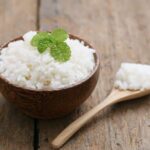
Ingredients 0 / 3 ✓
- 800 g water
- 1 tsp salt
- 300 g wild rice
Instructions 0 / 3
-
1
Add water and salt to the mixing bowl.
-
2
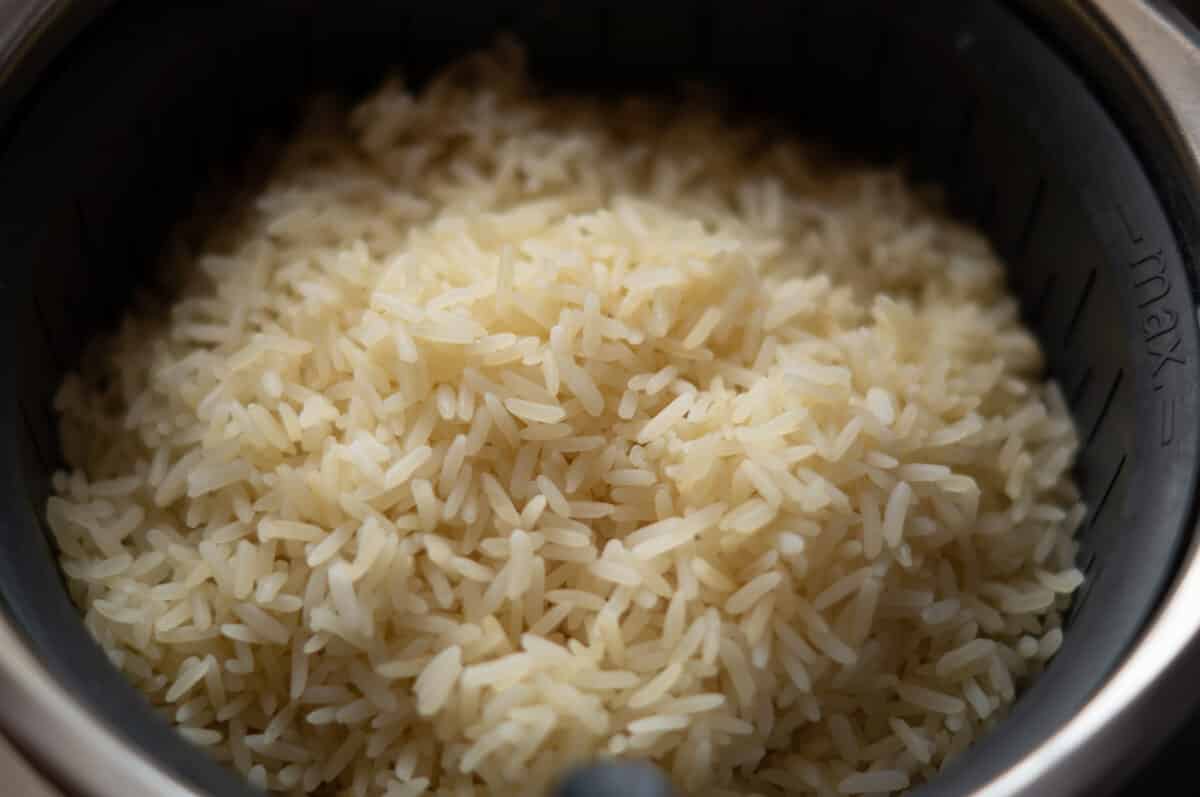
Weigh the rice into the steamer basket, rinse under running water, hang the steamer basket into the mixing bowl and cook for 20 min / Varoma / speed 1.
-
3
Serve the rice straight away, or continue to use as needed for your recipe.
Tip: Wild rice works brilliantly as a base for rice salads with all sorts of different ingredients.
Nutrition per serving
Method 1: Steamer basket (our main method)
This is the method from our main recipe below: 350 g long-grain rice in the steamer basket, 1000 g water in the mixing bowl, 20 minutes at 100 °C on speed 4. The rice cooks in the steam, not in direct contact with the water. No burning, no resting time, no sticking.
Advantage: You can put up to 600 g of rice in the steamer basket. The mixing bowl stays free for a sauce or vegetables in the Varoma attachment on top. Everything in parallel, all in one go.
How it works: Weigh the rice into the steamer basket, lift it out and rinse the rice under cold running water until the water runs clear (this reduces surface starch). Add water and salt to the mixing bowl, hang in the steamer basket, 20 min / 100 °C / speed 4. Done. No soaking, serve straight away.
For wild rice we use the same method with adjusted values: 300 g wild rice, 800 g water, 20 min / Varoma / speed 1 (see the second recipe below). Wild rice needs the higher steam temperature, but the cooking time stays the same.
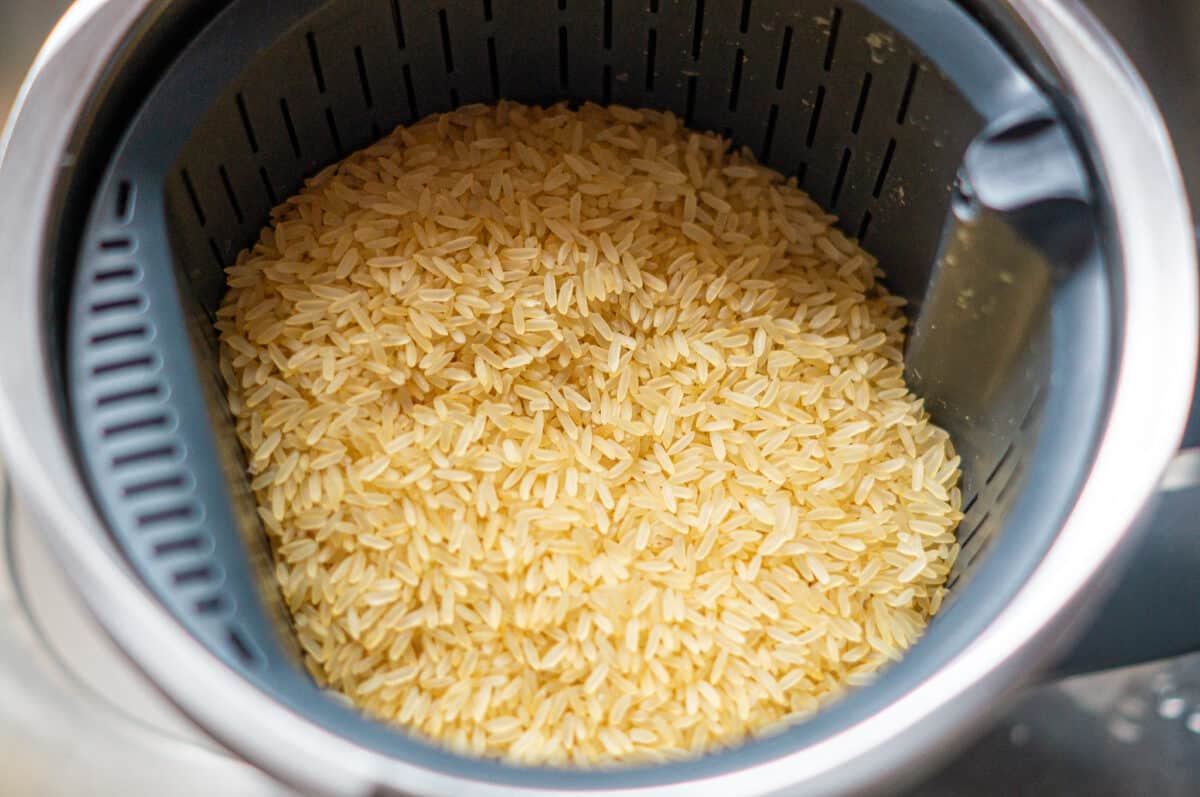
Method 2: Absorption method (alternative for smaller quantities)
The absorption method cooks the rice directly in the mixing bowl with a precisely measured quantity of water that the rice absorbs completely. After the cooking time the rice must rest for 10 minutes with the lid closed so it absorbs the remaining moisture and the starch settles back. This method suits a maximum of 400 g of rice and works best when you do not need the mixing bowl for other ingredients at the same time.
Water-to-rice ratios by variety: The ratio determines whether the rice turns out fluffy or mushy. Too much water causes the grains to burst, too little leaves them hard.
Important for the absorption method: Do not open the lid immediately once the cooking time is up. A 10-minute resting time with the lid closed is essential, otherwise excess starch stays in the rice and makes it sticky.
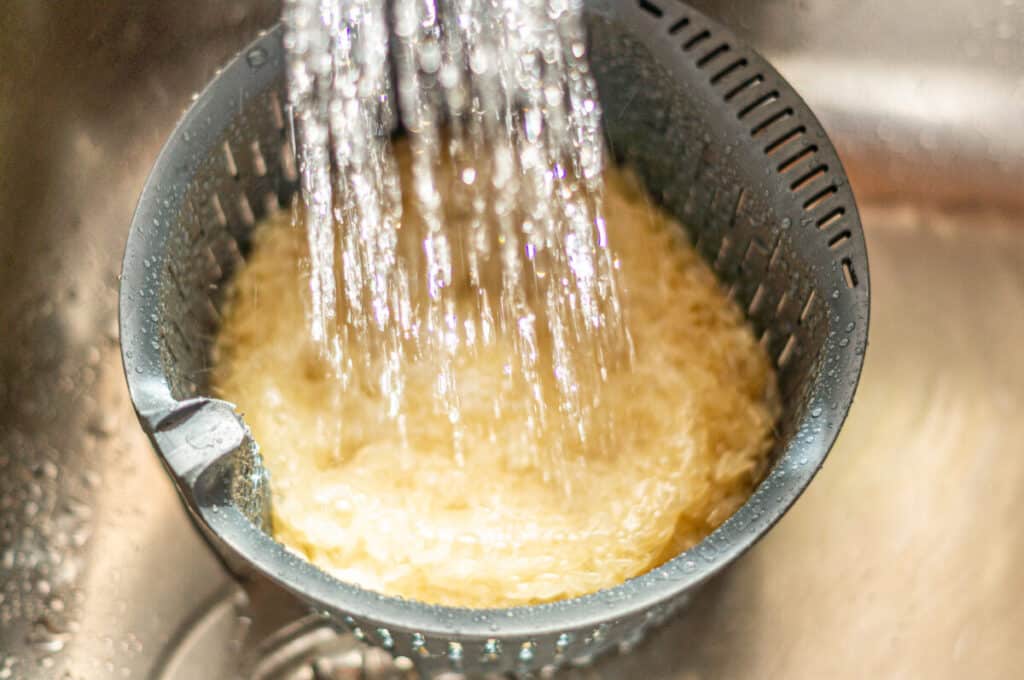
Rinsing rice: reduce starch, remove stickiness
Whether you should rinse rice before cooking depends on the variety and the result you want. Basmati and jasmine rice carry excess surface starch that leaches out during cooking and causes the grains to stick together. Rinsing the rice 2 to 3 times under cold water until it runs clear reduces the starch by 20 to 30 per cent (Journal of Food Science, Effect of Washing on Rice Starch Content 2018). The result is fluffy rice with separate grains.
For risotto or rice pudding the starch is actually welcome. It makes the dish creamy. In those cases do not rinse the rice. The same applies to sushi rice: the stickiness is intentional so that the rolls hold together.
The steamer basket method makes rinsing very easy: weigh the rice into the basket, lift it out and rinse it directly under the tap. The fine holes in the basket let the water drain away and not a single grain is lost.
Thermomix® models: TM7, TM6, TM5 and TM31 differences
Our main method (steamer basket) works identically on all models. The settings in the recipe cards apply to the TM5, TM6 and TM7. On the TM31 replace 100 °C with Varoma and add 2 to 3 minutes to the cooking time, as the TM31 takes slightly longer to reach temperature.
The TM6 (from 2019) and the TM7 (from 2024) include an automatic rice-cooking mode for the absorption method (Vorwerk TM6 user manual p. 28). The machine measures the temperature inside the mixing bowl and switches off once 100 °C is reached, then runs a 10-minute absorption phase with the lid closed. This works reliably for long-grain and basmati rice with the standard 1:2 ratio. For the steamer basket method you do not need the automatic mode, just set the time manually.
Sticky, hard, burnt: solving 3 common problems
1. Rice is sticky (absorption method)
Cause: Excess surface starch or missing resting time after cooking. If you do not rinse basmati or jasmine rice, the starch glues the grains together. If you open the lid immediately after cooking, the starch cannot settle back.
Our solution: Rinse the rice 2 to 3 times under cold water before cooking until the water runs clear. With the absorption method, keep to the 10-minute resting time with the lid closed. With the steamer basket method, sticky rice is almost never an issue because the steam distributes the starch evenly.
2. Rice stays hard (absorption method)
Cause: Too little water or too short a cooking time. Wholegrain rice needs more water and more time than white rice because the bran takes longer to soften. Using the standard 1:2 ratio for wholegrain will leave the centre hard.
Our solution: Check the water-to-rice ratio in the table above (absorption method). For wholegrain rice always use 1:2.5, not 1:2. If the rice is still firm after the stated cooking time, add 3 minutes and let it continue to absorb. The steamer basket method with 20 minutes works only for standard long-grain and wild rice, not for wholegrain.
3. Rice burns (absorption method)
Cause: Too little water in the mixing bowl or speed set too high. With the absorption method the water ratio must be exact, otherwise the water evaporates before the end of the cooking time and the rice sticks to the base.
Our solution: Use the steamer basket method. The rice cannot burn because it hangs above the water, never in direct contact with the base of the bowl. If you want to use the absorption method, follow the water ratios in the table strictly and never cook above speed 1.
Portions: 80 to 100 g per person
As a side dish, allow 80 g of uncooked rice per person. That gives roughly 200 g of cooked rice. If rice is the main dish, allow 100 to 120 g per person (DGE portion size guidelines 2022). Example for 4 people as a side dish: 320 g rice, with the steamer basket method use 1000 g water in the mixing bowl (this stays constant).
The steamer basket holds a maximum of 600 g of uncooked rice. That is enough for 6 to 7 people as a side dish or 5 people as a main course. If you need more, cook the rice in two batches.
Sushi rice: round-grain rice plus vinegar dressing
Sushi rice needs the absorption method because the starch is welcome here. Use round-grain rice, which is naturally sticky. The water ratio is 1:1.2 (for example 350 g rice plus 420 ml water). Cooking time: 18 min / Varoma / speed 1, then 10 minutes resting time.
After cooking, stir in a vinegar dressing: 3 tbsp rice vinegar, 2 tbsp sugar, 1 tsp salt. Fold the mixture into the still-warm rice using a wooden spatula. The vinegar gives the characteristic sushi flavour and the sugar balances the acidity.
Fridge and freezer storage
Cooked rice keeps for 3 days in the fridge in an airtight container. It freezes well for up to 3 months. Freeze it in shallow portions so it thaws more quickly. Reheat in the microwave (2 to 3 minutes at 600 W) or in the Thermomix® (5 min / Varoma / speed 1 with 50 ml water in the mixing bowl).
Risotto and rice pudding are not suitable for freezing. The starch crystallises on thawing and the rice turns grainy instead of creamy.
Our tip: Serviettenknoedel Thermomix®.
If you need rice as a base for other dishes, try our rice salad recipes, Djuvec rice or Asian vegetable rice. For sweet versions: Thermomix® rice pudding.