Advocaat made in the Thermomix® sits on a fine line between 68°C, where egg yolk sets, and 60°C, where salmonella survives. The 70°C setting is no accident; it is the narrowest safe corridor for a creamy consistency without curdling.
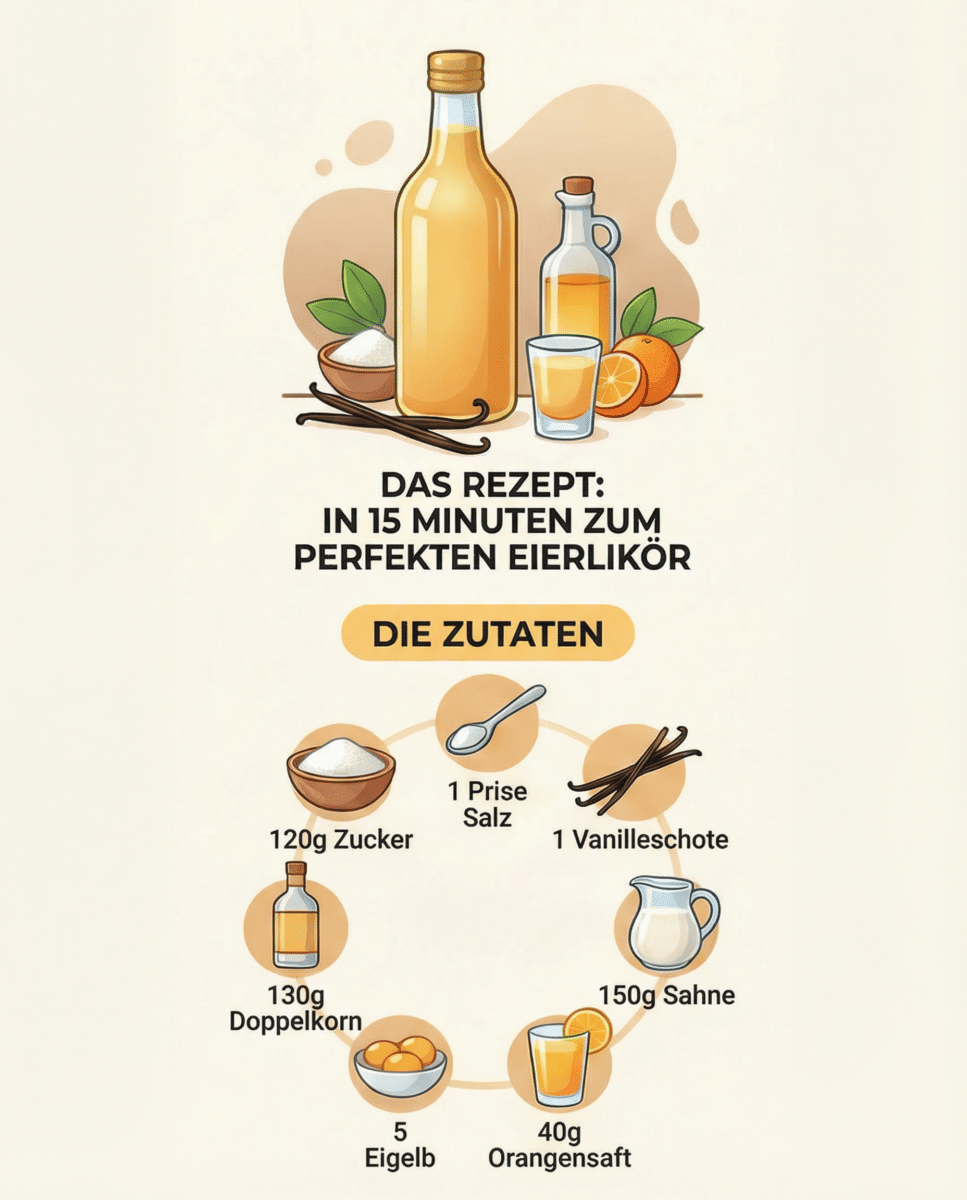
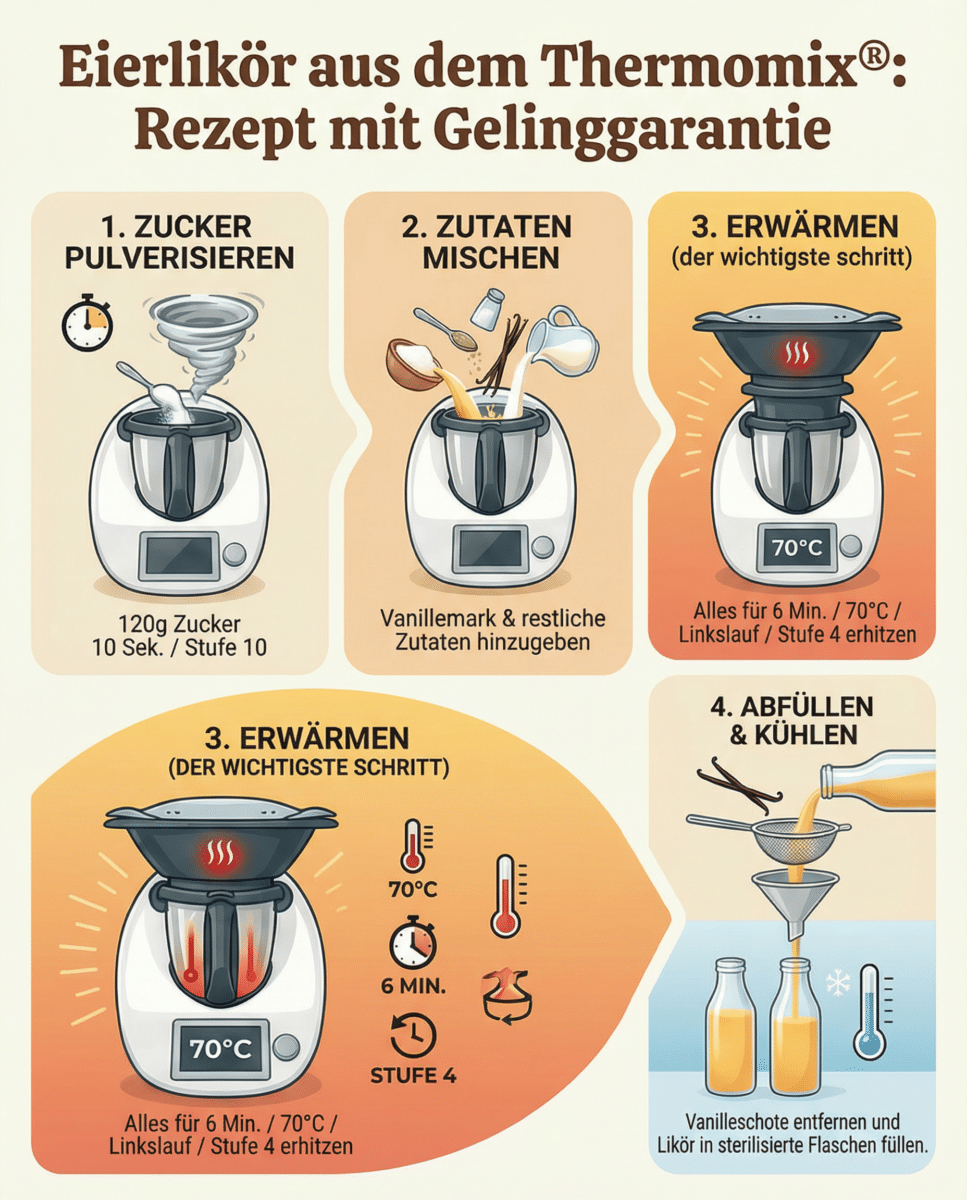
We make our advocaat to the same formula every time: 5 egg yolks, 150 g double cream, 130 g grain spirit, 120 g sugar, 1 vanilla pod, a pinch of salt and 40 g orange juice. We start by pulverising the sugar with the vanilla (10 seconds at speed 10), which distributes the vanilla flavour evenly. The mixture is then heated in reverse direction at 70°C for 6 minutes at speed 4. What at the hob demands a bain-marie, a whisk and constant attention runs in a single pass in the mixing bowl.
Advocaat with Whole Eggs, Thermomix®

Ingredients 0 / 6 ✓
- 1 vanilla pod
- 400 g sugar
- 700 g grain spirit (Korn)
- 9 egg
- 200 g double cream
- 350 g semi-skimmed milk
Instructions 0 / 3
-
1
Make vanilla sugar.
Slit the vanilla pod lengthways, scrape out the seeds, add to the mixing bowl with the sugar and pulverise for 15 sec / speed 10.
-
2
Heat the ingredients.
Add the vanilla pod and remaining ingredients to the mixing bowl and heat for 15 min / 70°C / reverse direction / speed 4. Remove the vanilla pod.
-
3
Bottle the liqueur.
Fill into sterilised bottles, leave to cool and place in the fridge.
Tip: You can also blend this advocaat with baking cocoa to make a chocolate advocaat.
Video
Nutrition per serving
Egg yolks or whole eggs: how does it affect the texture?
Our main version uses only egg yolks. This delivers the classic creaminess, because egg yolk consists of around 30 per cent fat (source: On Food and Cooking, Harold McGee 2004, p. 85). That fat binds with the alcohol and cream to form a stable emulsion. The liqueur becomes thick enough to cling to the side of the glass.
Using whole eggs instead produces a more pourable liqueur. Egg white is 90 per cent water and dilutes the fat phase. The flavour becomes milder and the texture more fluid. This is not a lesser version but a deliberate alternative for anyone who does not want to deal with leftover egg whites.
Both versions work in the TM7, TM6, TM5 and TM31. The yolk-only version often needs a splash of milk after 2 to 3 days in the fridge because the fat solidifies. The whole-egg version stays pourable on its own.
The 70-degree threshold: why this temperature is decisive
Egg yolk begins to set at 68°C (source: On Food and Cooking, Harold McGee 2004, p. 85). Below that threshold the mixture stays liquid; above it the eggs scramble and curdle. At the same time, salmonella only die reliably at 60°C after 3 minutes (source: BfR Federal Institute for Risk Assessment, Salmonella in Eggs fact sheet 2019). Between 60 and 68 degrees there is only 8 degrees of headroom.
We heat at 70°C because the Thermomix® measures and holds the bowl temperature directly. The TM6 (from 2019) and the TM7 (from 2024) have a digital temperature sensor that regulates to within half a degree. The TM5 (from 2014) and the TM31 (from 2004) require a timer and visual checks, as they control only the heating output, not the actual temperature.
At 6 minutes on speed 4 in reverse direction, the 5 egg yolks with cream and grain spirit reach the binding temperature without scrambling. Reverse direction is not optional but essential. In normal direction the blade would cut through the emulsion with its sharp edge (source: Thermomix® Mix Baking Book 2018, p. 12). The egg yolk would curdle, the cream would separate, and the liqueur would split into layers.
Technical difference between TM6/TM7 and TM5/TM31: Newer models hold 70°C automatically. The mixture steams gently but does not boil. With older models, check visually after 6 minutes. As soon as the surface begins to bubble, the temperature has risen above 75°C and curdling is imminent. Add 2 ice cubes to the mixing bowl immediately and blend for 30 seconds at speed 8. This saves the emulsion in 8 out of 10 cases.
Grain spirit, neutral spirit or rum: which alcohol works best?
We use double grain spirit because it gives the liqueur character. Grain spirit tastes of cereal, slightly nutty, sometimes with a bite on the finish. This is the classic Dutch style, as seen in Advocaat or Verpoorten.
Neutral spirit or vodka makes the liqueur smoother. The alcohol flavour recedes and vanilla and egg yolk dominate. This is the purist version for anyone who wants only sweetness and creaminess without any sharpness. Distillers often recommend neutral spirit because it keeps longer and contains fewer congeners.
Rum shifts the liqueur towards winter. Dark rum brings caramel and vanilla, white rum stays more neutral. With rum the liqueur becomes heavier and suits Christmas better than Easter.
Alcohol content and shelf life: With 130 g grain spirit in 455 g total mass (5 yolks at about 20 g each, 150 g double cream, 120 g sugar, 40 g orange juice, 130 g grain spirit) we land at around 19% ABV. Above 15% ABV a liqueur keeps for 6 months without refrigeration (source: The Joy of Mixology, Gary Regan 2003, p. 112). Reducing the grain spirit to 100 g brings it down to only 14% ABV and the liqueur must be used within 2 weeks.
Too thick from the fridge: how to make it creamy again
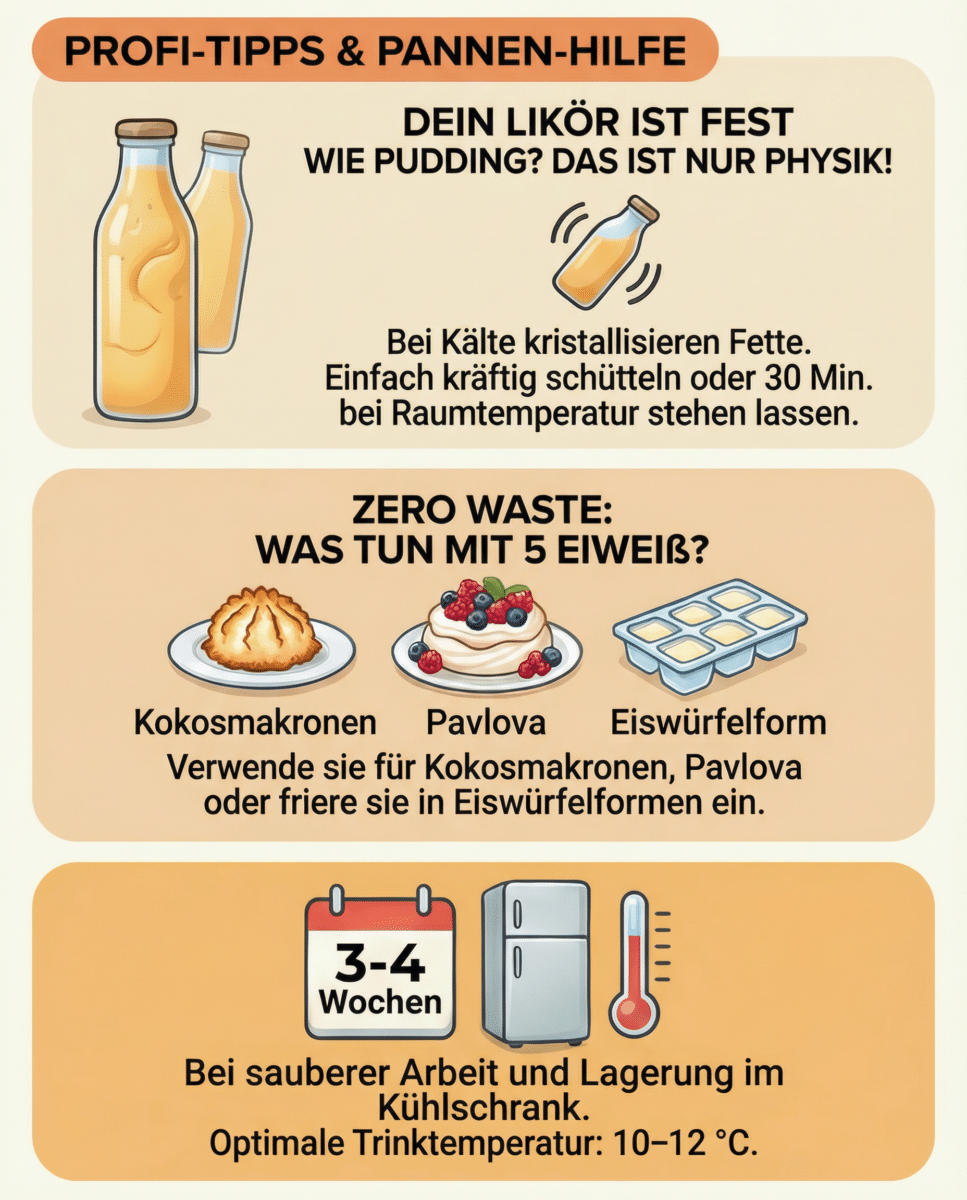
After 2 to 3 days in the fridge the liqueur often sets to a pudding-like consistency. This is not a fault but solidified fat. Cream and egg yolk contain saturated fatty acids that crystallise at 4 to 10°C (source: On Food and Cooking, Harold McGee 2004, p. 801). The yolk-only version is more affected than the whole-egg version because it contains more fat.
Solution 1: Leave at room temperature for 30 minutes. The fat melts and the liqueur becomes pourable again.
Solution 2: Stir in 1 to 2 tablespoons of milk per 100 ml of liqueur. The milk dilutes the fat phase without watering down the flavour. We return the liqueur to the mixing bowl, add the milk and blend for 10 seconds at speed 4. After that it stays pourable.
Solution 3: Shake vigorously before serving. This breaks up the fat crystals briefly. After 10 minutes, however, the liqueur will set again.
Sterilising bottles: 3 methods for 6 months shelf life
Without clean bottles the liqueur will turn after 2 weeks, regardless of the alcohol content. Mould spores and bacteria survive in traces of washing-up liquid or tap water. We sterilise every bottle before filling using one of these three methods:
Method 1: Boiling water. Place bottles and lids in a large saucepan, cover with water and boil for 10 minutes. Leave to drain on a clean kitchen towel; do not dry with a cloth. This is the simplest method for glass bottles and swing-top bottles.
Method 2: Oven. Place bottles and lids in the oven at 120°C top and bottom heat for 15 minutes. Leave to cool slowly. This works only for glass, not for plastic closures.
Method 3: Dishwasher. A 65-degree cycle without detergent is sufficient if the bottles have been roughly rinsed beforehand. Fill immediately after the cycle, while the bottles are still hot.
We fill the liqueur while it is hot, seal immediately and stand the bottles upside down for 5 minutes. The hot liquid sterilises the closure from the inside. Once cooled, store upright in the coldest compartment of the fridge, usually behind the vegetable drawer. With proper sterilisation and above 15% ABV the liqueur keeps for 6 months in the fridge.
5 recipes for leftover egg whites
The yolk-only version leaves 5 egg whites behind. Throwing them away is not an option when three simple uses exist:
1. Coconut macaroons. Whisk 5 egg whites to stiff peaks, fold in 200 g desiccated coconut and 150 g sugar, done. Our guide: Coconut Macaroons in the Thermomix®. The egg white binds the coconut without flour.
2. Meringue kisses. Whisk the egg whites with 250 g sugar, pipe onto a baking sheet and dry at 100°C for 90 minutes. Keeps in a tin for 4 weeks.
3. Chocolate mousse. Melt 200 g dark chocolate, whisk 5 egg whites to stiff peaks and fold in. The air bubbles in the egg white make the mousse light without cream.
4. Floating islands. Whisk the egg whites to stiff peaks, shape into quenelles using two spoons, slide into simmering milk and poach for 3 minutes. Serve floating in vanilla custard.
5. Freeze them. Freeze one egg white per ice-cube compartment. Keeps for 3 months; once thawed they whisk to stiff peaks just like fresh. This is the backup option for anyone who does not have time right now.
Orange juice in advocaat: why it works
The 40 g of orange juice in our recipe are not decoration but a matter of balance. Without acidity the liqueur coats the palate because 120 g of sugar dominates 455 g of total mass. The orange juice supplies citric acid and at the same time lifts the vanilla flavour (source: Flavor Chemistry and Technology, Gary Reineccius 2006, p. 234). Vanilla and citrus reinforce each other in aroma perception, making the liqueur taste fresher.
Anyone who dislikes orange juice can use 40 g of lemon juice instead. That makes the liqueur more tart but no worse. Using 40 g of water instead of juice removes the balance and the liqueur becomes one-dimensionally sweet.
Flavour variations: chocolate, Licor 43, rum, amaretto
Chocolate advocaat. Melt 50 g dark couverture with the cream at 70°C, then continue as in the main recipe. The chocolate makes the liqueur darker and more bitter. Full instructions: Chocolate Advocaat, Thermomix®.
Licor 43 version. Replace the grain spirit 1:1 with Licor 43 and reduce the sugar to 70 g. Licor 43 is already sweet and vanilla-flavoured; without the reduction the liqueur will be cloying. Full instructions: Advocaat with Licor 43.
Amaretto version. Almond and orange create a combination like fine marzipan. Replace the grain spirit 1:1 with amaretto. Full instructions: Amaretto Advocaat, Thermomix®.
Orange and cinnamon version. Pulverise 1 tsp cinnamon with the sugar for 10 seconds at speed 10 and add the zest of half an orange. This is the winter version for Christmas.
Alcohol-free. Replace the grain spirit with 80 g double cream and 50 g milk, plus one ampoule of rum flavouring. Without alcohol it keeps only 3 days in the fridge, but children can enjoy it too.
Giving as a gift: swing-top bottles, date labels, storage note
Home-made advocaat is one of the few gifts almost everyone is happy to receive. We bottle it in 250 ml swing-top bottles, which looks more refined than recycled screw-top jars. The label carries the date of production and the note: keep refrigerated, consume within 4 weeks. Serve at 10 to 12°C, that is cold from the fridge, not ice-cold from the freezer.
Anyone planning to post it should be aware: advocaat travels badly by post because the emulsion can break above 25°C. We prefer to hand it over in person or pack it carefully during winter on short journeys.
More liqueurs using the same principle
Once you have understood the 70-degree egg-yolk principle, you can apply it to other liqueurs:
- Egg flip liqueur as a coarser, more rustic variation with vanilla and cream.
- After Eight liqueur with mint and dark chocolate, same 70-degree logic.
- Chocolate advocaat with couverture as the flavour carrier.
- Licor 43 advocaat for the Spanish vanilla variation.
- Our 17 best liqueur recipes with the Thermomix® as an overview.
4 weeks or 6 months: why our method keeps longer
The standard whole-egg version uses 9 whole eggs with 350 g UHT milk and 700 g grain spirit in the mixing bowl, giving roughly 4 weeks shelf life in the fridge. We take a different approach: pure egg yolks, no milk, instead 150 g double cream and 130 g grain spirit in only 455 g total mass. This keeps us at around 19% ABV and clears the 15 per cent threshold above which a liqueur lasts 6 months in the fridge. The UHT milk version dilutes the alcohol to around 13% ABV, which is why it turns more quickly. Our method costs 5 egg whites as a by-product but gives us six months of storage time and a noticeably creamier texture.
Find more liqueurs made with the Thermomix® in our Liqueur Distillery collection.
Goes well with: Waffles, vanilla ice cream and Tiramisu.
Also worth a try: Limoncello, Thermomix®.
Whole-egg variation (for more volume)
This variation uses 9 whole eggs instead of just yolks and yields around 1.7 litres of liqueur with a milder flavour. The 70-degree rule and reverse direction remain the same; only the heating time increases to 15 minutes because of the larger quantity.